What just happened? The scale and speed of investments by OpenAI, Meta, Alphabet, and Microsoft in chips, data centers, and energy infrastructure have drawn comparisons to past build-outs, from the 19th-century railroad boom to the fiber-optic rollout. AMD's gains suggest a shift in the AI hardware market while underscoring how closely the leading players are tying their futures to rapid infrastructure growth.
OpenAI is partnering with Advanced Micro Devices in one of the largest semiconductor supply deals yet for AI data centers – a move that heightens competition with Nvidia in high-performance computing.
"We are in a phase of the build-out where the entire industry's got to come together and everybody's going to do super well," OpenAI chief executive Sam Altman said. "You'll see this on chips, you'll see this on data centers, you'll see this lower down the supply chain."
The multibillion-dollar arrangement will give OpenAI up to six gigawatts of AMD processors, starting with the MI450 model slated for release next year. The chips will be purchased directly or through the company's cloud partners. AMD chief executive Lisa Su told The Wall Street Journal that the deal could generate tens of billions of dollars in revenue over the next five years. AMD estimated that each gigawatt of computing capacity costs tens of billions of dollars, highlighting the project's massive scale, though AMD did not disclose the total value.
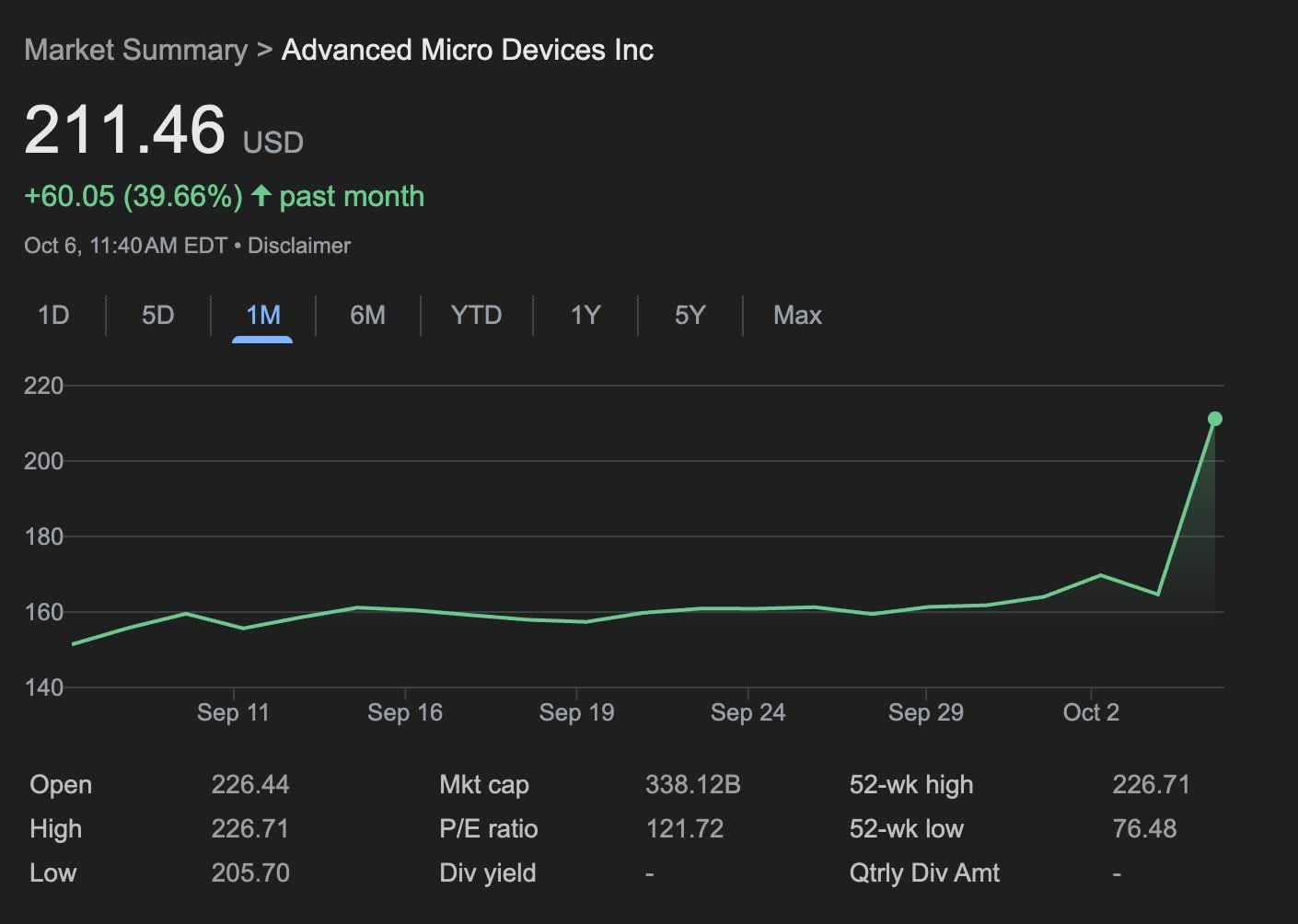
The partnership includes warrants giving OpenAI the right to acquire up to 160 million AMD shares – about 10 percent of the company – at a nominal price of one cent per share. AMD will issue the warrants in phases, contingent on OpenAI meeting deployment benchmarks, and OpenAI may exercise them only if AMD's stock price rises. OpenAI plans to deploy one gigawatt of MI450 chips in the latter half of next year to run inference workloads, the computation process that allows chatbots and other AI systems to respond to user queries.
Demand for inference processing has surged as large language models spread across consumer and enterprise applications.
"It's hard to overstate how difficult it's become to get enough computing power," OpenAI chief executive Sam Altman told The Wall Street Journal in a joint interview with Su.
Su said the partnership aligns incentives between the companies.
"It's a win for both of our companies, and I'm glad that OpenAI's incentives are tied to AMD's success and vice versa," she said.
Mizuho Securities reports that Nvidia remains the leading supplier of AI accelerators, holding more than 70 percent of the market, with combined CPU-GPU systems selling for up to $60,000 each in data center deployments. However, the company faces growing challenges from rivals and in-house designs by hyperscale cloud operators such as Google and Amazon. OpenAI is also diversifying its chip sourcing, signing a $10 billion agreement with Broadcom to develop proprietary processors.
In September, Nvidia announced plans to invest $100 billion in OpenAI over the next decade in a circular arrangement, with the proceeds used to purchase Nvidia hardware for AI data centers. Under the deal, OpenAI would deploy up to 10 gigawatts of Nvidia-powered compute.
Altman has finalized multiple high-value agreements in recent months to secure unprecedented computing capacity. In addition to the AMD deal, OpenAI reached a $300 billion agreement with Oracle to acquire 4.5 gigawatts of cloud resources over five years. The announcement followed a meeting of OpenAI and Oracle executives, where they discussed a long-term vision involving trillions of dollars in AI data center investment to meet rising demand for ChatGPT, which now counts 700 million weekly users.

"The thing you have to believe if you are us, or our whole industry, is that given everything we're seeing in our research and in our product metrics, the demand for AI at a reasonable revenue rate is going to continue to steeply increase," Altman said.
Sources told the Wall Street Journal that Monday's AMD deal was considered definitive by both companies, with regulatory filings expected immediately. OpenAI projects spending about $16 billion this year to rent server capacity, a figure that could climb to $400 billion by 2029. The company expects around $13 billion in revenue for 2025 and is prioritizing higher-margin applications that use its AI tools.
Greg Brockman, OpenAI's president and co-founder, said concerns about overspending are secondary to the risk of falling short on processing resources.
"I'm far more worried about us failing because of too little compute than too much," he said.
Image credit: The Wall Street Journal
OpenAI, AMD strike landmark partnership worth tens of billions


