OpenAI has struck a landmark deal with Oracle to buy $300 billion in computing power over five years, highlighting both the explosive rise of AI and the growing financial risks around it. People familiar with the matter told The Wall Street Journal that the contract – one of the largest cloud deals ever signed – will take effect in 2027.
The contract dwarfs OpenAI's current annual revenue of about $10 billion, committing the startup to an average of $60 billion per year for cloud services. The scale of the deal highlights the company's financial strain. OpenAI told investors last year it doesn't expect to turn a profit until 2029 and could rack up as much as $44 billion in losses before then.
Source: App Economy Insights
The deal also underscores the enormous energy demands of training and deploying AI systems. Oracle's work with OpenAI will require 4.5 gigawatts of electricity capacity – roughly the output of two Hoover Dams, or enough to power four million homes.
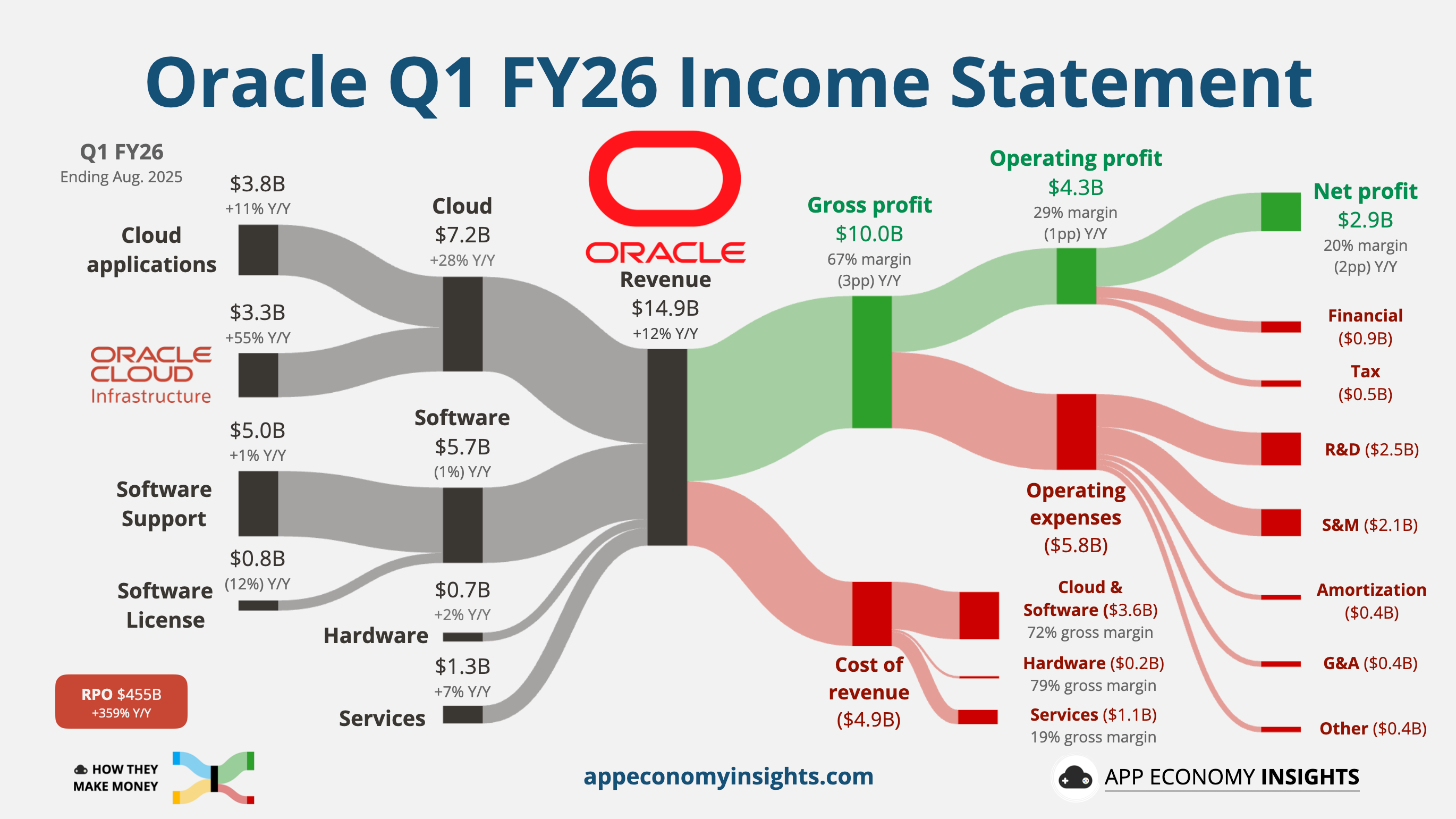
Oracle CEO Safra Catz told analysts the company's cloud pipeline reflects unprecedented demand. In a filing earlier this summer, Oracle hinted at the OpenAI contract by disclosing a cloud services deal expected to generate more than $30 billion in annual revenue starting in 2027.
The contract comes as OpenAI struggles with a persistent shortage of computing capacity, slowing new product rollouts and delaying next-generation AI models. The challenge extends across the industry, with tech firms racing to build data centers and secure advanced chips.
OpenAI has pursued several initiatives to expand its computing capacity. It struck a deal with Broadcom to develop custom chips and partnered with SoftBank on a major venture called Stargate, its umbrella for data center expansion. Stargate stumbled early, and OpenAI now considers the Oracle partnership part of that broader effort.
For years, OpenAI relied exclusively on Microsoft for computing power. With capacity constraints mounting, the company recently sought approval to bring in other cloud providers. The Oracle agreement marks a landmark shift, representing one of the largest bets on OpenAI's growth beyond its ties to Microsoft.
The deal carries significant risks for both sides. OpenAI faces a massive cost burden – many times its current revenue – betting its future on continued explosive growth of ChatGPT and adoption by consumers, businesses, and governments worldwide. At the same time, the startup confronts other pressures, including intense competition for talent, ongoing regulatory scrutiny, and sensitive negotiations with Microsoft over the future of their partnership.
For Oracle, the risk lies in concentrating a large share of future revenue on a single client while already carrying heavy leverage. Its debt-to-equity ratio stands at 427 percent, far above Microsoft's 32.7 percent, according to S&P Global Market Intelligence. Last fiscal year, Oracle generated $21.5 billion in operating cash flow against $27.4 billion in capital expenditures. By contrast, Microsoft produced $136 billion in operating cash flow with $88 billion in capital spending, leaving it far better positioned to handle the massive costs of building AI infrastructure – and highlighting just how big a gamble Oracle is taking.
OpenAI turns to Oracle in historic $300 billion cloud partnership