First look: At Computex 2026, Phison wasn't just talking about faster SSDs. The company used the show to outline where it thinks flash storage is headed, and how to get there without blowing the power budget. Its new controllers and enterprise drives all revolve around the same problem: squeezing out more performance without letting power consumption and heat get out of control.
That balancing act is most visible in its upcoming PCIe 6.0 controller, the X3, which is edging closer to market readiness. The controller uses a PCIe 6.0 x4 interface and supports NVMe 2.3, targeting roughly twice the throughput of today's high-end PCIe 5.0 SSDs. Phison is aiming for sequential speeds of up to 28 GB/s and up to 6.8 million IOPS in random workloads.
Those numbers put the controller well ahead of what most currently shipping systems can support. It's worth mentioning that PCIe 6.0 platforms remain limited to development environments, and Phison's own demonstrations are running on specialized hardware.
Still, the company is moving the X3 out of early testing and into reference designs that resemble shipping products. Phison plans to begin sampling the controller in December and ramp volume shipments in mid-2027.
The company also used the show to highlight the broader infrastructure required for PCIe 6.0, including redrivers, retimers, and cabling. In one demo, it showed a live PCIe 6.0 setup with PAM4 signaling, underscoring that moving to a new bus standard is as much about the ecosystem as it is about any single chip.
Efficiency is a central part of the X3 design. Phison is targeting 4 GB/s per watt, which would put total power draw at around 7 watts at peak throughput. At the same time, the controller is designed to scale in both capacity and speed, with support for up to 2 petabytes per SSD.
Initial deployments are expected in enterprise form factors, with current reference designs targeting E3.S and E1.S. Similar technology has historically trickled down into M.2 client drives.
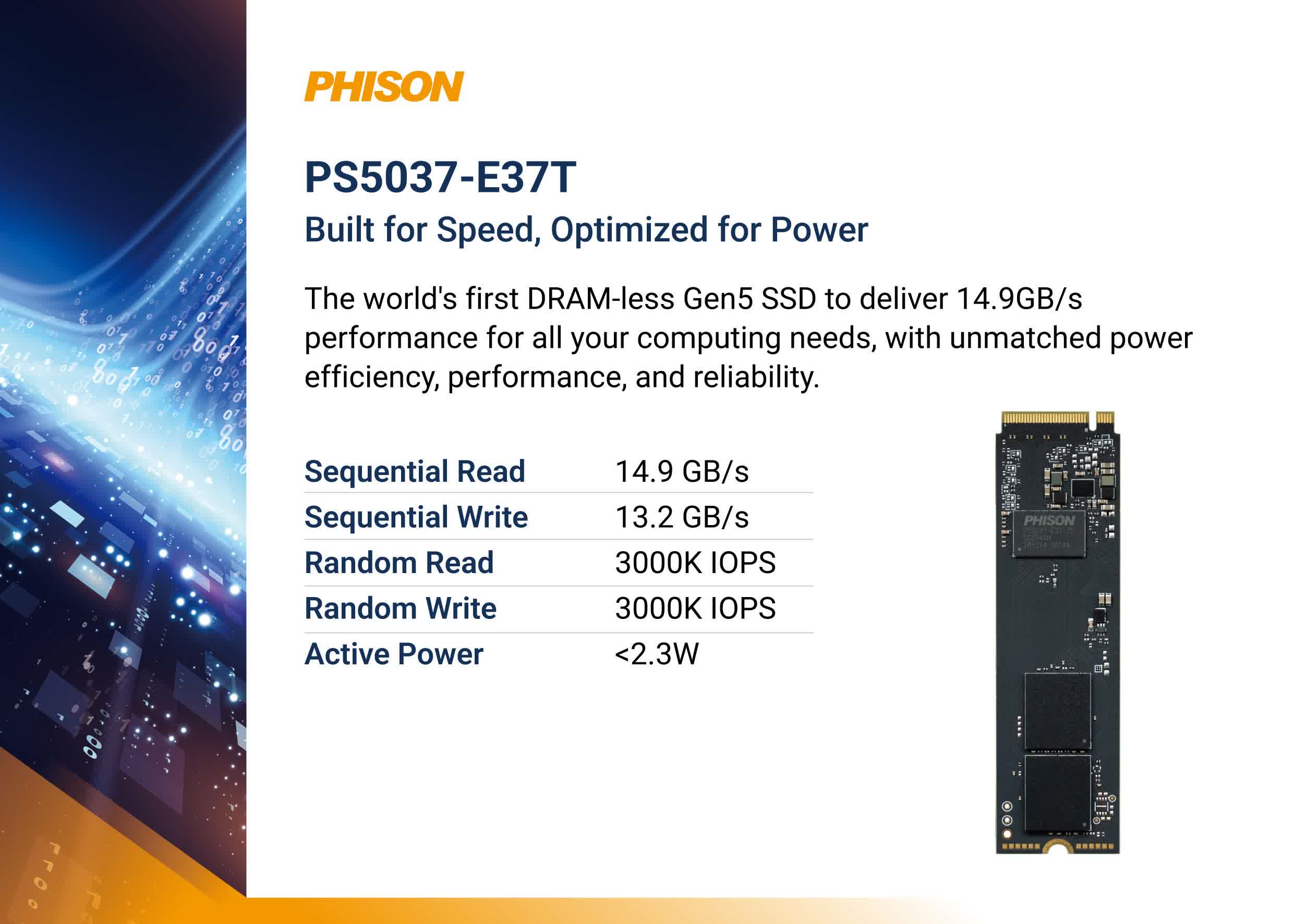
While the X3 is aimed at the next PCIe generation, Phison is also pushing its current PCIe 5.0 lineup to stay competitive in the near term. The E37T controller, a DRAM-less PCIe 5.0 client design, is aimed at power-sensitive systems and even appeared in a laptop demo at the show.
What stands out is how little performance is lost despite the absence of DRAM. The E37T delivers up to 14.9 GB/s in sequential reads and up to 13.2 GB/s in writes, roughly in line with high-end controllers that include DRAM.
Random performance reaches up to 3 million IOPS, helped in part by newer NAND, including 4800 MT/s BiCS memory that has yet to fully reach the market.
Power consumption is where the design begins to differentiate itself. Phison says the controller can run at around 4.5 watts, with some claims putting active power below 2.3 watts depending on the configuration. That opens the door to high-performance SSDs that can operate without active cooling, relying instead on a heat spreader or small heatsink – an approach that is especially appealing for thin systems and dense builds.
In one demo, a laptop equipped with the controller reached 14,239 MB/s in sequential reads.
There are also cost implications. Removing DRAM simplifies the bill of materials at a time when memory pricing remains volatile. The E37T will begin shipping this year, giving OEMs a more efficient PCIe 5.0 option while PCIe 6.0 matures.
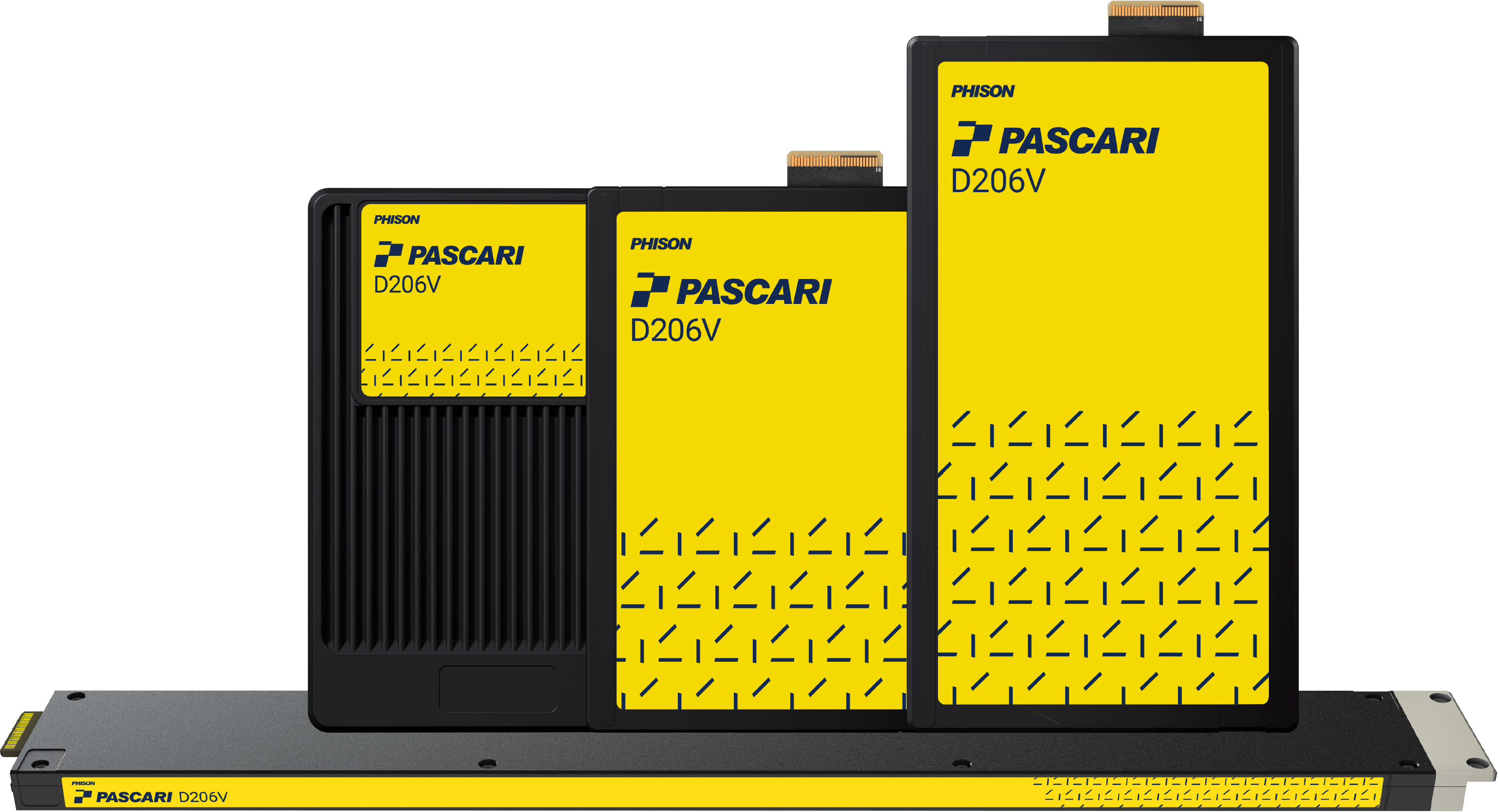
Beyond controllers, Phison is continuing to build out its enterprise portfolio under the Pascari brand. The latest drives lean into NVMe support and computational storage, reflecting a broader push to move certain processing tasks closer to the data itself.
The lineup spans E1.S and U.2 form factors, from 480 GB up to 15.36 TB, with top-end models rated at about 14.8 GB/s and 3.3 million IOPS.
Taken together, the announcements show a company working on two timelines at once. PCIe 6.0 is still a few years away from broad adoption, but the groundwork is already being laid. At the same time, incremental improvements to PCIe 5.0 – particularly in efficiency and cost – are where most near-term gains will appear.
In both cases, the underlying focus is the same: delivering more performance per watt, rather than simply chasing peak speeds.
Phison's next-gen PCIe 6.0 SSD controller hits 28 GB/s, and it's doing it at just 7 watts


