Python is still the most popular coding language, but challengers are gaining ground

Alfonso Maruccia

Posts: 2,544   +941
Staff
Playing with numbers: Programming languages are staying in step with the latest advancements in technology. While old favorites continue to be used by millions, modern contenders are emerging with more efficient ways to manage and process data – particularly in this increasingly generative AI-driven landscape.

The latest update to the TIOBE Index reveals notable shifts in the world of software development. While traditional programming languages remain popular, many developers are seeking out technologies that can make sense of the vast amounts of modern digital data. Legacy languages like C, COBOL, Fortran, and Assembly still have their place, but they no longer take center stage.

The TIOBE Index, a monthly measure of programming language popularity maintained by Dutch company TIOBE Software BV, gathers its "popularity" data from search results across over 20 websites, including Google, Amazon, Wikipedia, and Bing.

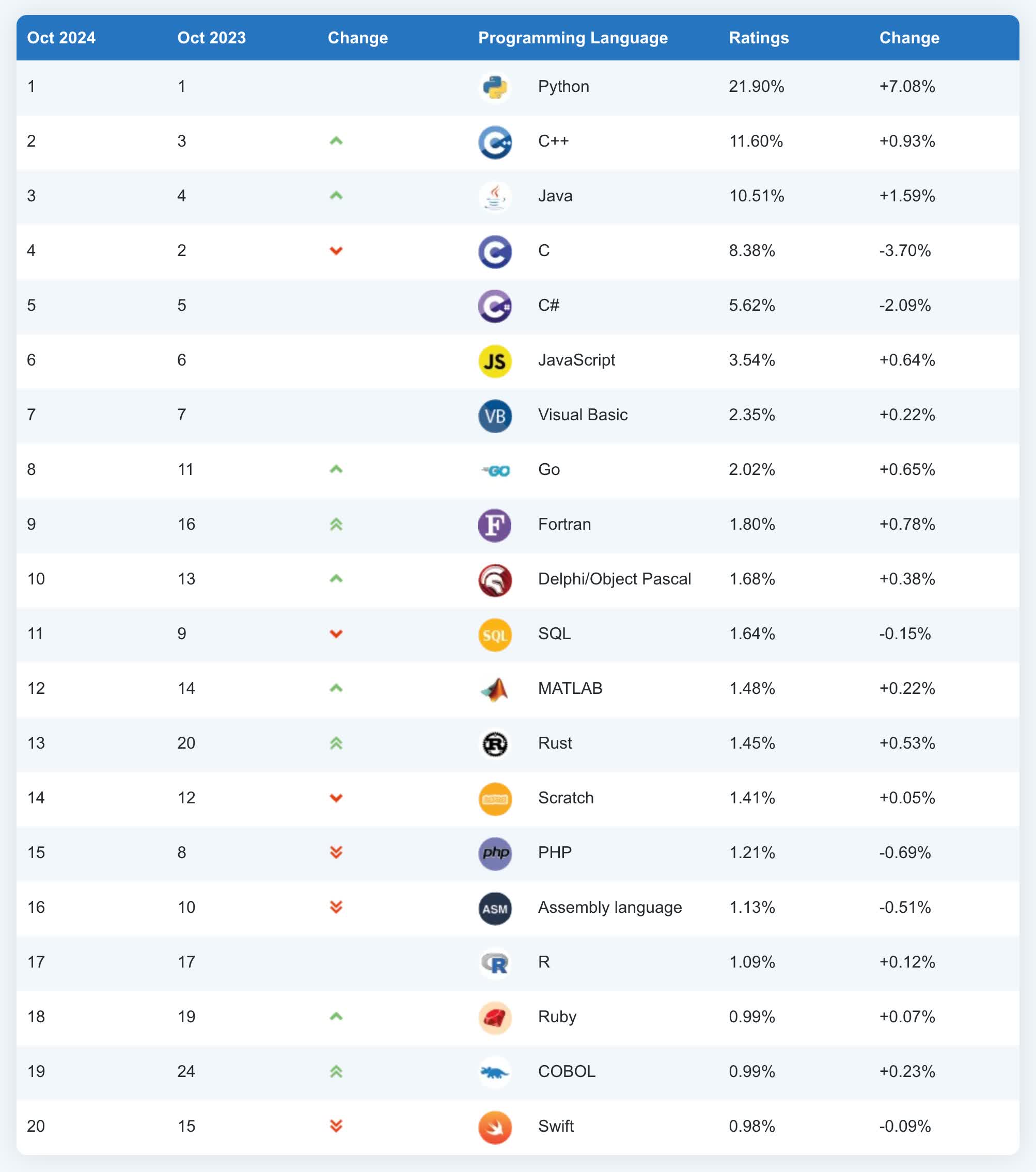
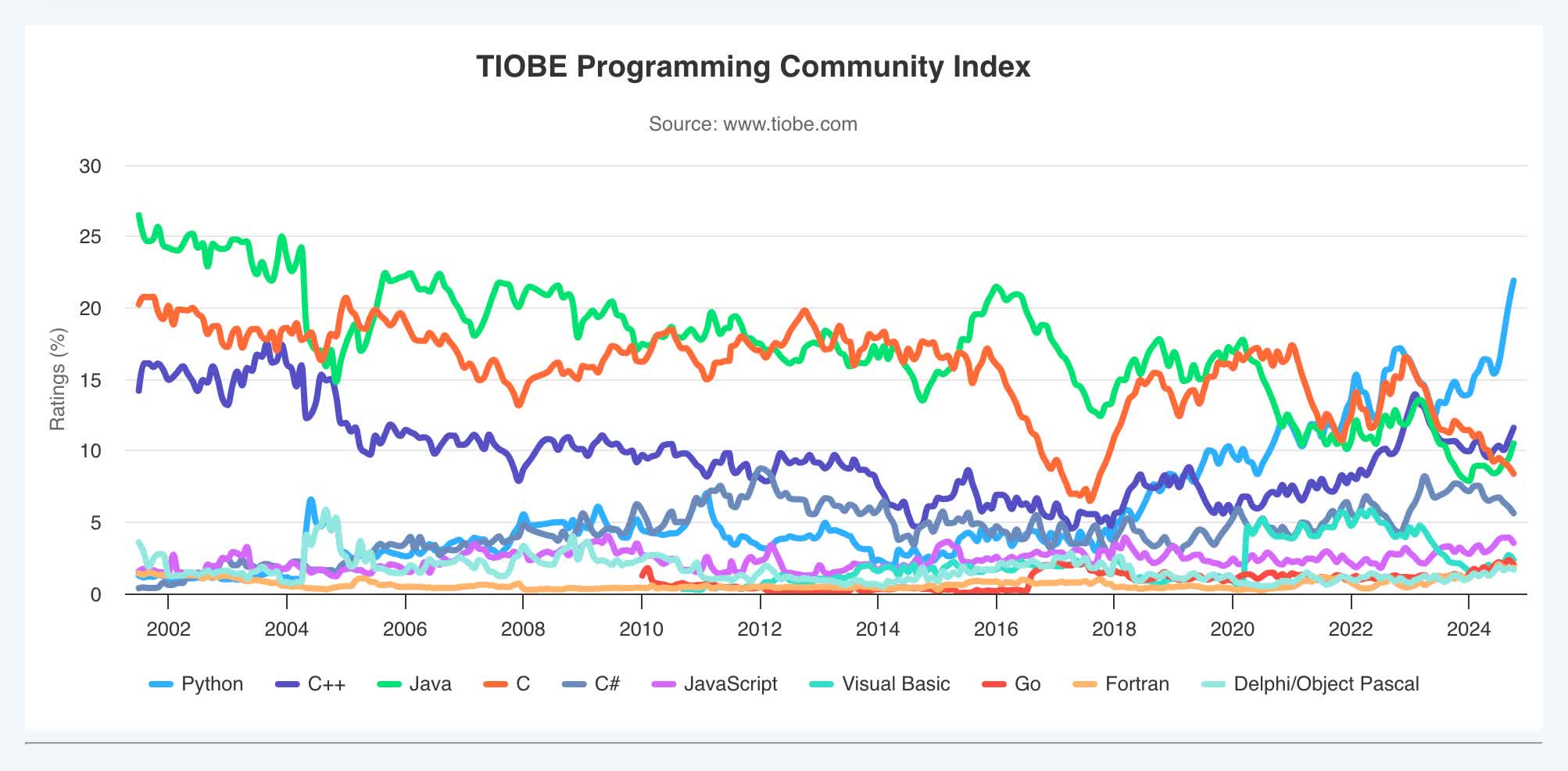
For October 2024, Python continues to reign as the most popular programming language, growing by +7.08 percent in the past month and holding a 21.90 percent market share. C++ has claimed second place with 11.60 percent, followed by Java with 10.51 percent. The classic C language, however, is losing ground, now ranking fourth with 8.38 percent market share, down 3.70 percent.
According to TIOBE Software CEO Paul Jansen, the amount of digital data in today's tech world is growing at an unprecedented pace, driving increased demand for tools that can efficiently process and manipulate this data. Programmers now require languages that excel in handling large volumes of bits and bytes, performing complex calculations, and delivering high performance.

Python is easy to learn and secure, but is not fast enough, Jansen said. It's why software engineers are "frantically" looking for more powerful alternatives. C++ could be a candidate, but isn't secure enough in memory management tasks. Rust is an interesting newcomer despite not being easy to learn, and is rapidly approaching the TIOBE Index top 10.
One surprising new entry is Mojo, a programming language created by Chris Lattner in 2023, which made its debut on the TIOBE Index in October 2024. Jansen describes Mojo as a blend of Python and Swift, offering much faster performance. Currently ranked 49th with a 0.15 percent share, Mojo is particularly suited for low-level programming on AI hardware, such as GPUs, without needing Nvidia's proprietary CUDA API for parallel computing.

Permalink to story:

 
For those not are not programmers.
Concepts between programming languages are pretty much all the same, the syntax of how you do it differs per language and some languages offer more features and/or are more forgiving than others.

Funnily enough the the top two ones there are almost complete opposites.
Python does a lot for you and is pretty forgiving. C++ forgives nearly nothing and let's you screw up royally.

This is good to know though, I'll make sure to move Python up a bit on my CV.

Java and C# are kinda in between and probably relatively easy to pick up once you're comfortable with python.

Disclaimer: I've done nearly nothing in C++, Only a couple of FreeCAD extensions in Python, some playing around in CircuitPython for ESP32-S3 boards. (Probably most comfortable in PHP and C#, but have some experience with Java/Javascript/Ruby and Visual Basic)
 
I am surprised to see that MATLAB is a programmation language.

However, it is true that MATLAB is a fantastic tool for any scientific automation.

I am not a programmer, but I have a solid base in coding as an engineer. I cannot create a user interface, but I can manage data easily and it is still part of my job to this day.

I learned JAVA first, did a lot of MATLAB and now I am mostly coding in C++. Learning to write scripts should be a requirement for any engineers.
 
I am not a programmer, but I have a solid base in coding as an engineer. I cannot create a user interface, but I can manage data easily and it is still part of my job to this day.

I am a Software Engineer, and will happily confirm working with user-interfaces SUCK.

Python does a lot for you, but managing the environment can certainly be a challenge; my general rule is to never touch it once it's working. Doing any type of update has a decent chance of breaking something. Performance is also *horrid* relative to C.

I note there needs to be a stronger distinction between C/Early C++ and modern C++. Modern C++ is a very safe language so long as you avoid it's legacy/C feature set.
 
I'm not buying this twisted "popularity contest". The entire web is JavaScript, and it will remain to be so. And so, TypeScript, NodeJS and other engines that produce JavaScript code are ahead of everything else. They also make up the fastest developing platform, while the rest of them are quite stagnant by comparison.
 
Last edited:
I'm not buying this twisted "popularity contest". The entire web is JavaScript, and it will remain to be so. And so, TypeScript, NodeJS and other engines that produce JavaScript code are ahead of everything else. They also make up the fastest developing platform, while the rest of them a quite stagnant by comparison.

JavaScript is not a programming language, just a garbled nightmare of useless and malicious scripts made by Google and other Big Tech evils :-D
 
JavaScript is not a programming language, just a garbled nightmare of useless and malicious scripts made by Google and other Big Tech evils :-D
2381828_orig.jpg
 
The study methodology seems awfully vague, and even if it published and repeatable, I'm not sure that any process based on internet search results is the right one for this topic.

I guess if you wanted to focus on which languages are mentioned most in job postings that might be one sub-topic that is interesting and discoverable via search.

I'm curious what search results led to Visual Basic being the "#7 most popular language". For comparison it does not appear at all on GitHub's global top 50 in use:

https://innovationgraph.github.com/global-metrics/programming-languages
 
The study methodology seems awfully vague, and even if it published and repeatable, I'm not sure that any process based on internet search results is the right one for this topic.

I guess if you wanted to focus on which languages are mentioned most in job postings that might be one sub-topic that is interesting and discoverable via search.

I'm curious what search results led to Visual Basic being the "#7 most popular language". For comparison it does not appear at all on GitHub's global top 50 in use:

https://innovationgraph.github.com/global-metrics/programming-languages
Agreed. It's probably searched so much because it is a PITA to use, lol (Idk if that's true, but that would explain why it is searched for a lot). Visual Basic does come in with 4.2% on the StackOverflow index, though, so it isn't completely forgotten.

Aggregating across different studies is the best way to see what is most "popular" or "used" or whatever the metric you're trying to go for is. But, does it matter to *you* what the most popular is? Probably not. If you're a web developer you're gonna know JavaScript, if you write firmware you'll probably know assembly and C, etc. Useful info for students perhaps, but doesn't really change much for professionals.
 
Disclaimer: I've done nearly nothing in C++, Only a couple of FreeCAD extensions in Python, some playing around in CircuitPython for ESP32-S3 boards. (Probably most comfortable in PHP and C#, but have some experience with Java/Javascript/Ruby and Visual Basic)

Ruby has fascinated me. It's very similar in a lot of ways to Python (very different, too), and it's about the same age, yet Python came out ahead. I've wondered why more people didn't use Ruby, just seems like there would have been a natural rivalry between the two.
 
Ruby has fascinated me. It's very similar in a lot of ways to Python (very different, too), and it's about the same age, yet Python came out ahead. I've wondered why more people didn't use Ruby, just seems like there would have been a natural rivalry between the two.
Part of it is because Python got adopted platform wide everywhere whilst Ruby (on rails specifically) took off more as a PHP alternative. But who knows really, sometimes things just go the way they go.

I did enjoy working in Ruby, it's got some fun syntactic sugar.
 
I'm not buying this twisted "popularity contest". The entire web is JavaScript, and it will remain to be so. And so, TypeScript, NodeJS and other engines that produce JavaScript code are ahead of everything else. They also make up the fastest developing platform, while the rest of them a quite stagnant by comparison.


Yeah all us physics and maths researchers flock to Javascript for our programming needs.
 
JavaScript is not a programming language, just a garbled nightmare of useless and malicious scripts made by Google and other Big Tech evils :-D
use strict mode.
It also makes JavaScript to be memory safe.

 
Last edited:
I'm not buying this twisted "popularity contest". The entire web is JavaScript, and it will remain to be so. And so, TypeScript, NodeJS and other engines that produce JavaScript code are ahead of everything else. They also make up the fastest developing platform, while the rest of them are quite stagnant by comparison.

Well according to their sampling, the entire internet is made up of purely backend and data science tools. I smell some **** in their methodology.
 
use strict mode.
It also makes JavaScript to be memory safe.

And TypeScript if you want to go full hog type-safety and intellisense.
 
I'm not buying this twisted "popularity contest". The entire web is JavaScript, and it will remain to be so. And so, TypeScript, NodeJS and other engines that produce JavaScript code are ahead of everything else. They also make up the fastest developing platform, while the rest of them are quite stagnant by comparison.

This is true but I'd argue that the popularity of Javascript is precisely because of all those runtimes popular for web development.

Python is similarly popular because most programming needs do not actually need too much in the way of efficiency: most of them would be good enough for use cases by being just a few notches above a macro/scripting language.

The rest of the list I suspect looks like that because of just maintaining old code: bunch of people are regularly hired to maintain some old Java implementation of like a custom module for various ERP and CRMs to be found around many companies of all sizes but particularly small and medium ones as the large ones are probably moving to cloud, coding everything on python and then letting Amazon or Microsoft deal with the backend to interpret that code however they want for a monthly service fee.

This also would explain why there's so little representation of the seemingly more popular languages like you correctly mention: If you're a programmer you're probably interested in new development and not maintaining someone else's barely functioning Java code on some tiny warehouse using damn excel files as their database but by numbers alone, there's probably more of those jobs than backend web devs but nobody even talks about their dead end java jobs they just keep doing it if they keep getting a check for it.
 
I feel like it's a major assumption that people online searching for something should equal popularity. I'm not sure searching for something online even means people are using it. For example, if I wanted to buy a new car, I might look up information on a bunch of brands/models, but that doesn't mean I end up liking them or buying them. Further, If I had used a technology for years then I would become good at it and not need to search for articles about it. I'm just not sure I would take this list very seriously.
 
I just use whatever language I need to get the job done. There is no way my mind can hold the specifics of any of these for very long. In 5 years programmers will likely be obsolete. The optimization of Tech is costing tech jobs, and forcing skill evolution at an astonishing rate.
 
Back