Researchers hit 112Gbps over wireless in a breakthrough that could shape 6G

DragonSlayer101

Posts: 978   +14
Staff
Looking ahead: Researchers at Japan's Tokushima University, the University of Tokyo, and Gifu University have developed a terahertz wireless communication system capable of transmitting data at 112Gbps in the 560GHz band. This is significantly faster than the few-gigabit-per-second data rates typically achieved by conventional terahertz communication systems operating at similar frequencies.
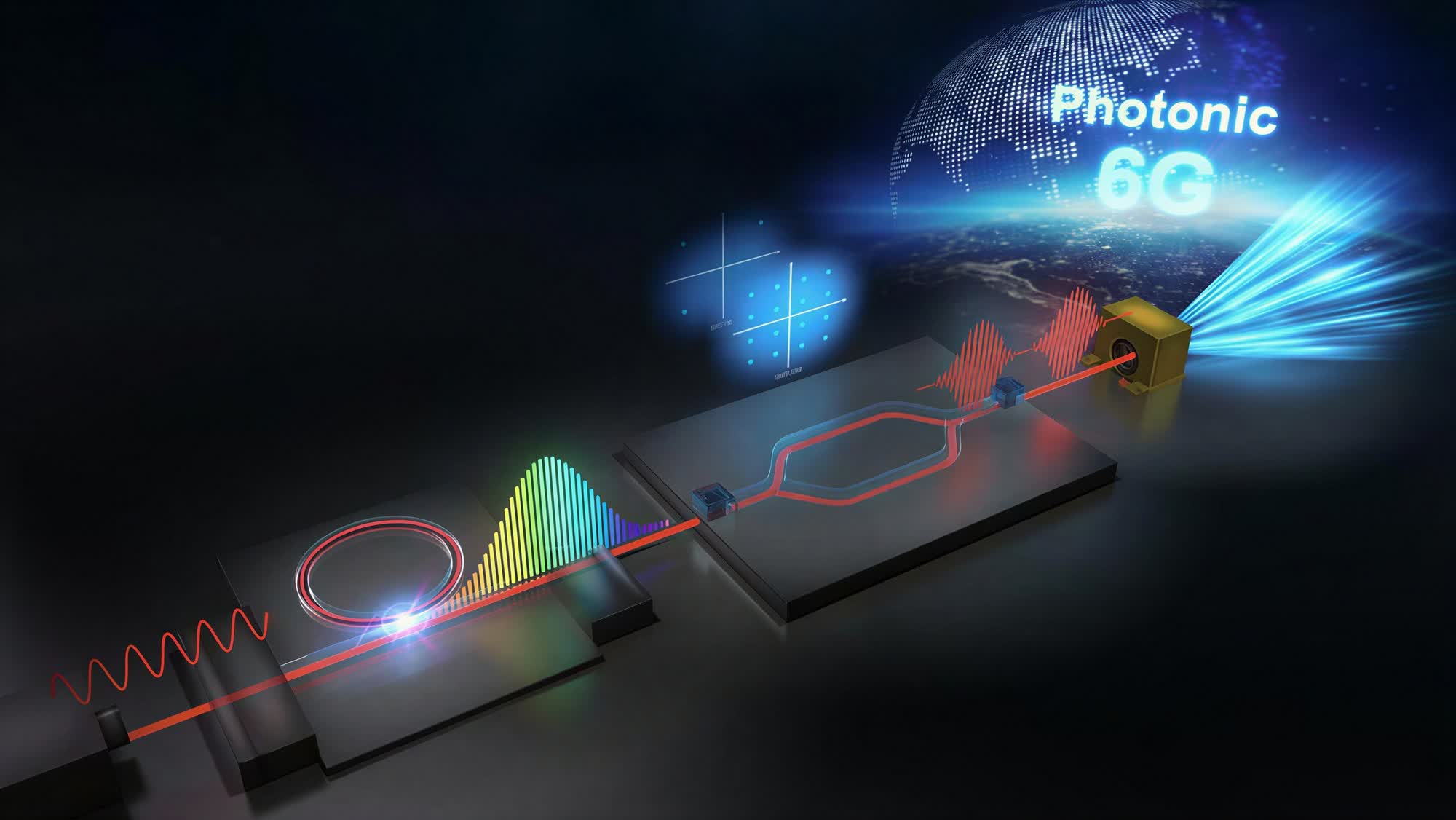
The researchers noted that this marks the first time any technology has achieved 100Gbps-class wireless communication beyond 420GHz, potentially opening a new frontier in high-frequency wireless communications and paving the way for 6G cellular networks, which promise extremely high speeds, ultra-low latency, and massive network capacity.

The discovery was originally announced last October before undergoing peer review and being published this week in the journal Nature. In the research paper, the study's authors noted that the biggest obstacles to generating stable, high-quality signals beyond 350GHz are increased phase noise and reduced power output.
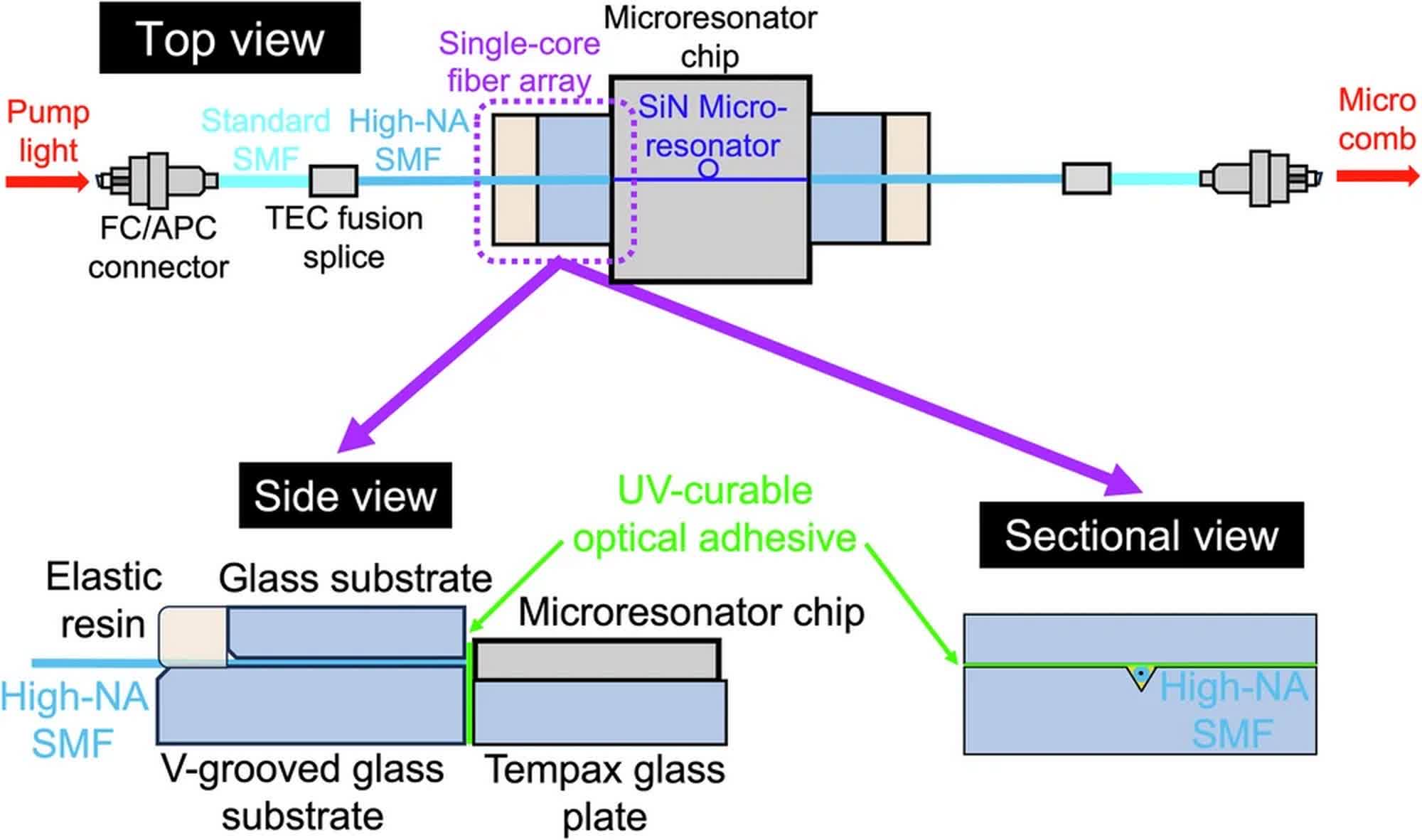
To overcome these limitations, the team combined fiber-coupled microcombs with high-order data modulation to develop its new prototype. Microcombs – short for microresonator frequency combs – were chosen because they offer high-frequency stability and low phase noise, making them ideal for transmitting reliable signals beyond 350GHz.

Microcombs are tiny photonic devices that function like optical rulers, splitting laser beams into a series of precise, evenly spaced, ultra-stable light frequencies. These ultra-thin laser lines enable extremely high-speed data transmission while minimizing phase noise, making microcombs well suited for terahertz communications.

The researchers explained that they prevented optical alignment distortion by permanently bonding an optical fiber directly onto a silicon nitride microcomb. This ensured that physical disturbances would not disrupt the connection and allowed the team to miniaturize a laboratory setup into a device no larger than a human fingernail.
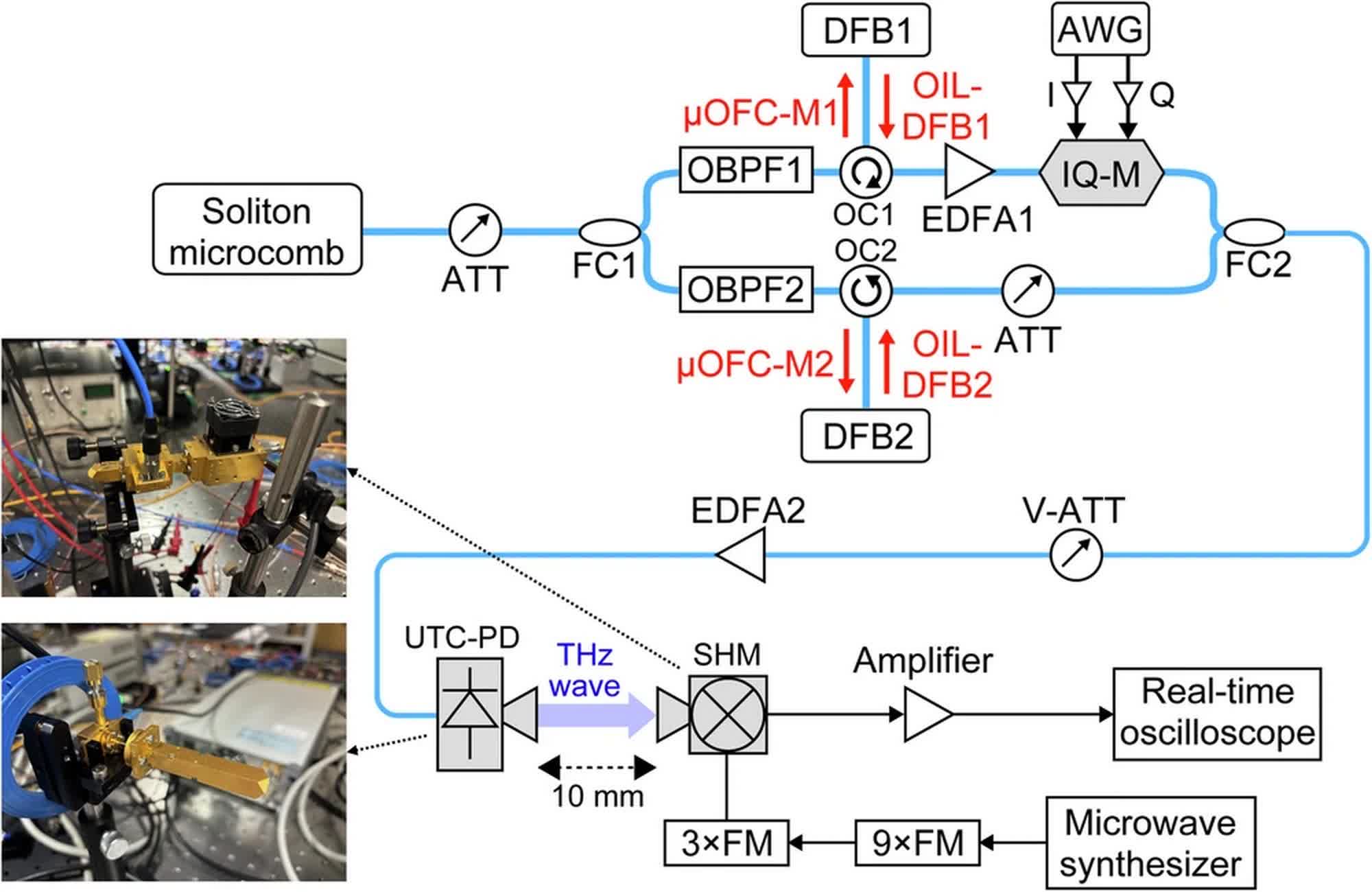
Researchers were also able to incorporate thermal regulation and climate-proofing technology into the tiny device, improving "the reproducibility of optical resonance characteristics and enhancing robustness against environmental temperature fluctuations."

Once the device was ready, the team had to demonstrate that it could transmit data at substantially higher speeds than current technologies. To achieve this, the researchers generated two highly stable optical carriers through optical injection and modulated the signals using the QPSK and 16QAM formats, achieving data rates of 84Gbps with the former and 112Gbps with the latter.

The invention of the microcomb-based device is being heralded as a major breakthrough in the world of wireless communications. According to professor Takeshi Yasui of Tokushima University, the result "represents a major step toward practical 6G wireless systems and ultra-high-speed mobile backhaul."

Permalink to story:

 
...Is it really necessary though? I currently get near-gigabit down and 55 up in areas where 5G UC is available and I've never ever considered that "slow". At home meanwhile, I'm lucky if I get 10 down and 2 up...maybe we could focus on covering distance from the cell towers, rather than higher speeds closer to them? Seems like it would be more valuable to more people.
 
...Is it really necessary though? I currently get near-gigabit down and 55 up in areas where 5G UC is available and I've never ever considered that "slow". At home meanwhile, I'm lucky if I get 10 down and 2 up...maybe we could focus on covering distance from the cell towers, rather than higher speeds closer to them? Seems like it would be more valuable to more people.
Yes, it is necessary.

Think you’re missing the point. This isn't about phone-to-tower speed but rather the invisible backbone of the network.

The article explicitly highlights "mobile backhaul." This kind of tech connects cell towers to each other and the main internet grid.

When thousands of people use a tower simultaneously, that tower requires massive throughput to handle the collective traffic. Laying physical fiber-optic cables is extremely expensive and slow. This wireless tech bridges towers through the air at fiber speeds.

Ironically, making tower connection cheaper and faster is exactly how providers can cost-effectively expand coverage and speed in under-served areas like you mention.
 
Yes, it is necessary.

Think you’re missing the point. This isn't about phone-to-tower speed but rather the invisible backbone of the network.

The article explicitly highlights "mobile backhaul." This kind of tech connects cell towers to each other and the main internet grid.

When thousands of people use a tower simultaneously, that tower requires massive throughput to handle the collective traffic. Laying physical fiber-optic cables is extremely expensive and slow. This wireless tech bridges towers through the air at fiber speeds.

Ironically, making tower connection cheaper and faster is exactly how providers can cost-effectively expand coverage and speed in under-served areas like you mention.
Admittedly I skimmed the article as it isn't in my area of expertise and a lot of it went over my head. Thanks for the dumbed down explanation for a dummy like me, advancements on the backend side make a lot more sense.
 
I read somewhere a while back that Japan has 1,000G up, and 1,000G down. If, they do anything like they built their vehicles, I'm sure it will be fantastic.
 
Microcombs are tiny photonic devices that function like optical rulers, splitting laser beams into a series of precise, evenly spaced, ultra-stable light frequencies....
I have to take issue with this "explanation" -- apparently generated from a ten-second Google AI search. Microcombs are pumped by a laser, but they don't 'split' the laser light into various frequencies (lasers are monochromatic by definition). And in fact the microcombs used in this innovation don't even emit visible light, but sub-infrared terahertz radiation.
 
I think of this stuff beyond the Earth limits. High frequency communication, that allows high bandwidth transmissions that might be niche on Earth, could be used in the future for high bandwidth communications between the Moon and Earth. Earth to Mars. Mars to Moon. Honestly, 6Ghz Wi-Fi is barely usable in a home, unless you have a 3 AP Mesh system, or more.

Interference between towers is less likely and more predicable in an interstellar environment. Communication between celestial bodies is predicable. Solar interference is generally predicable and will improve.

I see this less of a replacement for fibre on Earth and more a baseline of where we could take things 20-50 years from now. Because regardless of anyone's brain power, wireless frequencies can only carry so much data and we can always run more fibre optic cable to carry more data.
 
Thankfully, the world isn’t run by tinfoil-hat people.
if only you read the articles from medics that researched the schools and kids, that were affected by those towers and were placed too close to facilities (why do you think high frequency towers are HIGH in the air, usually on rooftops, some on streets) because they know the danger they pose.

But someone who has no idea and thinks everyone lies but only he holds the truth, well, keep lying to yourself.
 
if only you read the articles from medics that researched the schools and kids, that were affected by those towers and were placed too close to facilities (why do you think high frequency towers are HIGH in the air, usually on rooftops, some on streets) because they know the danger they pose.
A tech site is the last place for tinfoil-hat nonsense like this. Those towers are placed high not because "they cause cancer", but for the same reason we used to put TV antennas on roofs, not in underground basements .... the reception is better up there. Not to mention it's much harder for some teenage vandal to come by and swing a club at the sensitive electronics when they're 50 feet up in the air.
 
Just remember a radio can only "talk / communicate" with one device at a time.
This will be great for back bone communications
 
if only you read the articles from medics that researched the schools and kids, that were affected by those towers and were placed too close to facilities (why do you think high frequency towers are HIGH in the air, usually on rooftops, some on streets) because they know the danger they pose.

But someone who has no idea and thinks everyone lies but only he holds the truth, well, keep lying to yourself.
Those people have no tech knowledge whatsoever. No clue about this subject. They went in with a tinfoil-hat on their head and was biased from day one.

Multiple studies have debunked those claims. Read the actual research — meta-analyses consistently conclude there is no risk.

But feel free to live in a faraday cage.
 
Back