
Looking ahead: Researchers at Japan's Tokushima University, the University of Tokyo, and Gifu University have developed a terahertz wireless communication system capable of transmitting data at 112Gbps in the 560GHz band. This is significantly faster than the few-gigabit-per-second data rates typically achieved by conventional terahertz communication systems operating at similar frequencies.
The researchers noted that this marks the first time any technology has achieved 100Gbps-class wireless communication beyond 420GHz, potentially opening a new frontier in high-frequency wireless communications and paving the way for 6G cellular networks, which promise extremely high speeds, ultra-low latency, and massive network capacity.
The discovery was originally announced last October before undergoing peer review and being published this week in the journal Nature. In the research paper, the study's authors noted that the biggest obstacles to generating stable, high-quality signals beyond 350GHz are increased phase noise and reduced power output.
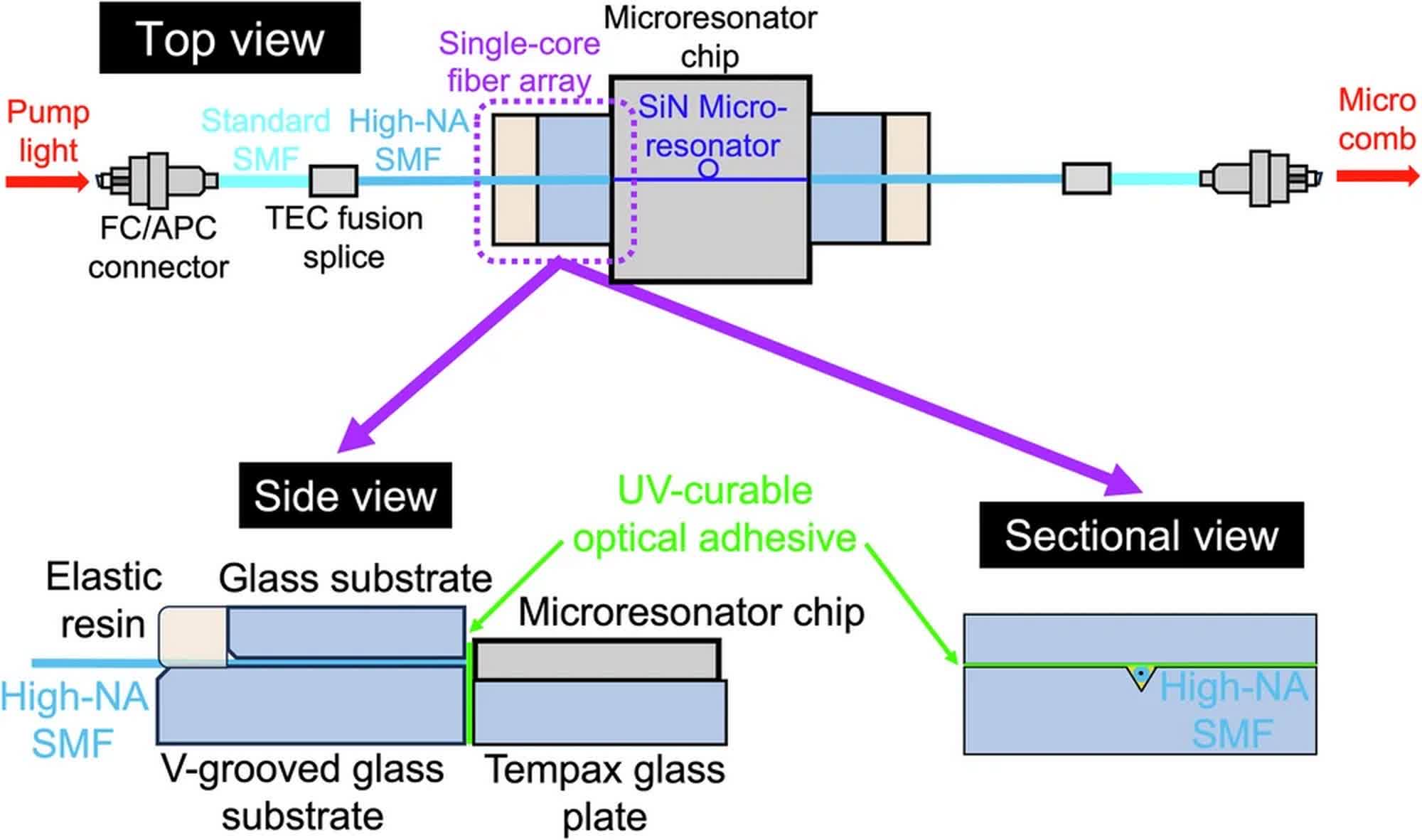
To overcome these limitations, the team combined fiber-coupled microcombs with high-order data modulation to develop its new prototype. Microcombs – short for microresonator frequency combs – were chosen because they offer high-frequency stability and low phase noise, making them ideal for transmitting reliable signals beyond 350GHz.
Microcombs are tiny photonic devices that function like optical rulers, splitting laser beams into a series of precise, evenly spaced, ultra-stable light frequencies. These ultra-thin laser lines enable extremely high-speed data transmission while minimizing phase noise, making microcombs well suited for terahertz communications.
The researchers explained that they prevented optical alignment distortion by permanently bonding an optical fiber directly onto a silicon nitride microcomb. This ensured that physical disturbances would not disrupt the connection and allowed the team to miniaturize a laboratory setup into a device no larger than a human fingernail.

Researchers were also able to incorporate thermal regulation and climate-proofing technology into the tiny device, improving "the reproducibility of optical resonance characteristics and enhancing robustness against environmental temperature fluctuations."
Once the device was ready, the team had to demonstrate that it could transmit data at substantially higher speeds than current technologies. To achieve this, the researchers generated two highly stable optical carriers through optical injection and modulated the signals using the QPSK and 16QAM formats, achieving data rates of 84Gbps with the former and 112Gbps with the latter.
The invention of the microcomb-based device is being heralded as a major breakthrough in the world of wireless communications. According to professor Takeshi Yasui of Tokushima University, the result "represents a major step toward practical 6G wireless systems and ultra-high-speed mobile backhaul."