Rocket reentries are leaving measurable lithium pollution in the upper atmosphere

Skye Jacobs

Posts: 2,030   +59
Staff
Why it matters: The idea that falling spacecraft quietly burn away without consequence is beginning to look outdated. Scientists have observed that rocket hardware disintegrating on reentry leaves behind lithium, altering the chemical balance in the upper atmosphere.
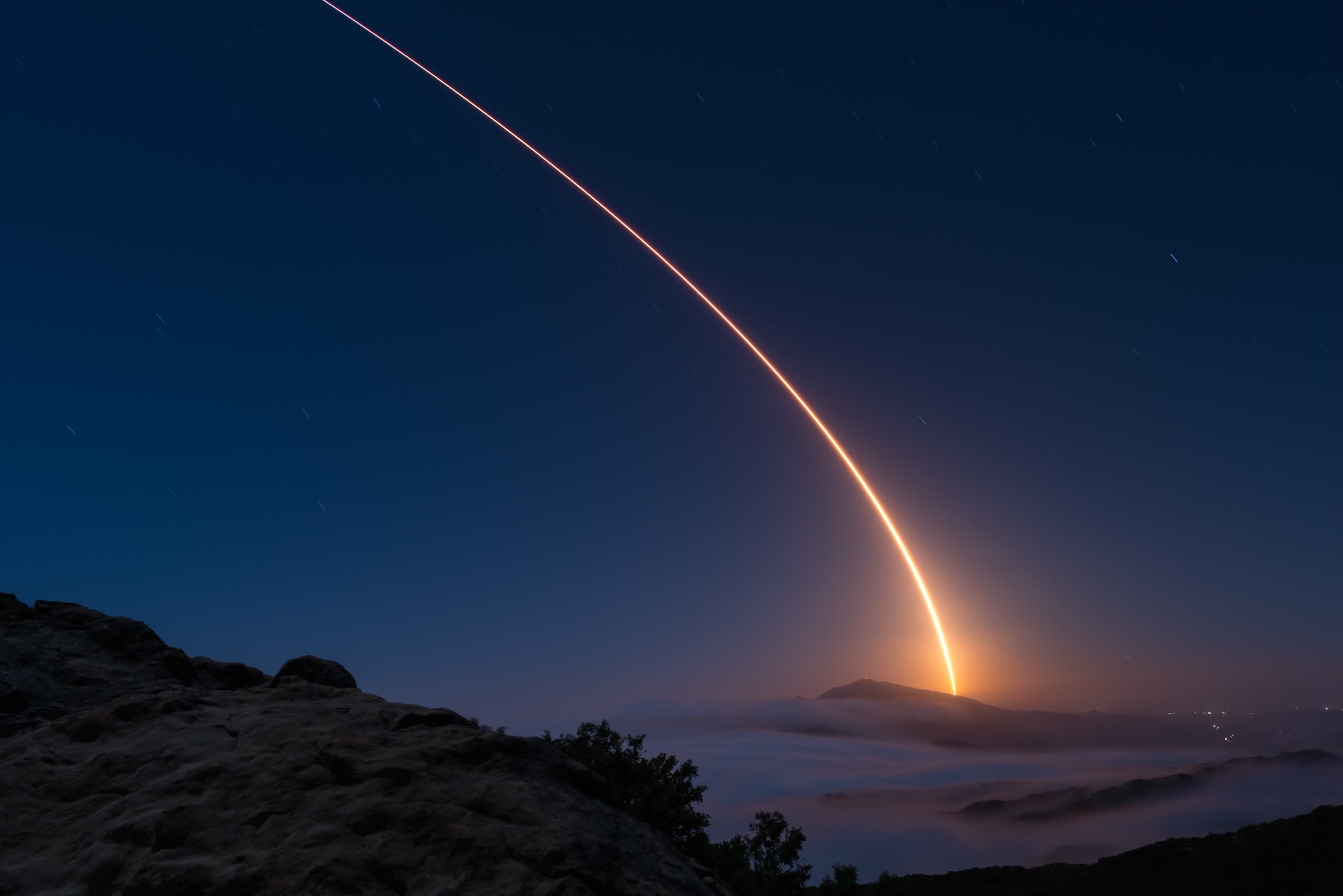
On February 19, 2025, a SpaceX Falcon 9 booster fell back toward Earth, its fiery descent slicing across Europe's night sky. Researchers at the Leibniz Institute of Atmospheric Physics in Germany captured the event using their lidar system, running it during the predicted reentry window. A new study published in Communications Earth & Environment reports that the uncontrolled reentry coincided with a tenfold spike in lithium atoms high above Earth's surface.

Lidar, short for "light detection and ranging," uses laser pulses to map atmospheric composition. In this case, the instruments at a research station in Saxony detected a narrow plume of lithium atoms between 94 and 97 kilometers above sea level – about 10 times the concentration normally present at those altitudes. The unplanned observation shows that rocket hardware disintegrating on reentry can leave measurable traces in the upper atmosphere.

Robin Wing, a lead author on the study, said his team specifically chose lithium because they expected it could serve as a tracer for spacecraft material during reentry. Aerospace-grade lithium-aluminum alloys are common in spacecraft structures, making lithium an ideal marker for human-made debris.

Previous research had already demonstrated that metals from decaying satellites and rockets – including aluminum, copper, and lead – now exceed the natural influx of those elements from cosmic dust. Until now, however, there had been no direct measurement linking a single reentry to a localized, quantifiable metal plume.

What happens next inside that thin atmospheric band is still unclear. The metals could interact with charged particles or other compounds, subtly shifting how the upper atmosphere absorbs solar radiation or forms noctilucent clouds. Scientists simply don't know. That uncertainty is driving a growing concern among atmospheric chemists. As the global launch cadence rises and old spacecraft reenter the atmosphere almost weekly, the cumulative effect could amount to a long-term chemical transformation above the stratosphere.

"There are many elements present inside spacecraft which are not very present in our atmosphere due to natural causes," Wing told Gizmodo. "We know very little about what metals actually exist in the atmosphere and how that relates to re-entry pollution."

Permalink to story:

 
OMG can this cause more "climate change"? 🤣🤣🤣

Isn't it better to completely stop any space exploration because someone measured something?
You seem to have skipped over the middle-ground where space exploration continues, but, just possibly, with an eye to monitoring and ensuring that said exploration isn't harming people or the planet irreversibly in the long-term. Almost as though multiple competing goals can co-exist and find a balance without jumping to extremes. But this is the internet, so I'm not sure what I expected.
 
You seem to have skipped over the middle-ground where space exploration continues, but, just possibly, with an eye to monitoring and ensuring that said exploration isn't harming people or the planet irreversibly in the long-term. Almost as though multiple competing goals can co-exist and find a balance without jumping to extremes.
The extreme position here is an infinitesimal, temporary spike in lithium levels generating histrionic media headlines globally, without even the hint of a suggestion of potential "irreversible harm" to the planet. I won't even mention the use of loaded language like claiming SpaceX is "peppering the planet with pollution". Nor will I bring up how many millions of tons of pollutants -- including lithium -- enter the atmosphere each year from asteroid strikes ... and have been doing so for countless millennia.
 
The extreme position here is an infinitesimal, temporary spike in lithium levels generating histrionic media headlines globally, without even the hint of a suggestion of potential "irreversible harm" to the planet. I won't even mention the use of loaded language like claiming SpaceX is "peppering the planet with pollution". Nor will I bring up how many millions of tons of pollutants -- including lithium -- enter the atmosphere each year from asteroid strikes ... and have been doing so for countless millennia.
I'm pretty sure the article outright says that they don't know if or what the consequences of this increase could be. That's why they're concerned. I certainly hope it's nothing. It may well be nothing. That doesn't mean it shouldn't be monitored and observed and be made aware of in case it isn't nothing. In here we find the middle ground.
 
Now that space flights are mostly commercial, observe the byproducts of their fabricated "need" for growth. More, more, more, always more, until nothing is left or something breaks and everyone dies. So long as someone thinks there's money to be made, the rocket launches will continue to increase.

Furthermore, if the last president couldn't be bothered to properly enforce regulations when a train derailed and polluted half a town, what do you think the big business party guy is gonna do about the rockets? Nothing on your behalf, that's for sure.

There's nothing you can do. No one cares unless you are rich. Move on.
 
"On February 19, 2025, a SpaceX Falcon 9 booster fell back toward Earth, its fiery descent slicing across Europe's night sky"

Huh? Falcon 9 boosters do not reach orbital velocity, and do not perform any reentry. They land either back near the launch pad or on a barge in the Atlantic. They never get anywhere remotely close to Europe.
 
I'm pretty sure the article outright says that they don't know if or what the consequences of this increase could be.
A sentence in the next-to-last paragraph doesn't compete with headlines screaming that the earth is being showered with pollutants, especially when that disclaimer is immediately followed by the intentionally-leading statement that, "this uncertainty is driviing a growing concern among atmospheric scientists".

This particularly article is actually more restrained than others I've read on this study. But all of them failed to directly inform readers that there was NO increase measured in overall atmospheric levels -- the measurements were taken within the reentry plume of the rocket. The study is akin to putting a sensor in the exhaust pipe of a diesel truck, and claiming the measurements are relevant to worldwide pollutant levels.

Huh? Falcon 9 boosters do not reach orbital velocity, and do not perform any reentry. They land either back near the launch pad or on a barge in the Atlantic. They never get anywhere remotely close to Europe.
This was a failure event; the only such upper-atmosphere failure in over 600 Falcon 9 launches, in fact. A normal reentry would not create this lithium plume -- another fact the article omits.
 
Well don't let that happen over california skies or they will find a tax
🤣 Actually, they would make it illegal due to cancer causing potential. :rolleyes:
Nor will I bring up how many millions of tons of pollutants -- including lithium -- enter the atmosphere each year from asteroid strikes ... and have been doing so for countless millennia.
Welcome back, man! Just in time for the mid-terms, I see.

Good of you to bring up a straw man. Actually, you could probably get Avi Loeb to argue that some civilization in interstellar space is firing projectiles at Earth that are made of highly pure lithium-aluminum alloys. Oh wait. asteroids are not pure and vary in elemental content, and science does not consider residuals from asteroid strikes as pollution. In point of fact, there is a theory out there that an asteroid strike, or strikes, may have brought the Earth the basic ingredients for life.

Then again, the article considers rockets that are made of highly pure lithium-aluminum alloys.
 
🤣 Actually, they would make it illegal due to cancer causing potential. :rolleyes:
Yes they would and that nobody pays any attention to but costs consumers money. I was listening to Adam Corolla today. He tuned me into the road maintenance fee. I hope CA recovers, it's a beautiful place
 
Welcome back, man! Just in time for the mid-terms, I see.
Thanks.

...Oh wait. asteroids are not pure and vary in elemental content...the article considers rockets that are made of highly pure lithium-aluminum alloys.
Rockets are not pure lithium, nor even pure lithium-aluminum. The point is that all elements found in rockets can also be found in asteroids. That is, in fact, why the earth's upper atmosphere already contains a great deal of lithium.

...and science does not consider residuals from asteroid strikes as pollution.
Very untrue. Some environmentalists consider anything emitted by mankind to be "a pollutant", whereas the exact same compound, substance, or element emitted by any other source as a "natural, benign" substance ... but any true scientist rejects such obvious absurdity.
 
If it wasn't Space X, we'd never hear about this. It's just the "scientific" community doesn't like Musk.
And that's evident by the fact that this was reported long ago, with a direct link to rockets and satellites. Although the TechSpot article claims the link is new, exact ratios of elements were measured in the upper atmosphere to match those used in special alloys for spacecraft. In addition, NOAA didn't mention SpaceX because this applies to all spacecraft: https://research.noaa.gov/noaa-scie...n-the-upper-atmosphere-to-rockets-satellites/
 
The study is akin to putting a sensor in the exhaust pipe of a diesel truck, and claiming the measurements are relevant to worldwide pollutant levels.
catalytic converter seems to have prevented a lot of pollutants into the air so... seems like a good idea.
 
OMG can this cause more "climate change"? 🤣🤣🤣

Isn't it better to completely stop any space exploration because someone measured something?

The world should have stopped wasting money on this already.

We already have enough problems here; there is no reason to waste hundreds of billions on pointless projects.
 
catalytic converter seems to have prevented a lot of pollutants into the air so... seems like a good idea.
I believe you miss the point. You don't measure global CO2 levels in the plume of an active volcano. Nor do you accurately measure lithium levels in the plume of a disintegrating spacecraft constructed of lithium-aluminum alloys.

The world should have stopped wasting money on this already.

We already have enough problems here; there is no reason to waste hundreds of billions on pointless projects.
Space exploration is one endeavor that pays for itself many times over. It's given us thousands of technological advances, just one of which -- weather satellites -- which, through better storm prediction, have saved us trillions of dollars and hundreds of thousands of lives globally.
 
I believe you miss the point. You don't measure global CO2 levels in the plume of an active volcano. Nor do you accurately measure lithium levels in the plume of a disintegrating spacecraft constructed of lithium-aluminum alloys.
You seem to miss the point. Measuring pollutants at the point of being released into the atmosphere is how you discover this problem.

Quoting you specifically:
"The study is akin to putting a sensor in the exhaust pipe of a diesel truck, and claiming the measurements are relevant to worldwide pollutant levels." - Patently false. No goal post moving or subject changing. Putting a sensor in the exhaust pipe is exactly how we determine if there is a problem because once in the atmosphere we cant measure it meaningfully or where it came from. Catalytic converters are a real world living example of how putting something on the end of the exhaust has been relevant to the measurements to worldwide pollutant levels.
 
You seem to miss the point. Measuring pollutants at the point of being released into the atmosphere is how you discover this problem.
Was that a joke? When you put a sensor in the plume of a rocket's fiery disintegration, you're going to detect all the elements that rocket was composed of. You need a study to tell you this? What exactly do you believe we "discovered" here, beyond the fact that if you heat lithium-aluminum metals to the point of vaporization, that they do indeed become vapor?

Catalytic converters are a real world living example of how putting something on the end of the exhaust has been relevant to the measurements to worldwide pollutant levels.
Very incorrect. We didn't determine that vehicles were polluting air by placing sensors in tailpipes -- we detected it directly, by measured changes in air quality in our cities. Prior to the introduction of catalytic converters, locations like the LA valley were literally filled with a thick brown soup. We didn't need to sniff tailpipes to locate the problem.
 
"On February 19, 2025, a SpaceX Falcon 9 booster fell back toward Earth, its fiery descent slicing across Europe's night sky"

Huh? Falcon 9 boosters do not reach orbital velocity, and do not perform any reentry. They land either back near the launch pad or on a barge in the Atlantic. They never get anywhere remotely close to Europe.

This was a failure event; the only such upper-atmosphere failure in over 600 Falcon 9 launches, in fact. A normal reentry would not create this lithium plume -- another fact the article omits.

There was no Falcon 9 launch on February 19 2025. Closest launches were:
Starlink Group 10-12: February 18. Droneship landing confirmed.
Starlink Group 12-14: February 21. Droneship landing confirmed.

Since there were no anomalies on those flights, and the booster was not expended, this article has something wrong.
 
There was no Falcon 9 launch on February 19 2025. Closest launches were:
Starlink Group 10-12: February 18. Droneship landing confirmed.
Starlink Group 12-14: February 21. Droneship landing confirmed.

Since there were no anomalies on those flights, and the booster was not expended, this article has something wrong.
I believe they're referring to launch 438, on Feb 18 -- the reentry actually occurred early morning Feb 19 by European (UTC) time. Here's a link to an article describing the failure:

 
Back