Sam Altman's universal basic income experiment reveals benefits and limitations in addressing AI job losses

midian182

Posts: 11,726   +177
Staff member
A hot potato: It's been posited that Universal Basic Income (UBI) could be the best, or perhaps only, way to address the problem of AI-driven job losses. OpenAI CEO Sam Altman backed a three-year study to investigate the viability of such a program, and the lead researcher has revealed the latest findings: there are benefits to UBI, but it's not a silver bullet.

The impact generative AI is having on the jobs market is well documented. Altman, boss of ChatGPT-maker OpenAI, said that in 2016, he started realizing the effects that advanced AI could have on society, especially jobs, and conducted an experiment aimed at showing that UBI could negate some of these issues. That program gave 1,000 people $1,000 per month, while a 2,000-person control group was given $50 per month.

Most UBI programs gave the payments to adults in the form of recurring payments, regardless of how much money they have or their employment status. The Altman-backed program focused on giving payments to low-income adults.

Total running costs of the study came to $60 million. Altman reportedly contributed $14 million of his own money to the project, along with $10 million from OpenAI.

Elizabeth Rhodes, the research director for the Basic Income Project at Open Research, told Business Insider that while basic-income payments are beneficial in many ways, these programs also have "clear limitations."

The initial findings of the project were released in July. Most people only increased their spending on basic needs, such as food, housing, and transportation. Recipients were also more likely to visit a hospital, see a specialist, go to the dentist, and cut down on excess alcohol and drug use, though the researchers noted that there was no direct evidence of greater access to healthcare or improvements in physical and mental health. For many participants, "the additional $1,000 per month alone may not be sufficient to overcome the larger systemic barriers to healthcare access and reduce health disparities."
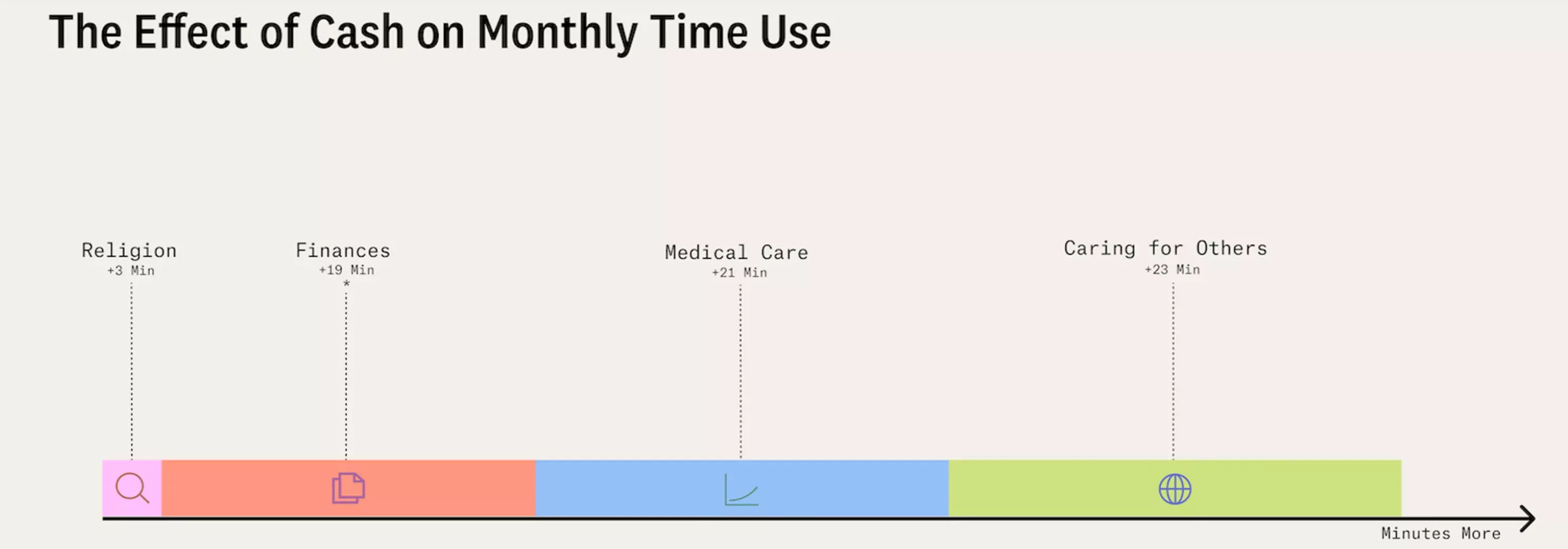
Interestingly, recipients were more selective when it came to choosing work: some chose lower-paid jobs for more independence or the opportunity to enter a certain industry. They were also more likely to start their own business.

The latest set of findings released this month show that recipients actually valued work more after receiving the monthly payments, challenging the long-held belief the UBI will lead to people not wanting to work. Stress, mental distress, and food insecurity also diminished in the first year, though the effects faded in the program's second and third years.

"Poverty and economic insecurity are incredibly difficult problems to solve," Rhodes said. "The findings that we've had thus far are quite nuanced."

"It [the project] reinforced to me the idea that these are really difficult problems that, maybe, there isn't a singular solution."

In May, Altman said that UBI could be supplanted by what he calls universal basic compute. "[E]verybody gets a slice of GPT-7's compute and they can use it, they can resell it, they can donate it to somebody to use for cancer research," Altman suggested.

One of the many big names in the tech world that support UBI is Geoffrey Hinton, one of the Godfathers of AI. He said these programs are a necessity in the face of AI-related job losses. On the other side of the coin, Dario Amodei, CEO of AI startup Anthropic, thinks UBI won't be enough to address the problem.

Permalink to story:

 
The issue is that years of privatized health care and rampant real estate speculation is skewing the effectiveness of patchwork solutions like UBI: you'd need to establish universal health care and nation wide rent control first to lower the floor and yes, this will cause deceleration of the economy because that's what it takes to truly redistribute wealth: there is no point in trying to level the playing field if the wealthy have over 100 years of a head start there's never going to be any way for regular people to afford housing until public housing and rent control are enforced at the expense of current speculators. Similar story with health care just less years but perhaps even more severe speculation.

The worst part is that the wealthy like Altman (Not him personally but similarly wealthy people) will use this study to say we should to *nothing* at all to address income disparity and then just demand even more policing to avoid the Luigis that are definitively coming.
 
and yes, this will cause deceleration of the economy because that's what it takes to truly redistribute wealth.
Fatuous, wrong-headed wealth redistribution schemes have been responsible for more human death and misery in the last century than WWI and WWII both combined.

Nothing better expresses the Left's childlike ignorance on this than a nation-ranking metric they created: the so-called Gini Index, which considers a nation in which everyone is dirt-poor to be superior to one in which few are poor, but most are wealthy. By their absurd Gini ranking, Ethiopia, Myanmar, and Turkmenistan are among the best places to live on Earth, while the US is sheer hell.
 
They thought $1000 a month was going to be enough to make up for losing your career to AI? $1000 a month is poverty-level. You can't live on that.

The $1000/mo becomes your income floor.

So if you're already making $5/hr or $10,000/yr you're now at $22,000/yr.

Since minimum wage is $7.5/hr (?) adding ubi to it would put at $25,000/yr.

Still not great but a single person might be able to live on that.

Truthfully I'm on the side that minimum wage should be linked to inflation, and that the inflation should start in 1970.

And to quote google:
U.S. minimum wage: real and nominal value 1938-2024 Although the real dollar minimum wage in 1970 was only 1.60 U.S. dollars, when expressed in nominal 2024 dollars this increases to 13.05 U.S. dollars. This is a significant difference from the federal minimum wage in 2024 of 7.25 U.S. dollars.
 
The $1000/mo becomes your income floor.

So if you're already making $5/hr or $10,000/yr you're now at $22,000/yr.

Since minimum wage is $7.5/hr (?) adding ubi to it would put at $25,000/yr.

Still not great but a single person might be able to live on that.

Truthfully I'm on the side that minimum wage should be linked to inflation, and that the inflation should start in 1970.

And to quote google:
U.S. minimum wage: real and nominal value 1938-2024 Although the real dollar minimum wage in 1970 was only 1.60 U.S. dollars, when expressed in nominal 2024 dollars this increases to 13.05 U.S. dollars. This is a significant difference from the federal minimum wage in 2024 of 7.25 U.S. dollars.

I guess I was thinking longer-term, like AI replaces all jobs and they just give everyone $1,000 a month because there are no jobs anywhere you can earn any money at all. Personally, I don't want my career to be replaced by AI if it means I have to go work a minimum wage job instead. I don't think anyone would be happy about that. It sounds terrible. They can let the robots have those jobs too as far as I'm concerned.
 
The $1000/mo becomes your income floor.

So if you're already making $5/hr or $10,000/yr you're now at $22,000/yr.

Since minimum wage is $7.5/hr (?) adding ubi to it would put at $25,000/yr.

Still not great but a single person might be able to live on that.

Truthfully I'm on the side that minimum wage should be linked to inflation, and that the inflation should start in 1970.

And to quote google:
U.S. minimum wage: real and nominal value 1938-2024 Although the real dollar minimum wage in 1970 was only 1.60 U.S. dollars, when expressed in nominal 2024 dollars this increases to 13.05 U.S. dollars. This is a significant difference from the federal minimum wage in 2024 of 7.25 U.S. dollars.

Linking minimum wage to inflation makes a lot of sense to me too. Same for social security and government pay like Army etc. Taxes go up with inflation automatically, so maybe those should too.
 
The $1000/mo becomes your income floor.

So if you're already making $5/hr or $10,000/yr you're now at $22,000/yr.

Since minimum wage is $7.5/hr (?) adding ubi to it would put at $25,000/yr.

Still not great but a single person might be able to live on that.

Truthfully I'm on the side that minimum wage should be linked to inflation, and that the inflation should start in 1970.

And to quote google:
U.S. minimum wage: real and nominal value 1938-2024 Although the real dollar minimum wage in 1970 was only 1.60 U.S. dollars, when expressed in nominal 2024 dollars this increases to 13.05 U.S. dollars. This is a significant difference from the federal minimum wage in 2024 of 7.25 U.S. dollars.
Raising the "floor" by $1000 just means that your baseline expenses raise up by $1000. It doesnt fix anything. If you give everyone $1000, you are merely devaluing your currency by $1000 per capita. Do that every month, and you end up with hyperinflation. The people with bad jobs or no jobs will continue to be in poverty, the only difference will be the cost of everything surges upwards.

A rising tide raises all ships, but your rowboat is no closer to being a yacht.
The issue is that years of privatized health care and rampant real estate speculation is skewing the effectiveness of patchwork solutions like UBI: you'd need to establish universal health care and nation wide rent control first to lower the floor and yes, this will cause deceleration of the economy because that's what it takes to truly redistribute wealth: there is no point in trying to level the playing field if the wealthy have over 100 years of a head start there's never going to be any way for regular people to afford housing until public housing and rent control are enforced at the expense of current speculators. Similar story with health care just less years but perhaps even more severe speculation.

The worst part is that the wealthy like Altman (Not him personally but similarly wealthy people) will use this study to say we should to *nothing* at all to address income disparity and then just demand even more policing to avoid the Luigis that are definitively coming.
It's always the people calling for wealth redistribution that dont understand that it is THEM who will get their wealth redistributed. Remember what happened when we all started getting stimulus money? Right, prices went through the roof, and it was the working class that got hit hardest from that. UBI has been tried, numerous times, in other countries. ones with socialized healthcare and rent control. It never worked.

Rent control doesnt work either. How many uber expensive cities have tried it now, only to see rents go UP? Basic supply and demand has always escaped the champagne socialists. If you make the supply *free*, you dramatically increase demand, and now your supply cannot keep up. This results in huge price increases. Someone must pay this.

When you "decelerate the economy", you are NOT "catching up" to the rich. You are shedding the poorest first, and the longer you decelerate, the more people get shed. The only way you shed the rich and powerful is if everyone else has already been dropped into the sludge of object poverty. Even then, those at the top remain there, because SOMEBODY has to run the systems in place. See also: the soviet union, Vietnam, any communist country.
 
Raising the "floor" by $1000 just means that your baseline expenses raise up by $1000. It doesnt fix anything. If you give everyone $1000, you are merely devaluing your currency by $1000 per capita. Do that every month, and you end up with hyperinflation. The people with bad jobs or no jobs will continue to be in poverty, the only difference will be the cost of everything surges upwards.

A rising tide raises all ships, but your rowboat is no closer to being a yacht.

It's always the people calling for wealth redistribution that dont understand that it is THEM who will get their wealth redistributed. Remember what happened when we all started getting stimulus money? Right, prices went through the roof, and it was the working class that got hit hardest from that. UBI has been tried, numerous times, in other countries. ones with socialized healthcare and rent control. It never worked.

Rent control doesnt work either. How many uber expensive cities have tried it now, only to see rents go UP? Basic supply and demand has always escaped the champagne socialists. If you make the supply *free*, you dramatically increase demand, and now your supply cannot keep up. This results in huge price increases. Someone must pay this.

When you "decelerate the economy", you are NOT "catching up" to the rich. You are shedding the poorest first, and the longer you decelerate, the more people get shed. The only way you shed the rich and powerful is if everyone else has already been dropped into the sludge of object poverty. Even then, those at the top remain there, because SOMEBODY has to run the systems in place. See also: the soviet union, Vietnam, any communist country.

To be fair, the inflation that we saw post 2021 wasn't solely due to the stimulus checks. It was primarily caused by pent up demand due to the lockdowns of 2020, massive supply shortages due to supply chain interferences, and the fact that many people aside from those who received stimulus checks not only were able to transition to working from home, but had increased savings due to the lockdowns and various factors that led to less spending during that time period. The people most hurt from the lockdowns were on the lower end of the income spectrum. Middle and upper-classes kept working, had very little to spend their money on since they couldn't do much outside the home, and once the vaccines dropped in Jan 2021 and lockdowns (especially in major cities) ended, you had a massive demand spike and spending spree from those that kept working, and those who received stimulus checks.

In fact, the amount directed towards individuals and families versus businesses was roughly the same: $1.8 trillion to $1.7 trillion. In fact, the PPP and the total amount dispered via stimulus checks are also remarkably similar: between $800 - $900 billion for each. So, in reality, much of the inflationary pressure was due on the business-side of things. People making six figures were, by and large, ineligible for stimulus checks, yet they were the people most likely to have jobs deemed essentially or able to be completed from home. The inflationary pressure, if looking solely at individuals, are on that end of the income/salary/wealth spectrum (which is most easily seen in the massive increase in housing/rental costs in many metro and suburban areas of the country).

I'm not disagreeing with you in totality; you're certainly right on the substantive points. However, focusing on stimulus checks as the cause of the post-2020 inflation spike misses the mark. It was A cause, not THE cause.
 
Fatuous, wrong-headed wealth redistribution schemes have been responsible for more human death and misery in the last century than WWI and WWII both combined.

Nothing better expresses the Left's childlike ignorance on this than a nation-ranking metric they created: the so-called Gini Index, which considers a nation in which everyone is dirt-poor to be superior to one in which few are poor, but most are wealthy. By their absurd Gini ranking, Ethiopia, Myanmar, and Turkmenistan are among the best places to live on Earth, while the US is sheer hell.
The US is hell compared to most places on this Earth
 
Raising the "floor" by $1000 just means that your baseline expenses raise up by $1000. It doesnt fix anything. If you give everyone $1000, you are merely devaluing your currency by $1000 per capita. Do that every month, and you end up with hyperinflation. The people with bad jobs or no jobs will continue to be in poverty, the only difference will be the cost of everything surges upwards.

A rising tide raises all ships, but your rowboat is no closer to being a yacht.

So you're saying everyone who is on Social Security, disability, wic, food stamps, etc contribute to inflation? hmm.... not quite.

Inflation has multiple sources.

Every time you buy something with credit such as a house, car, or use your credit card you are contributing to inflation because money is created out of thin air. (fiat currency, hello!?)

When you pay these same balances off you destroy the money you originally created by getting the loan.

While you are correct that a rising tide lifts all boats, you're also not seeing some things:

Being poor is EXPENSIVE.
This money is again adjusts the FLOOR for the poor not for everyone.

Giving people a minimum income gives them a chance to get out of the situation they are in as noted in the article. Some people were able to get better jobs, others were able to start businesses etc.

And in the end I feel raising the minimum wage to be more inline with inflation would be the better way to go. Will contribute to inflation? yes it will more money in the economy, but with more money in the economy businesses will have a larger market and more cash on hand.
In the end everyone would see a boost to their income not just the poor.
 
UBI is simply a new fancy title for Welfare which has failed, failed, and failed every time it has been tried.

Universal Basic Compute is the most ridiculous idea ever that only people completely convinced of AI’s hype won’t just burst out laughing when pitched like a real solution.
 
To be fair, the inflation that we saw post 2021 wasn't solely due to the stimulus checks. It was primarily caused by pent up demand due to the lockdowns of 2020, massive supply shortages due to supply chain interferences, and the fact that many people aside from those who received stimulus checks not only were able to transition to working from home, but had increased savings due to the lockdowns and various factors that led to less spending during that time period. The people most hurt from the lockdowns were on the lower end of the income spectrum. Middle and upper-classes kept working, had very little to spend their money on since they couldn't do much outside the home, and once the vaccines dropped in Jan 2021 and lockdowns (especially in major cities) ended, you had a massive demand spike and spending spree from those that kept working, and those who received stimulus checks.

In fact, the amount directed towards individuals and families versus businesses was roughly the same: $1.8 trillion to $1.7 trillion. In fact, the PPP and the total amount dispered via stimulus checks are also remarkably similar: between $800 - $900 billion for each. So, in reality, much of the inflationary pressure was due on the business-side of things. People making six figures were, by and large, ineligible for stimulus checks, yet they were the people most likely to have jobs deemed essentially or able to be completed from home. The inflationary pressure, if looking solely at individuals, are on that end of the income/salary/wealth spectrum (which is most easily seen in the massive increase in housing/rental costs in many metro and suburban areas of the country).

I'm not disagreeing with you in totality; you're certainly right on the substantive points. However, focusing on stimulus checks as the cause of the post-2020 inflation spike misses the mark. It was A cause, not THE cause.
But the stimulus checks also paid businesses to retain employees!

Those 60k to 100k salaried employees got their salaries covered by the PPP program. So while they didn't get a direct stimulus check, they basically got paid to work from home (which meant they were contributing less to the economy through spending).

This caused savings to increase and then they spent these savings at the end of the pandemic leading to inflationary pressures when combined with the supply chain issues.

Btw I'm not arguing against the stimulus package as it possibly prevented us from spiralling into a more severe recession. I also think the US economy can handle a certain amount of inflation.

For me, the main problem with the current wealth gap is the perception that the bottom 99% have that they are *owed* more. This perception is more dangerous than the fact.
 
The issue is that years of privatized health care and rampant real estate speculation is skewing the effectiveness of patchwork solutions like UBI: you'd need to establish universal health care and nation wide rent control first to lower the floor and yes, this will cause deceleration of the economy because that's what it takes to truly redistribute wealth: there is no point in trying to level the playing field if the wealthy have over 100 years of a head start there's never going to be any way for regular people to afford housing until public housing and rent control are enforced at the expense of current speculators. Similar story with health care just less years but perhaps even more severe speculation.

The worst part is that the wealthy like Altman (Not him personally but similarly wealthy people) will use this study to say we should to *nothing* at all to address income disparity and then just demand even more policing to avoid the Luigis that are definitively coming.

So sad that Healthcare is among the top worries in the US - Most countries have free universal healthcare, shouldn't really be a question, it should be an "of course it's free".
I see benefits with this UIB trial - but the totals shouldn't be 1000 dollars, it should be closer to 2000 dollars and it should replace disability checks, unemployment checks etc. - That way the insane administration costs of those would vanish and they might actually end up not spending "that much more", it would also remove alot of anxiety and stress for people worried about their jobs. "Ok, so if I loose my job, I still have the basic income until I find something else, I'll make do".

Basic income checks could be handed out to anyone with less than 25k yearly income.
As it stands, I guess the US can't cover that cost, as the debt has passed like..34 trillion? But for other countries it could absolutely work

 
But the stimulus checks also paid businesses to retain employees!

Those 60k to 100k salaried employees got their salaries covered by the PPP program. So while they didn't get a direct stimulus check, they basically got paid to work from home (which meant they were contributing less to the economy through spending).

This caused savings to increase and then they spent these savings at the end of the pandemic leading to inflationary pressures when combined with the supply chain issues.

Btw I'm not arguing against the stimulus package as it possibly prevented us from spiralling into a more severe recession. I also think the US economy can handle a certain amount of inflation.

For me, the main problem with the current wealth gap is the perception that the bottom 99% have that they are *owed* more. This perception is more dangerous than the fact.
We're in agreement, don't worry.

I was merely pointing out the fact that when you say "stimulus checks", the majority of people are going to think about the direct payments to people, not the PPP or any subsidies directed towards businesses.

It was all inflationary (and, frankly, the business side was significantly more inflationary, but that's another discussion entirely), but I wasn't disagreeing with you on the substance.
 
UBI is simply a new fancy title for Welfare which has failed, failed, and failed every time it has been tried.

Universal Basic Compute is the most ridiculous idea ever that only people completely convinced of AI’s hype won’t just burst out laughing when pitched like a real solution.

Citation needed

Welfare has failed all times, every where er Ok
UBI has been tested before from memory in was it Finland, had interesting results

Lets hope all welfare is removed in USA , free health care , free education , free roads, parks, infrastructure - need user pay everywhere

No free pensions, unemployment, sickness, mental health

No free lawyers
Make charities and free help groups illegal
No free dentists for kids
No free prisons, prisoners who stole to survive with mental health problems , and no legal representation need to become slaves

Yeah make US of A great again , kick your kids out at 15

Europe , Australia, NZ and Japan are not happy , less stressful countries , they are lazy and must live longer in a suffering welfare states

So much BS spewed about , early days .
Lots of research also in the micro payments' to mothers in developing countries etc

All I see here is Dogma , close minded belief systems

No democracy is perfect - eg USA is judged poorly here, but it is what you have
No welfare system is perfect
No legal system is perfect
No EVs are perfect

yet lets just mindlessly keep throwing the baby out with the bath water

few of you are discussing the merits or cons, You are shoehorning your dogma and biases to rationalise it

This is another example that the the usual suspects promoting their dogma and political views

Never admit nothing
Never truly discuss from a position with honesty , it is always 100% outright attack

They can't even say it would be nice if UBI worked on some level but I think it fails 100%
ie they have no desire for it to work and be developed into a viable solution
 
The worst part is that the wealthy like Altman (Not him personally but similarly wealthy people) will use this study to say we should to *nothing* at all to address income disparity and then just demand even more policing to avoid the Luigis that are definitively coming.
One of the fears starting these things, the real fear, is possible mistakes resulting in terrible outcomes, specifically for the poorest, people whom these changes would be designed to help.
As an example, who got screwed the most by handouts during covid? The poorest, people who were helped. I will not argue it is true, but I heard one of the issues in 2008 housing crisis was giving people with really bad credit. As some people said, it would fix inequalities and allow people from minority groups to get a house easier. So, who were the first people who lost jobs and their newly acquired homes first? The ones being helped.

I think it is very possible that the mistakes bringing these changes to life could cause the damage that will result in people never trusting things such as UBI again. I am worried that people being helped will be screwed up again.
 
The US is hell compared to most places on this Earth
So when are you emigrating to the paradise of Ethiopia, with its near-perfect Gini index?

Yeah, I didn't think so.

So you're saying everyone who is on Social Security, disability, wic, food stamps, etc contribute to inflation?
No. He stated that creating money to pay for social engineering programs like UBI contributes to inflation.

Inflation has multiple sources.
Long-run inflation has only one cause: expansion of the money supply. As Nobel-prize winning economist says, "inflation is, always and everywhere, a monetary phenomenon".

... with more money in the economy businesses will have a larger market and more cash on hand.
In the end everyone would see a boost to their income not just the poor.
Adding money to the economy doesn't create more goods and services -- it simply creates more competition for those that already exist. That's inflation.
 
Last edited:
Unfortunately it is very hard to have a good discussion on such topics

It means people need to be arguing in good faith.
To be open and prepare to move their beliefs, or at less to more research

Also requires due diligence,
To discuss this in any detail you NEED to go and unless read some of the paper or research
Not saying case here but endless examples of media quoting research wrongly or even saying the complete opposite of what the research says, or that it is not applicable unless who are even remotely like those who were studied

I take a few supplements - creatine, Mg , B12, and not high doses. I am very conservative and always subject to new evidence = eg don't take B6 as some downsides, and upside can be taken care of by diet and other stuff

I thing UBI is a topic du jour, as world changes. High inequalities and wealth distributions is related to negative outcomes. Not saying this is the solution, but is worthy of further research

here is an example of someone doing a wonderful job analysing a head line
that seed oils increase colon cancer


This is very high discussion of the research, and was very informative over and about a headline and brief article

Note most scientific papers have some form of error

 
Lets hope all welfare is removed in USA , free health care , free education , free roads, parks, infrastructure - need user pay everywhere ... Make charities and free help groups illegal.
Anyone who considers roads and parks "welfare" is beyond rational debate. As for the idea that anyone is advocating to illegalize voluntary charity, that's simply absurd.

They can't even say it would be nice if UBI worked on some level but I think it fails 100%
It would be nice if UBI worked, just as it would be nice if unicorns and rainbow candy fountains existed. Rational people know otherwise.

To be more specific, societies can afford a certain degree of deadweight loss. Compared to, say, the Medieval Era, we can afford much more. Our higher level of prosperity is the **only** reason we have a more comprehensive social safety net .... not because we have somehow 'progressed' ethically. AI means more prosperity for all, which inevitably will mean more social services for those who don't contribute to society.
 
But the stimulus checks also paid businesses to retain employees!

Those 60k to 100k salaried employees got their salaries covered by the PPP program. So while they didn't get a direct stimulus check, they basically got paid to work from home (which meant they were contributing less to the economy through spending).

This caused savings to increase and then they spent these savings at the end of the pandemic leading to inflationary pressures when combined with the supply chain issues.

Btw I'm not arguing against the stimulus package as it possibly prevented us from spiralling into a more severe recession. I also think the US economy can handle a certain amount of inflation.

For me, the main problem with the current wealth gap is the perception that the bottom 99% have that they are *owed* more. This perception is more dangerous than the fact.
The 99% are in a rigged system tailored to maximise profit for the 1%. Radical reforms are needed and soon. At the moment certain factions are selling the idea that the bottom 1% of illegal immigrants and the poor are the problem. They managed to win most of the western world with these ideas...only issue is they won't deliver anything... because they are lying. The real reason why the world doesn't work is that we play a game of monopoly with the hoover of the 1% sucking the houses, hotels and bank notes out of the game.
 
The economy comprises numerous constantly fluctuating variables (we could describe it as a chaotic system, with instances where it can reach an unstable balance). Therefore, it is challenging to justify a static macro-change (such as basic income) in a dynamic system. Nevertheless, let's attempt to view the economy from a more abstract perspective.

Economy is the sum of transactions—exchanges, either through the use of money as an intermediary or directly by trading goods and services. Through their intelligence, humans control and transform raw materials (which represent energy) to meet their needs and survive. Money, in essence, expresses social energy, while goods embody physical energy. Despite humans often perceiving themselves as significant, the most crucial aspect of the economy relies on physical energy and its accessibility. For instance, to produce fertilizers for fertile soil, fuels must be consumed to facilitate the chemical reaction that creates fertilizers. Energy is required to move anything, etc. Therefore, 80% of the economy is about joules, not dollars.

For a human to survive with dignity, they need a minimum of shelter, water, food, electricity, clothing, internet and a car. Thus, the social contract implies that individuals should utilize their intelligence and time to transform raw materials (they represent physical energy, ex metal is energy from a star in which was fused) into products that cater to vital needs, ensuring everyone's survival through mutual aid. However, we now have access to synthetic intelligence. So, if there is sufficient physical energy, there is no reason why synthetic intelligence cannot take on this role and humans should not be under the pressure of dedicating all their time and intelligence to product creation for survival. The counterargument might be that this is unfair to others. But the distribution of rewards is also unfair. Because when a job requires little specialization, the compensation decreases. For example, someone producing food or working in a power plant earns significantly less than a football player, basketball player, or singer, even though being without food or electricity is much worse than not attending a sports event. There aren’t always demand for the available human skills in the area, so someone who has an expertise on something cannot contribute even if he wants. Furthermore, people constantly facing survival threats tend to behave more aggressively, especially towards those who are more successful.

I have a theory that a society is as happy as its prisoners in it’s jails.
 
Fatuous, wrong-headed wealth redistribution schemes have been responsible for more human death and misery in the last century than WWI and WWII both combined.

Nothing better expresses the Left's childlike ignorance on this than a nation-ranking metric they created: the so-called Gini Index, which considers a nation in which everyone is dirt-poor to be superior to one in which few are poor, but most are wealthy. By their absurd Gini ranking, Ethiopia, Myanmar, and Turkmenistan are among the best places to live on Earth, while the US is sheer hell.
Interesting strawman, this interpretation of the Gini. What about the Nordics, Baltics, the Benelux, Israel?
 
Interesting strawman, this interpretation of the Gini. What about the Nordics, Baltics, the Benelux, Israel?
It's the definition of the Gini Index, not an interpretation of it. And I'm glad you asked about those other nations. The Nordic Countries score rather high -- though lower than consumer paradises like Moldava, Belarus, Slovenia and Ukraine -- but the the Baltics are near the bottom of the list.

The Gini Index equates universal poverty with utopia. When China was a nation of a billion agrarian peasants, all laboring in the sun 18 hours a day, it scored near perfect. Leftist utopia.
 
Back