Samsung is building floating data centers on ships, and it's already got regulatory approval

Alfonso Maruccia

Posts: 2,576   +957
Staff
Does AI Float?: The need for massive infrastructure to store digital data is growing, so tech giants are trying some novel approaches. Samsung's shipbuilding division, for example, would like to move AI data centers away from the mainland and out to sea.
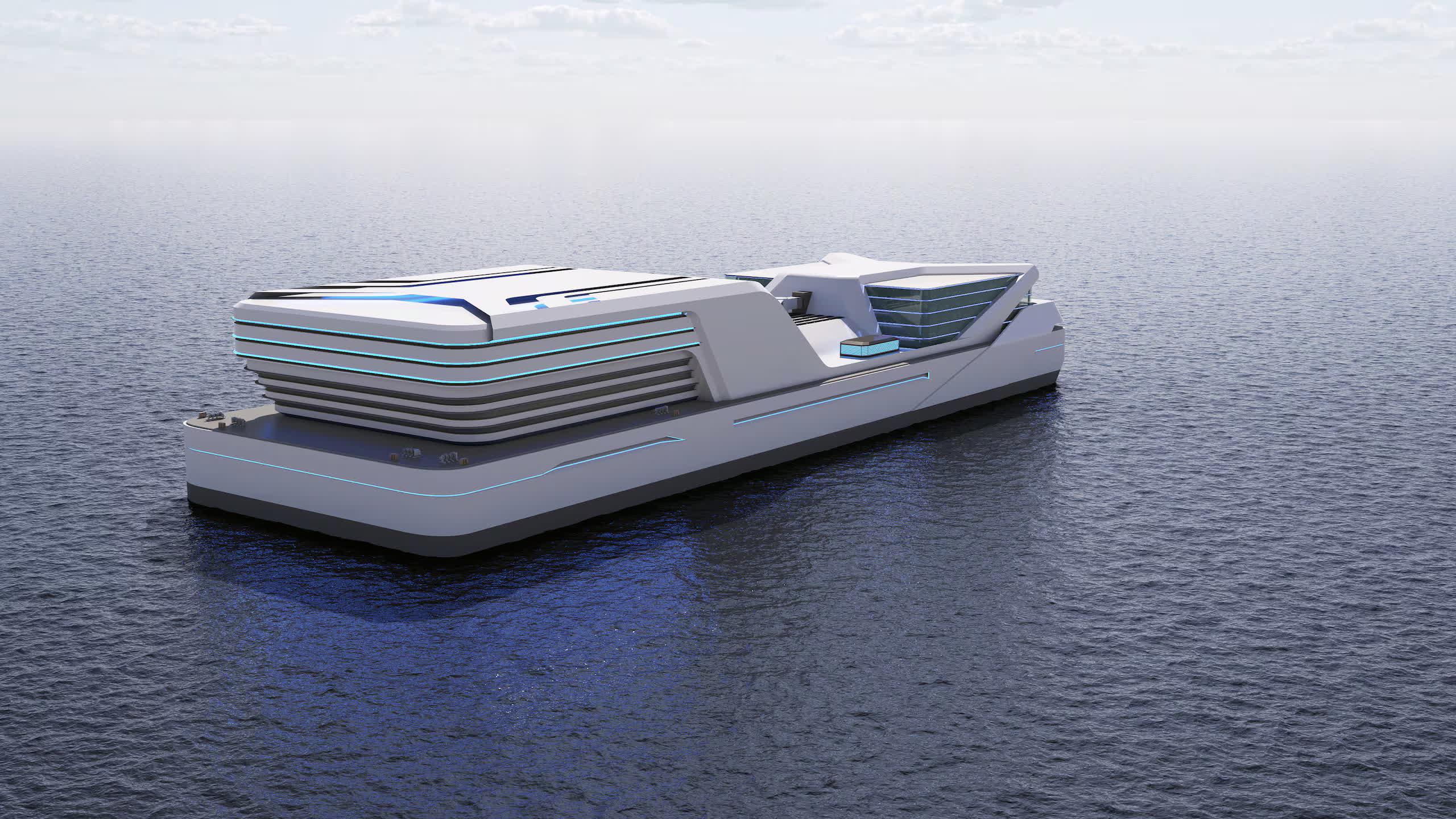
Hitachi recently announced a partnership with Mitsui O.S.K. Lines to develop floating systems to host self-sustaining AI data center facilities. Now, Samsung Heavy Industries is cooperating with different partners to fully develop its novel Floating Data Centers (FDC) concept. Samsung Heavy Industries is a South Korean shipbuilding company that's part of the wider Samsung Group conglomerate.

While Hitachi is working with Mitsui to convert existing vessels into "refurbished" data center plants, Samsung HI is doing something different. The Korean corporation recently signed an agreement with Capital Clean Energy Carriers, a Greece-based shipowner, to develop new data-ready vessels from scratch.

Samsung HI Executive Vice-President and CTO Young-kyu Ahn previously stated that FDCs are a new business model that brings shipbuilding capabilities and digital infrastructure together. Samsung has already developed its 50MW-class FDC model, which could run on both a self-generating power system and an external power source coming from the mainland.
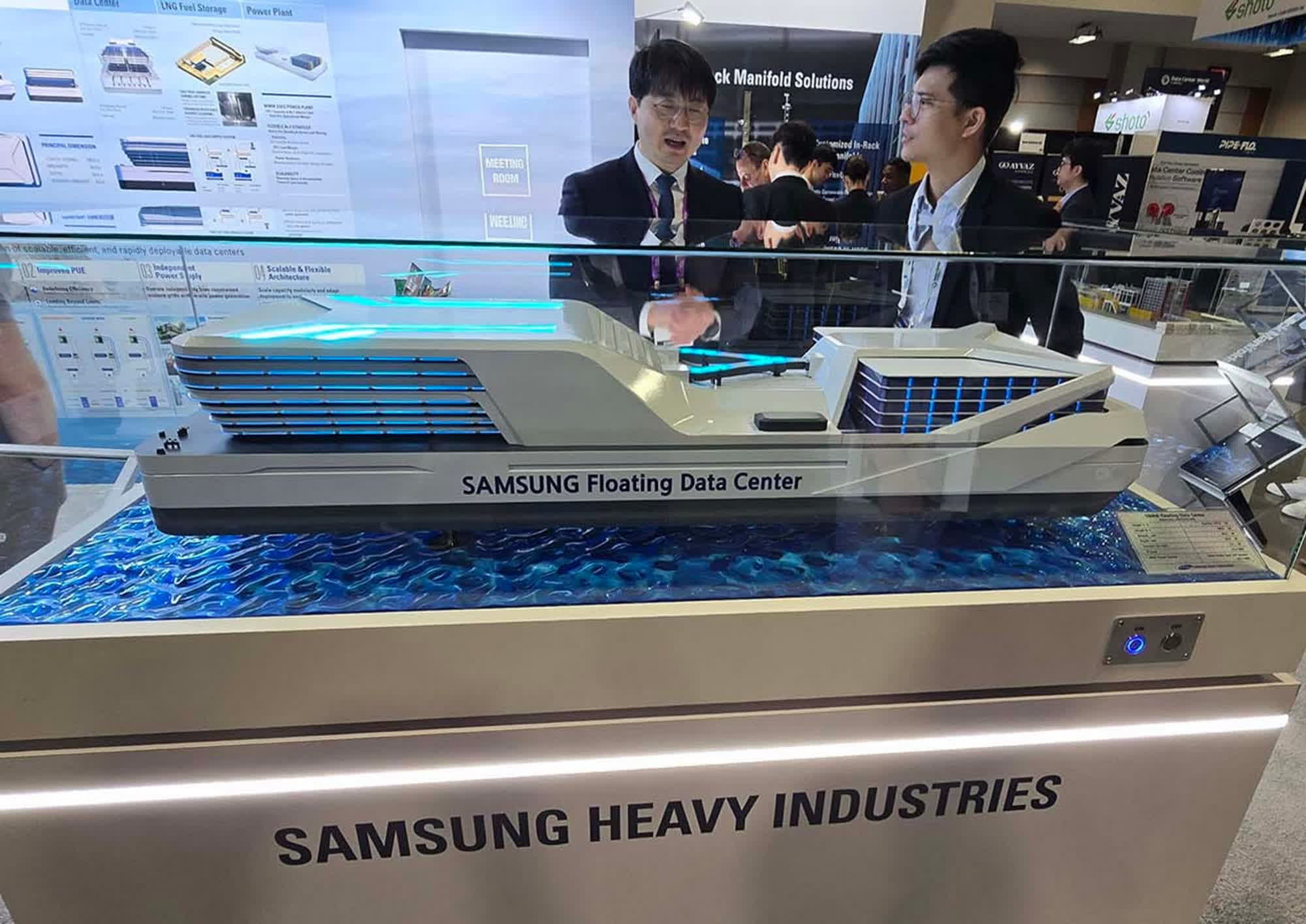
Samsung's 50MW FDC concept design has already been approved by the American Bureau of Shipping and Lloyd's Register, but the job is not done yet. Together with Capital Clean Energy, the Asian giant is now looking to fully validate its concept with real-world prototypes. The partnership is instrumental in checking for potential issues with the FDC design, looking for reliability problems with the data-related workloads, humidity or salinity damage, vibration, and more.

Turning a data center operation into a seafaring vessel is no easy feat, which is why Samsung previously signed an agreement with Supermicro to develop new server setups. At any rate, Samsung HI is investing significant energy in this new FDC idea.

A few weeks ago, the company signed yet another agreement with US venture Mousterian Corporation. The Dallas-based specializes in developing floating and "water-adjacent" data center infrastructure, which is a core concept behind the FDC design.

According to Mousterian CEO Min Suh, the partnership with an established shipbuilding business such as Samsung HI serves as a clear demonstration of the business viability of floating data center designs. A few months ago, Samsung signed an agreement with OpenAI to greatly expand AI data center capacity around the world. If the FDC model works, some of these facilities might not be on land.

Permalink to story:

 
I'm not a big environment guy, but this seems like one of those things that will create a massive algae bloom or similar unforeseen consequence of dumping massive amount of heat into the ocean.
 
Floating data centers will rely more on satellite for communication like Starkink and the like. Although Starlink also want to have flying data centers in space as well.
 
I'm not a big environment guy, but this seems like one of those things that will create a massive algae bloom or similar unforeseen consequence of dumping massive amount of heat into the ocean.
Yeah also coral bleaching, noise pollution, Biofouling and Coatings ( potential leaking of chemicals that prevent algae and corrosion). When it comes to ai big government will often look the other way as long as their personal self inrests and investments are solid. The data center in the ocean takes away focus locally and makes the problem elsewhere. Hocus pocus!
 
I'm not a big environment guy, but this seems like one of those things that will create a massive algae bloom or similar unforeseen consequence of dumping massive amount of heat into the ocean.
LOL, what? The earth's oceans are continually receiving some 85 quadrillion watts of heat from the sun, or 85B megawatts. These datacenters are 50MW class -- we could build 10,000 of them a year for centuries and not appreciably raise ocean temperatures.

Yeah also coral bleaching, noise pollution, Biofouling and Coatings ( potential leaking of chemicals that prevent algae and corrosion). When it comes to ai big government will often look the other way
See above. Why can't people learn math?
 
LOL, what? The earth's oceans are continually receiving some 85 quadrillion watts of heat from the sun, or 85B megawatts. These datacenters are 50MW class -- we could build 10,000 of them a year for centuries and not appreciably raise ocean temperatures.


See above. Why can't people learn math?
Interesting, Although in nature plants use that energy to convert into glucose which then gets eaten by local microbes and animals. I wonder how The energy from data centers gets absorbed? My guess is that local underwater bioomes may be affected not by indirectly from ozone as you speak of but local delta warming directly bleaching the corals locally.
Why can't people learn science! 🙃

Who needs wild caught when you can get farm raised.
 
Last edited:
I wonder how The energy from data centers gets absorbed? My guess is that local underwater bioomes may be affected not by indirectly from ozone as you speak of but local delta warming directly bleaching the corals locally.
Why can't people learn science! 🙃
Snark is no substitute for facts. The amount of additional energy from these centers is a fraction of a billionth of a percent. Your statement is akin to claiming I'll overflow the earth's oceans by tossing a pebble into it at my local beach.
 
If we have to have data centres somewhere, it would seem sensible to stick them in the sea. The sea heating they generate would be so tiny as to be insignificant. What won't be insignificant unfortunately is the massive amount energy they consume and greenhouse gases they then pump into the air. All so a few very unpleasant people can get very rich while they make everybody else's life a misery.
 
Snark is no substitute for facts. The amount of additional energy from these centers is a fraction of a billionth of a percent. Your statement is akin to claiming I'll overflow the earth's oceans by tossing a pebble into it at my local beach.
Even the math wizards know that the summation of pebbles add up unless you are bias math wizard just says everyone should learn the bias math.
 
This solution has many obvious disadvantages, but not a single obvious advantage.
What am I missing?
 
Snark is no substitute for facts. The amount of additional energy from these centers is a fraction of a billionth of a percent. Your statement is akin to claiming I'll overflow the earth's oceans by tossing a pebble into it at my local beach.

- While a lot of hand-wringing over data centers is certainly the result of good business (for news outlets) rather than good sense, simply averaging across the surface of the Earth when we actually care about localized climate where people/animals/plants actually live isn't inherently a sound argument either.

Anyone who has experienced the heat island effect in a city isn't going to care what global average temperatures are, for example.

Like any rapidly developing technology, people's opinions on the issue outpace any actual science or understanding.
 
All so a few very unpleasant people can get very rich while they make everybody else's life a misery.
The world economy runs on data. It's the ultimate irony that you're posting these inanities on a web forum that itself requires a cloud datacenter ... not to mention almost certainly consuming countless other online comerce, gaming services, and others that utilize datacenters.

simply averaging across the surface of the Earth when we actually care about localized climate where people/animals/plants actually live isn't inherently a sound argument either.

Anyone who has experienced the heat island effect in a city isn't going to care what global average temperatures are, for example.
Oops! Ocean water dissipates heat more than 3,000X faster than does air. You also forgot that heat islands exist because of the gargantuan amounts of heat from the sun -- at noon, for instance, NYC is receiving some 1.2 billion kilowatts of solar heat.

Cities don't have heat islands from local power consumption, but because materials like asphalt and concrete retain the sun's far larger energy contribution.
 
Don't worry guys, the datacenter can no longer damge the environment because it's been towed outside the environment.
 
Even the math wizards know that the summation of pebbles add up unless you are bias math wizard just says [sic] everyone should learn the bias math.
Wrong again. In a static analysis, then yes, if you tossed pebbles into the ocean one by one, in a few billion years you'd overflow the earth's oceans. Dynamically, however, tectonic effects dwarf this contribution no matter what time frame one considers.

Similarly, adding a tiny amount of heat to the ocean will *never* change its temperature, because it's not only receiving a trillion times as much solar energy, but also radiating a trillion times as much back into space. The equilibrium between these two rates is based on temperature ... raise it even a trivial percent of one degree, and it results in an enormous increase of energy radiating into space.
 
Oops! Ocean water dissipates heat more than 3,000X faster than does air. You also forgot that heat islands exist because of the gargantuan amounts of heat from the sun -- at noon, for instance, NYC is receiving some 1.2 billion kilowatts of solar heat.

Cities don't have heat islands from local power consumption, but because materials like asphalt and concrete retain the sun's far larger energy contribution.

- I know we have some combative dialogue in the past but this isn't it chief.

You're getting too fixated on the example itself and missing the broader concept that humans can and do have effects on localized climate regardless of their effect on global climate.

Prior small very small scale oceanic data center projects have had a minor localized impact on water temperature, especially if the data center was placed in a coastal region with relatively poor water circulation. AI based data centers are orders of magnitude larger and more power hungry than prior proof of concept sea based data centers and will undoubtedly be clustered together close to shore for ease of access/maintenance.

It's really is a topic that warrants further investigation. We haven't even gotten to coastal communities taking issue with a potentially ruined horizon they way they do with wind turbines or oil derricks.
 
Prior small very small scale oceanic data center projects have had a minor localized impact on water temperature, especially if the data center was placed in a coastal region with relatively poor water circulation.
Please cite one of these imaginary studies that shows a far smaller datacenter causes any actual negative effects. Just one.

I myself have read several such studies, all of which concluded the same: "we didn't see any negative effects, but 'uncertainty remains'". Across several thousand peer-reviewed studies, both in climate science and elsewhere, I have yet to read one which doesn't include such an escape clause.

A previous project I saw released heated water only 1.5C above ambient into the ocean -- into an ocean that already varies from 0C to 35C naturally. And even that 1.5C remains in a tiny bubble around the center itself, dissipating mere meters away.

It's really is a topic that warrants further investigation.
Keep investigating till the sun goes out. In the meantime, stop pretending such effects exist.
 
Last edited:
Please cite one of these imaginary studies that shows a far smaller datacenter causes any actual negative effects. Just one.
- In all honesty its actually extremely difficult to find any scientific literature on this topic at all. Everything I have read has come from second hand reporting, which as well all know is extremely unreliable. Ironically much of it gleaned from using, you guessed it, AI.

Likely made more complicated by the very limited practical deployment of these data centers, or the deployments happening in China, or that there is so much *money* behind AI and datacenters that there could be an active attempt to control the narrative surrounding any of these deployments.

I myself have read several such studies, all of which concluded the same: "we didn't see any negative effects, but 'uncertainty remains'". Across several thousand peer-reviewed studies, both in climate science and elsewhere, I have yet to read one which doesn't include such an escape clause.
- Fantastic, then you should be a prime source for scientific literature. If you can point me to some good links on the topic, I'd be happy to read them.

A previous project I saw released heated water only 1.5C above ambient into the ocean -- into an ocean that already varies from 0C to 35C naturally. And even that 1.5C remains in a tiny bubble around the center itself, dissipating mere meters away.
- Great, can you provide me literature on this? I am not married to any kind of personal dogma on this topic, I'm open to changing my mind, but I need more than "global averages" and "trust me bro".

Keep investigating till the sun goes out. In the meantime, stop pretending such effects exist.
- Indeed. Never stop learning, never stop questioning dogma, and never stop using your own logical brain in the face of "science" that silences criticism through claims of authority over evidence. I'm glad that on this at least we agree.
 
LOL, what? The earth's oceans are continually receiving some 85 quadrillion watts of heat from the sun, or 85B megawatts. These datacenters are 50MW class -- we could build 10,000 of them a year for centuries and not appreciably raise ocean temperatures.


See above. Why can't people learn math?


Most people have no real understanding of Insolation and its effect on climate change.

Most people have no real understanding of Earth's interior, geothermal energy or just about anything else having to do with science.

I once got into an argument with a "master mechanic" about perpetual energy for EV. He really thought that cars could create their own power. I tried to explain regenerative braking and he flat out dismissed me. Some people have no idea about the laws of thermodynamics.
 
I'm not a big environment guy, but this seems like one of those things that will create a massive algae bloom or similar unforeseen consequence of dumping massive amount of heat into the ocean.

I get where you're coming from about algal blooms, jellyfish population explosions and other thermal pollution related issues, but the reality is the Earth absorbs far more energy from the sun on a per-second basis than humans could ever create in their entire lifetime. The oceans do offer passive cold water cooling and care would be taken to prevent leaks.
 
Snark is no substitute for facts. The amount of additional energy from these centers is a fraction of a billionth of a percent. Your statement is akin to claiming I'll overflow the earth's oceans by tossing a pebble into it at my local beach.
"Snark". Rather ironic. The pot calling the kettle black. .......That is to say: "ooops."
 
Because they've been told math is hard. ;) 🤣
I only got an A in Calculus, Kinetics ( adding Calculus to Medicine ) as well as Statistics. Although that was 2 decades ago. I might be a bit rusty lol. I conclude this as a potential outliers and needs more studies. Although one might ask how top heavy in data center portfolio via conflict of interest. Math doesn't teach us to ask those questions either. 😎
 
... there is so much *money* behind AI and datacenters that there could be an active attempt to control the narrative surrounding any of these deployments.
You mean like the Chinese government funding anti-AI groups and propaganda in the US, while they subsidize their own AI buildout to the tune of hundreds of billions of dollar per year?

- Great, can you provide me literature on this? I am not married to any kind of personal dogma on this topic

Note: there's a large difference between a center (or a power plant) that vents heat into a river or enclosed body of water, vs. one which does so into the near-infinite heat sink of the earth's oceans.
 
Back