Samsung reveals Exynos 2600: world's first 2nm smartphone chip could supercharge Galaxy S26

midian182

Posts: 11,746   +178
Staff member
What just happened? Samsung has announced the Exynos 2600, the first-ever smartphone SoC built on the 2nm GAA (Gate-All-Around) manufacturing process. The chip is set to arrive next year, powering at least some Galaxy S26-series handsets. Samsung promises that its next-gen SoC will introduce better performance, thermals, and support for cameras up to 320MP.
The Exynos 2600, manufactured by Samsung Foundry, features a 10-core configuration based on Arm's v9.3 architecture. It uses the new C1-Ultra (prime) and C1-Pro (middle) cores – Samsung has dropped the low-power cores in this Exynos model.
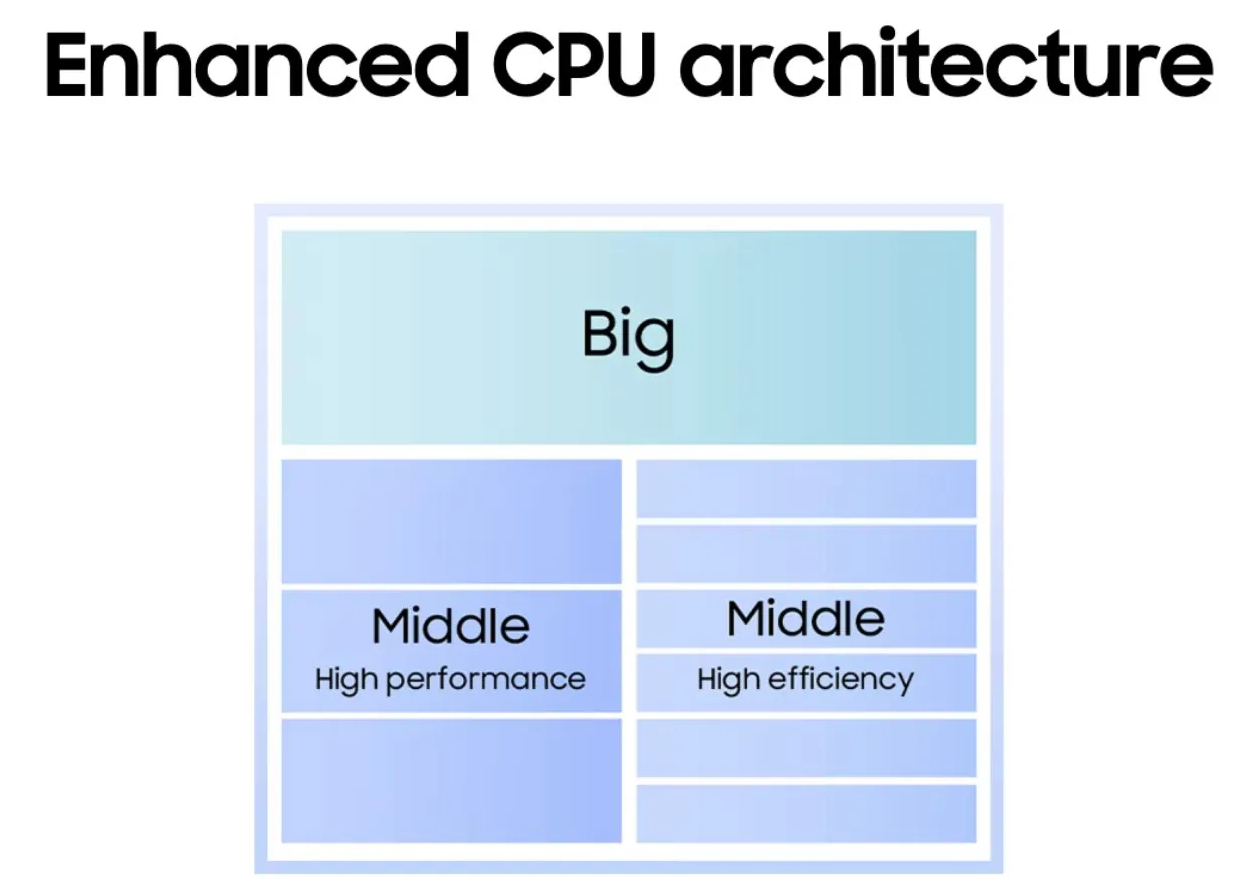
The CPU configuration consists of a single Arm C1-Ultra prime core clocked at around 3.8GHz, supported by three C1-Pro performance-focused middle cores running at approximately 3.25GHz, alongside six C1-Pro efficiency-tuned middle cores operating at roughly 2.75GHz.

Samsung says the design aims to improve overall CPU performance by up to 39%. Support for Arm's SME2 instructions promises enhanced on-CPU machine learning capabilities compared to its predecessor, along with reduced latency for AI features. With the enhanced NPU, generative artificial intelligence processing performance has been also been improved by up to 113%.

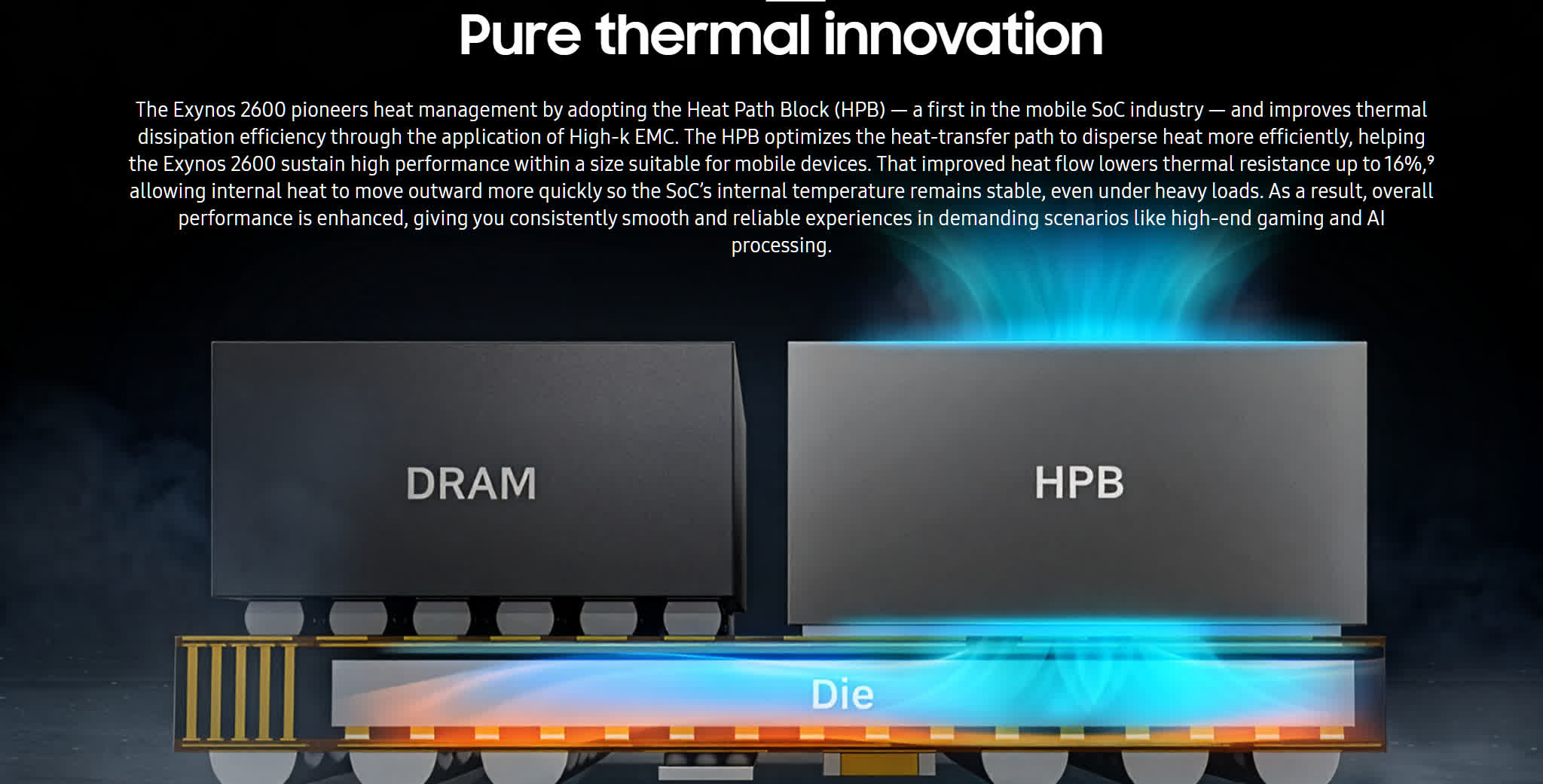
When it comes to thermal management, Samsung has added a Heat Path Block to the Exynos 2600 – the first time it has done so in a mobile chip. This reduces thermal resistance by up to 16% and helps maintain more stable internal temperatures under heavy workloads.
Graphics-wise, the chip features the Xclipse 960 GPU. It offers twice the computing performance as its predecessor, resulting in a ray-tracing performance increase of 50%, according to the maker.

Another graphics feature is the Exynos Neural Super Sampling technology that offers upscaling and frame generation abilities. Samsung says games "feel" three times smoother with this technology enabled, which seems more honest than Nvidia's claims about frame generation.

Photography gets an upgrade in the Exynos 2600. The chip's integrated ISP supports cameras up to 320MP and enables zero shutter lag for 108MP shots. There's also 8K recording at 30fps and 4K at up to 120fps with HDR, and support for Samsung's APV codec, which improves detail and color precision.

There are also AI camera elements, including an AI-based Visual Perception System (VPS) that allows the ISP to recognize a variety of detailed elements and process them in real-time, and deep learning Video Noise Reduction (DVNR) for enhancing video quality in low-light conditions.

The Galaxy S26 series is set to be unveiled at the Galaxy Unpacked 2026 event at the end of February.

Permalink to story:

 
More lies, or?

Samsung 2nm is probably on par with TSMC 5nm, if not 7nm.

RTX 3000 series were made on Samsung 8nm. Sounded nice, as AMD was using TSMC 7nm. Close right? The only problem, was that Samsung 8nm is a renamed 10nm node, which was pretty much on par with TSMC 12nm.

This was the reason RTX 3000 series and especially 3080 and 3090 series uses massive amounts of power, and undervolting is almost a must do. 3090 Ti especially was off the charts in terms of powerdraw.

3060 and 3070 series did way better overall, in terms of performance per watt but Samsung 8nm was never a good process, hence the low price.

Nvidia did the right thing tho, because TSMC was heavily overbooked back then and Nvidia maximized the GPU output, especially when coming back to TSMC with RTX 4000 series on 4N/5nm while still making 3000 series at Samsung.

Nvidia fixed the power usage, when going back to TSMC with 4000/5000 series.
TSMC is simply vastly better than Samsung and you can't just compare them on nanometer claims and numbers.

So I don't give much for this "2nm" process until it has been compared in depth with both TSMC 2-3nm and Intel 18A/14A, powerdraw, clockspeed and performance per watt is the true metric. Output even (or yields).

Nanometer has become a marketing term. Has been for years.
 
Last edited:
Funny how Samsung keeps pushing Exynos on North American markets while they sell Snapdragon chips to everyone else. Samsung can take their Exnos garbage and shove it up their you know what. Frankly, I would never buy any chip made by Samsung, but that's just me.
 
More lies, or?

Samsung 2nm is probably on par with TSMC 5nm, if not 7nm.

RTX 3000 series were made on Samsung 8nm. Sounded nice, as AMD was using TSMC 7nm. Close right? The only problem, was that Samsung 8nm is a renamed 10nm node, which was pretty much on par with TSMC 12nm.

This was the reason RTX 3000 series and especially 3080 and 3090 series uses massive amounts of power, and undervolting is almost a must do. 3090 Ti especially was off the charts in terms of powerdraw.

3060 and 3070 series did way better overall, in terms of performance per watt but Samsung 8nm was never a good process, hence the low price.

Nvidia did the right thing tho, because TSMC was heavily overbooked back then and Nvidia maximized the GPU output, especially when coming back to TSMC with RTX 4000 series on 4N/5nm while still making 3000 series at Samsung.

Nvidia fixed the power usage, when going back to TSMC with 4000/5000 series.
TSMC is simply vastly better than Samsung and you can't just compare them on nanometer claims and numbers.

So I don't give much for this "2nm" process until it has been compared in depth with both TSMC 2-3nm and Intel 18A/14A, powerdraw, clockspeed and performance per watt is the true metric. Output even (or yields).

Nanometer has become a marketing term. Has been for years.
Some of this is fair criticism, but a lot of it is exaggerated or mixing generations to force a narrative.

Samsung 8nm was a weak node, agreed, but calling it “on par with TSMC 12nm” is a stretch. It was a customized 10nm derivative with density and efficiency issues, not a time travel back two full TSMC nodes. RTX 3000’s power draw wasn’t just process related either...Ampere was a brute force architecture pushed hard on clocks and voltage. Samsung didn’t help, but it wasn’t the sole culprit.

Fast forward to now...Samsung’s 3nm GAA is already shipping in volume, and 2nm is a completely different class of process than their old FinFET nodes. You can’t meaningfully compare Samsung 2nm to TSMC 5/7nm, that’s not how nodes, density, or transistor architecture work anymore.

You’re right about one thing...nanometers are marketing. Performance per watt, clocks, and yields are what matter. But dismissing Samsung 2nm before silicon exists while treating TSMC as infallible is just bias, not analysis.

Reality is this. TSMC is still the leader, Intel is catching up with 18A, and Samsung is rebuilding credibility after past failures. Whether SF2 succeeds will be proven in silicon, not Reddit math based on a bad 8nm experience from 2020.

Compare results when they exist. But pretending Samsung 2nm is magically equivalent to TSMC 7nm is just as much marketing fiction as believing node names ever told the full story.
 
Some of this is fair criticism, but a lot of it is exaggerated or mixing generations to force a narrative.

Samsung 8nm was a weak node, agreed, but calling it “on par with TSMC 12nm” is a stretch. It was a customized 10nm derivative with density and efficiency issues, not a time travel back two full TSMC nodes. RTX 3000’s power draw wasn’t just process related either...Ampere was a brute force architecture pushed hard on clocks and voltage. Samsung didn’t help, but it wasn’t the sole culprit.

Fast forward to now...Samsung’s 3nm GAA is already shipping in volume, and 2nm is a completely different class of process than their old FinFET nodes. You can’t meaningfully compare Samsung 2nm to TSMC 5/7nm, that’s not how nodes, density, or transistor architecture work anymore.

You’re right about one thing...nanometers are marketing. Performance per watt, clocks, and yields are what matter. But dismissing Samsung 2nm before silicon exists while treating TSMC as infallible is just bias, not analysis.

Reality is this. TSMC is still the leader, Intel is catching up with 18A, and Samsung is rebuilding credibility after past failures. Whether SF2 succeeds will be proven in silicon, not Reddit math based on a bad 8nm experience from 2020.

Compare results when they exist. But pretending Samsung 2nm is magically equivalent to TSMC 7nm is just as much marketing fiction as believing node names ever told the full story.

Ampere was pushed hard on clocks - What?
3080/3090s runs like 1.8-1.9 GHz for the most part when actually pushed, meaning full GPU usage.

I had a 3080 and 3080 Ti both with undervolt and OC and 2+ GHz in games with peak GPU usage was rare.

2+ GHz was possible but mainly in lesser demanding games, meaning not peaking GPU usage. It was a rare sight on both my Ampere cards. Even with undervolting and overclocking they still dropped below 2 GHz in demanding games at times.

Clockspeed were not pushed at all, it was mediocre and so was the power usage.
But sure, clockspeeds were better than TSMC 12/16nm. Not much who. A few hundred MHz I'd say. I remember my GTX 1080 hitting like 1.8+ GHz in games.

Samsung "8nm" was part of the reason AMD came close to RTX 3000 series.
AMD used TSMC 7nm where ~2.5 GHz 3D clocks were possible. That is like 25% higher clockspeed than Ampere, at similar efficiency.

Meaning TSMC 7nm was far superior to Samsung 8nm (aka 10nm).
The only good thing about going with Samsung, was price and availability because TSMC was under heavy pressure back then. This turned out to be clever in the end, as Nvidia went back to TSMC for 4000 series and made GPUs on two different fabs at the same time = Higher output, leading to more marketshare.


Bought a 4090, now I saw 3+ GHz in tons of games post tweaking (UV + OC) with 2.8+ GHz at stock.

A good friend of mine runs his 4080 at like 3.2+ GHz regardless of load/game.

Anyway, that is like a +50-60% clockspeed increase compared to Ampere and you claim Samsung 8nm was good? The only good thing about Samsung is price really. Low yields. Bad clockspeeds. Bad efficiency. That is Samsung.

I 100% expect Samsung "2nm" to be worse than TSMC 5nm.

Intel 18A and 14A is the hope to counter TSMC really, I have little hope in Samsung (unless chip needs to be really cheap)
 
Last edited:
Back