Samsung unveils living room-friendly 75-inch Micro LED TV at CES

Shawn Knight

Posts: 15,830   +202
Staff member
Why it matters: Samsung's modular Micro LED display technology is a 2019 CES Best of Innovation Award winner, and rightfully so. It promises the best of OLED technology with greater flexibility and fewer shortcomings. What's not to like (besides perhaps, the price)?
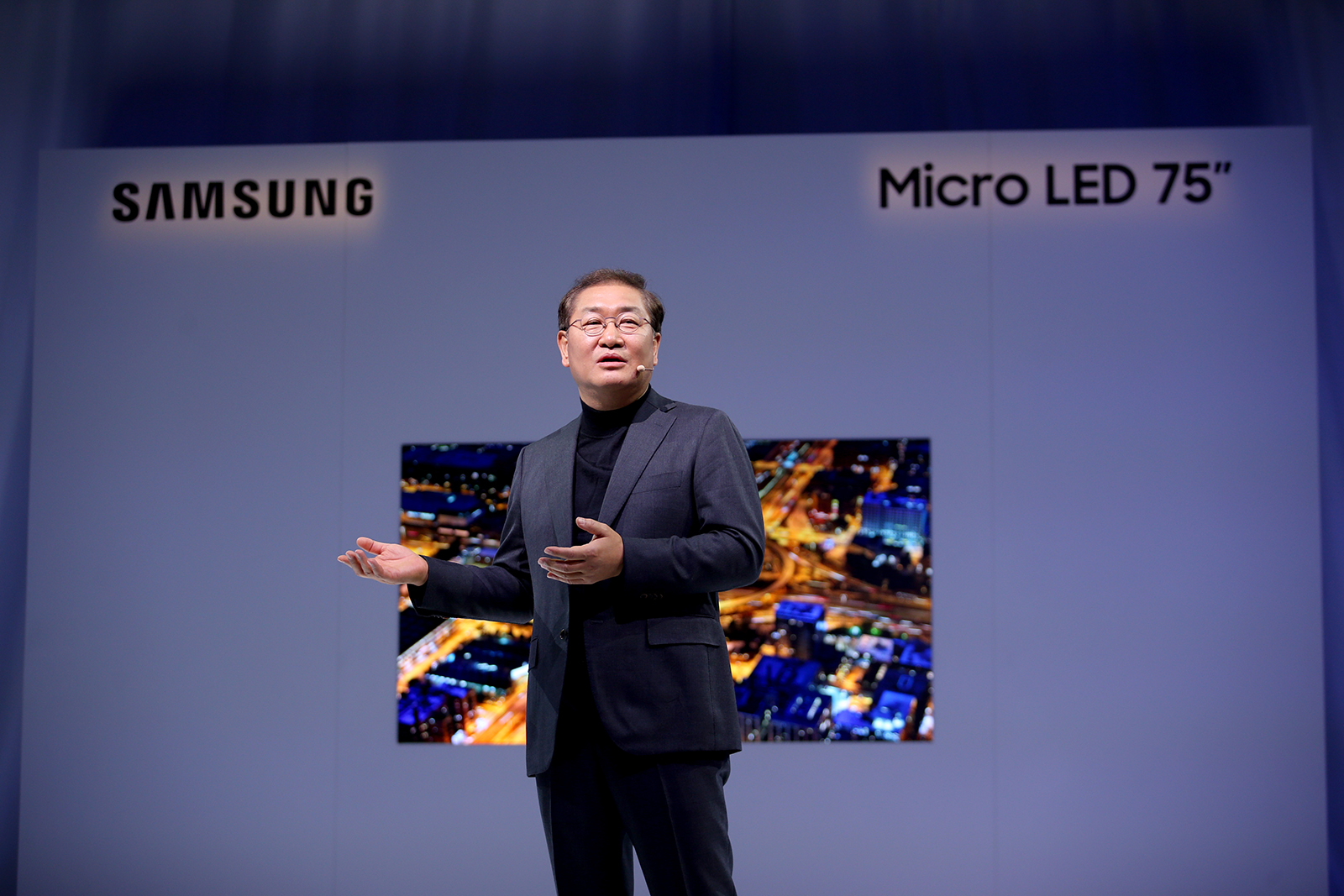
Samsung at CES 2018 unveiled The Wall, a massive 146-inch display powered by Micro LED technology. Technical advancements in the ultra-fine pitch semiconductor packaging process made over the past year have allowed Samsung to narrow the gap between the microscopic LED chips, thus allowing the company to create a more home-friendly 75-inch form factor.

Samsung also went in the opposite direction, showcasing an enormous 219-inch variant of The Wall at this year's show.

Micro LED technology is unique for a couple of different reasons. First and foremost is its modular nature which allows users to create virtually any screen size to meet spatial, aesthetic or functional needs. Back panels hook together by twisting a dial; then, simply attach the display panel onto it magnetically and watch the action come to life.

The bigger appeal of Micro LED, as The Verge highlights, is picture quality that should rival or beat OLED technology without the shortcomings associated with using an organic material (Micro LEDs are inorganic). The tech is also expected to eliminate burn-in concerns and last longer than OLED panels.
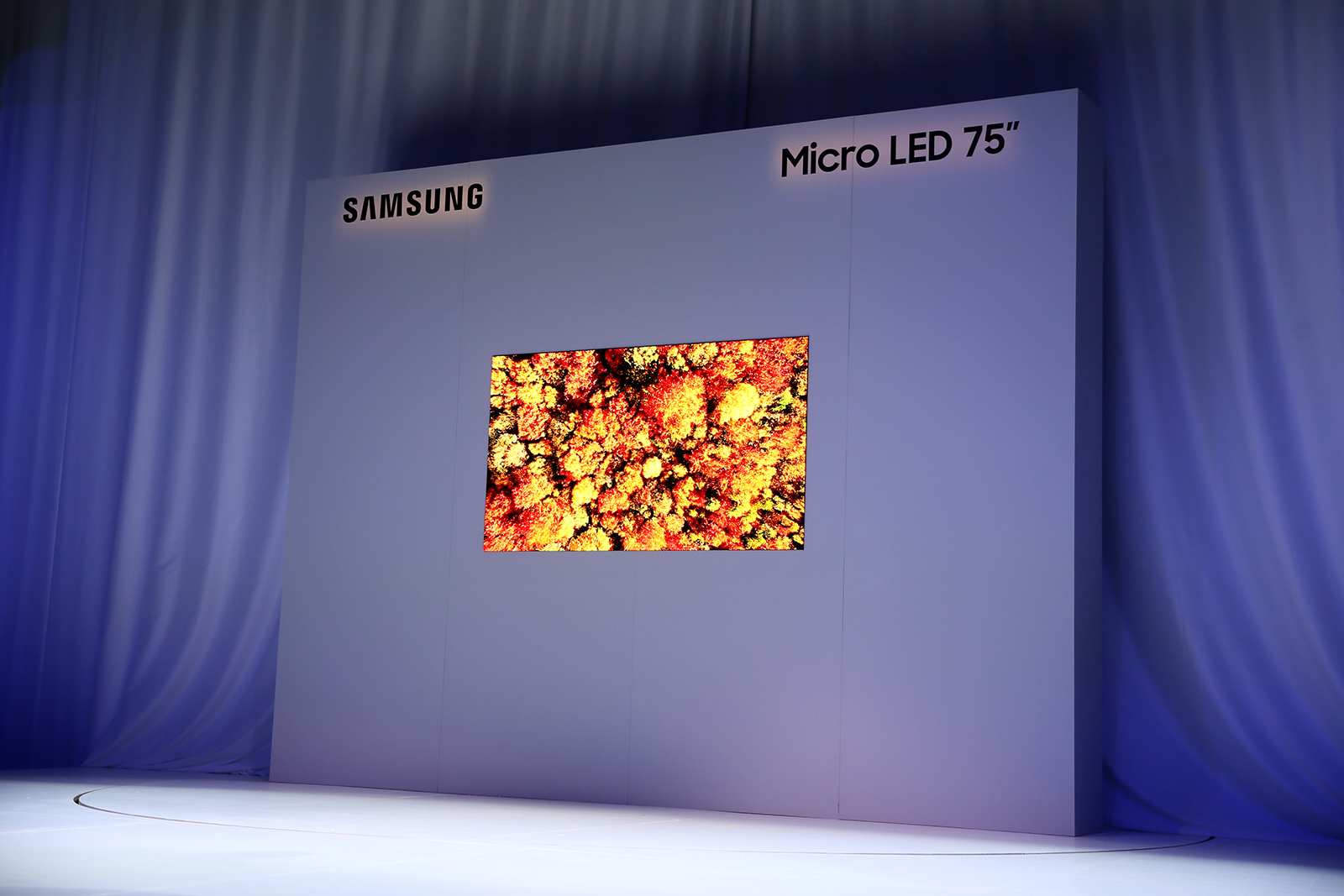
Samsung hasn’t released pricing or availability information on its 75-inch 4K Micro LED set but you can bet it’ll be expensive.

Permalink to story.

 
I am sure this thing will be stunning and should easily far exceed current OLED sets out there with both higher peak brightness and lack of burn-in. However, I would be surprised if this is affordable for most people at this time. It will be interesting to see just what the price is if they bring it to market this year.
 
Question: Can Micro-LED get as black as OLED?
Depends on how dark the LED's appear to the eye when they are not on, I suppose. In a dark room I'd imagine yes, but in a well-lit room it may not be as pleasing to the eye. Then again OLED's aren't exactly black holes that absorb all light.

This seems like cool tech but these displays won't be bendable I would imagine, at least not to the extent an OLED can be. So what would the advantage be other than no burn-in and modularity? Cost? Power consumption?
 
Question: Can Micro-LED get as black as OLED?
Yes. https://www.digitaltrends.com/home-...ill-rule-your-living-room-in-the-near-future/
Unlike the TVs we ubiquitously call “LED” now, which use LED backlights shone through quantum dot sheets, color filters, and numerous other layers to produce images, Samsung’s new MicroLED technology is also emissive, just like OLED, and able to match OLED’s pefect black levels and lightning-fast response time.

MicroLED should also be able to far exceed OLED peak brightness levels which should make for a superior HDR image.

Depends on how dark the LED's appear to the eye when they are not on, I suppose. In a dark room I'd imagine yes, but in a well-lit room it may not be as pleasing to the eye. Then again OLED's aren't exactly black holes that absorb all light.

This seems like cool tech but these displays won't be bendable I would imagine, at least not to the extent an OLED can be. So what would the advantage be other than no burn-in and modularity? Cost? Power consumption?
If you look closely at LG's rollable TV that it introduced, it does not appear to be on a continuous sheet - the OLED emitters appear to be on individual segments which fold as they are rolled. How they managed an image without any indication of those fold points is beyond me. However, it is not a sheet. In theory, there is no reason that MicroLED could not do something similar. The biggest of the current MicroLED sets use tiled panels that are connected together in what sounds like a fashion that also eliminates the seams between the panels in the image.
 
Last edited:
Yes. https://www.digitaltrends.com/home-...ill-rule-your-living-room-in-the-near-future/


MicroLED should also be able to far exceed OLED peak brightness levels which should make for a superior HDR image.


If you look closely at LG's rollable TV that it introduced, it does not appear to be on a continuous sheet - the OLED emitters appear to be on individual segments which fold as they are rolled. How they managed an image without any indication of those fold points is beyond me. However, it is not a sheet. In theory, there is no reason that MicroLED could not do something similar. The biggest of the current MicroLED sets use tiled panels that are connected together in what sounds like a fashion that also eliminates the seams between the panels in the image.

Higher brightness is great but it won't solve issues getting darker colors to show. SkyrimVR for example would be terrible without the ability to see darker colors that the Oculus Rift's OLED panel enables. If MicroLEDs are smaller then it might be possible to improve blacks with fine control of the backlight. I'm no expect on them though which is why I'm trying to see if that is possible.
 
Higher brightness is great but it won't solve issues getting darker colors to show. SkyrimVR for example would be terrible without the ability to see darker colors that the Oculus Rift's OLED panel enables. If MicroLEDs are smaller then it might be possible to improve blacks with fine control of the backlight. I'm no expect on them though which is why I'm trying to see if that is possible.
There is no back light in a MicroLED TV.

That is why they can match the black level of OLED. When the pixel is off, it is really off. Think OLED where OLED has an emissive dot, MicroLED has a MicroLED.

Perhaps I should compare MicroLED with LED LCD TV. In the latter, you have an LCD controlling the amount of light that comes from the backlight that gets through and you can see.

In MicroLED, there is no LCD. What is forming the picture is an array of tiny, hence the term Micro, LEDs of various colors. Those MicroLEDs are the pixels that form the picture much as in OLEDs, the emissivie organic dots are the pixels.

That is why they can match OLED black levels, and since peak brightness is significantly higher than OLED, so is dynamic range, and thus contrast.

The complete quote from the article that I linked to is
Emissive is the key tech word here. OLED is heralded for its ability to emit light and color at the pixel level, allowing each pixel to turn on and off individually, and therefore, create perfect black levels and formerly unmatched contrast. Unlike the TVs we ubiquitously call “LED” now, which use LED backlights shone through quantum dot sheets, color filters, and numerous other layers to produce images, Samsung’s new MicroLED technology is also emissive, just like OLED, and able to match OLED’s pefect black levels and lightning-fast response time.

That article may do a better job of explaining it than I, so if you have time, I suggest reading it.

EDIT: I've been following OLED and various other display technologies, including MicoLED, for quite a while. I see MicroLED as a potentially superb display technology. The only problem with it in comparison to OLED is it is significantly more costly and difficult to manufacture than OLED.
 
Last edited:
There is no back light in a MicroLED TV.

That is why they can match the black level of OLED. When the pixel is off, it is really off. Think OLED where OLED has an emissive dot, MicroLED has a MicroLED.

Perhaps I should compare MicroLED with LED LCD TV. In the latter, you have an LCD controlling the amount of light that comes from the backlight that gets through and you can see.

In MicroLED, there is no LCD. What is forming the picture is an array of tiny, hence the term Micro, LEDs of various colors. Those MicroLEDs are the pixels that form the picture much as in OLEDs, the emissivie organic dots are the pixels.

That is why they can match OLED black levels, and since peak brightness is significantly higher than OLED, so is dynamic range, and thus contrast.

The complete quote from the article that I linked to is

That article may do a better job of explaining it than I, so if you have time, I suggest reading it.

EDIT: I've been following OLED and various other display technologies, including MicoLED, for quite a while. I see MicroLED as a potentially superb display technology. The only problem with it in comparison to OLED is it is significantly more costly and difficult to manufacture than OLED.

Well then, it sounds to be the better choice all around.
 
I wanna buy that tv and then build a turning wall for that tv to be able to watch movies outside in summer.
 
There is no back light in a MicroLED TV.

That is why they can match the black level of OLED. When the pixel is off, it is really off. Think OLED where OLED has an emissive dot, MicroLED has a MicroLED.

Perhaps I should compare MicroLED with LED LCD TV. In the latter, you have an LCD controlling the amount of light that comes from the backlight that gets through and you can see.

In MicroLED, there is no LCD. What is forming the picture is an array of tiny, hence the term Micro, LEDs of various colors. Those MicroLEDs are the pixels that form the picture much as in OLEDs, the emissivie organic dots are the pixels.

That is why they can match OLED black levels, and since peak brightness is significantly higher than OLED, so is dynamic range, and thus contrast.

The complete quote from the article that I linked to is

That article may do a better job of explaining it than I, so if you have time, I suggest reading it.

EDIT: I've been following OLED and various other display technologies, including MicoLED, for quite a while. I see MicroLED as a potentially superb display technology. The only problem with it in comparison to OLED is it is significantly more costly and difficult to manufacture than OLED.

Well then, it sounds to be the better choice all around.
Absolutely. In fact, I bet if the 75" MicroLED were next to a 77" OLED with both properly calibrated and displaying the same material, the MicroLED would likely have an obviously better picture noticeable to more than just videophiles.

MicroLED based TVs are almost certainly better in all aspects, lifetime, burn-in, PQ, etc., than OLED; however, it will likely take some time for them to become cost competitive with OLED if they ever do. And OLED is about to go one step further in production cost reduction - several manufacturers are starting to print them with inkjet printers. There is significant research being done in OLED, too, on bettering the technology with things like higher peak brightness and longer lifetime. IMO, it is a exciting time for display technology.
 
Back