Sandisk is launching new SATA SSDs in 2026 because NVMe prices are out of control

midian182

Posts: 11,734   +177
Staff member
Winners & losers: In what some may see as a case of desperate times calling for desperate measures, Sandisk is releasing a couple of products that may save those clamoring for more storage but unwilling to pay current M.2 NVMe prices: the Sandisk 320 and Sandisk 520 SATA drives.
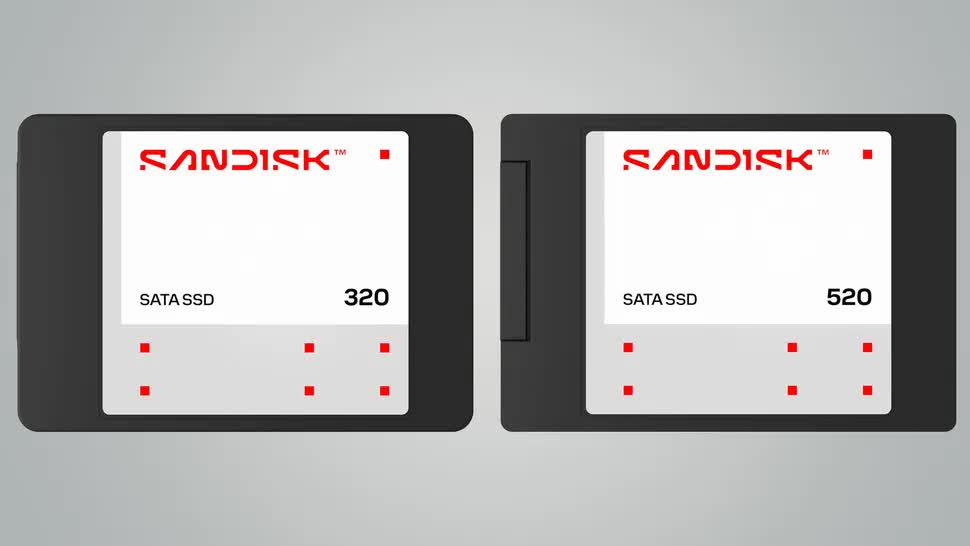
Spotted by hardware leaker momomo_us on Amazon UK, both drives use the familiar 2.5-inch, 7mm-thick format, making them suitable for a wider range of PCs and laptops. The Sandisk 320 is the mainstream model, with capacities from 250GB to 2TB and sequential speeds of up to 545 MB/s read and 525 MB/s write. The Sandisk 520 ranges from 500GB to 4TB, with reads up to 560 MB/s and the same 525 MB/s write ceiling. The 4TB version has a 1,000 TBW rating. No word on what controller is being used.

It's worth remembering that this is still SATA. Even a good SATA SSD is limited by the interface, which tops out around 600 MB/s. A typical PCIe 4.0 NVMe drive can deliver 5,000 MB/s to 7,400 MB/s sequential reads, while PCIe 5.0 models go much higher. SATA also means cables in a desktop, a 2.5-inch bay, and no easy upgrade path for many modern ultrabooks or consoles that rely on M.2 slots.
For a boot drive in a modern gaming or workstation PC, these aren't especially exciting. For replacing a hard drive, adding bulk storage, reviving an old laptop, or keeping a Steam library somewhere that does not need top speeds, they make more sense – assuming the price is right.

Storage has become another casualty of the AI hardware boom, with NAND and SSD supply squeezed by data center demand. Tom's Hardware notes that even SATA SSD prices have risen 10% to 20% over the past year: 250GB models start around $42, 500GB drives at $101, 1TB models around $204, and 4TB drives reach $329.

Sandisk has not confirmed US pricing for the drives, and there doesn't appear to have been any update since the original report, though the UK listing seems to have been removed. One Dutch retailer reportedly lists the 520 with a June 3 arrival date.

Thanks to the AI-driven memory apocalypse, the older technology of Sandisk's new drives is now being positioned as the practical option for many buyers. If the 320 and 520 do undercut NVMe pricing by enough, they could be a welcome alternative. If they land too close to faster M.2 drives, they'll just be another reminder of how broken the storage market has become.

Permalink to story:

 
LOL, here we have nvme drives cheaper than sata, samsung especially. I have old msi laptop with 1 nvme and 1 sata hdd, so I was out for sata SSD.

I've got multiple 970, 980 and 990 offers cheaper than 850 EVO leftovers I've reached middle of the list.
 
Honestly this will change absolutely nothing. The problem is a shortage of NAND. Launching more products with NAND does not fix that issue, it makes it worse.

The only good news will be for those upgrading older PCs, theres still a lot of SATA hardware out there.
 
"Old-school SATA storage could become appealing again if Sandisk gets the pricing right"

Only if the price is truly right...not just for those overspenders.
This article and your comment make no sense. How can this new drive have the right price when all the components needed to make it are overpriced? You can't build a cheap product using overpriced components. That is just basic math.
 
This article and your comment make no sense. How can this new drive have the right price when all the components needed to make it are overpriced? You can't build a cheap product using overpriced components. That is just basic math.
That's why I questioned it.."only if the price is truly right"...but I think as well many manufacturers as taking advantage to overprice this items beyond the A.I boom...just like when manufacturers overpriced toilet paper back in COVID days.
 
Aye, it's still NAND so no idea how they are going to magically get waffer space for it at a lower cost. It's just a different controller and interface. Unless we get a new generation of WD Raptors I don't see this changing much.
 
That's why I questioned it.."only if the price is truly right"...but I think as well many manufacturers as taking advantage to overprice this items beyond the A.I boom...just like when manufacturers overpriced toilet paper back in COVID days.
Those same TP manufacturers had to run triple shifts and pay OT out the arse to meet the insane demand (In the middle of lockdowns, BTW), but for some reason when it comes to paying workers well for the work they do people get very angry and accuse companies of overpricing things.....
 
Aye, it's still NAND so no idea how they are going to magically get waffer space for it at a lower cost. It's just a different controller and interface. Unless we get a new generation of WD Raptors I don't see this changing much.
The AI companies would probably grab up any HDD's too, prices of HDD's have already more than doubled.
New SSD's being launched is pointless unless the AI bubble pops, the limitless amount of greed is ruining the entire tech industry as the consumer market is being marginalized.
 
Honestly this will change absolutely nothing. The problem is a shortage of NAND. Launching more products with NAND does not fix that issue, it makes it worse.

The only good news will be for those upgrading older PCs, theres still a lot of SATA hardware out there.
You’re forgetting that NVMe drives often require very fast NAND, if not the best NAND available, in order to take full advantage of the interface. SATA drives, on the other hand, don’t necessarily need the very best NAND because the NAND itself usually isn’t the main performance bottleneck. The limiting factor is typically the SATA interface.
 
These drives are probably going to have bottom of the barrel QLC NAND, good enough for the average system, or to replace an HDD, however $200 for 1TB is ridiculously overpriced.
A SATA SSD also really doesn't cut it anymore for a newer system with W11.
 
Those same TP manufacturers had to run triple shifts and pay OT out the arse to meet the insane demand (In the middle of lockdowns, BTW), but for some reason when it comes to paying workers well for the work they do people get very angry and accuse companies of overpricing things.....
If only the government would've done something before it was too late to stop anyone from hoarding TP, like they should've done over a year ago with AI companies being allowed to hoard RAM wafers.
 
A SATA SSD also really doesn't cut it anymore for a newer system with W11.
WRONG!!!

A SATA SSD is absolutely still usable in a modern Windows 11 system. Is NVMe faster? Of course. But saying a SATA SSD “doesn’t cut it anymore” is flat-out wrong.

The biggest bottleneck with old traditional hard drives was mechanical latency. The drive physically had to move a read/write head to the correct location on a spinning platter before it could access the data. That delay may seem tiny to us, but to a computer it might as well be an eternity.

It gets even worse when a file is fragmented where pieces of the same file can be scattered across different parts of the disk, meaning the hard drive has to keep seeking back and forth to read the whole thing. That mechanical seek time is one of the main reasons hard drives feel so slow, especially when booting Windows, opening programs, loading lots of small files, or multitasking.

An SSD, even a SATA SSD, doesn't have that problem. There's no spinning platter and no read/write head that has to physically move around. Even if the data is not laid out sequentially, an SSD can access it electronically with extremely low latency. On top of that, SSD controllers can read and write across multiple NAND dies and channels in parallel, which is a big part of why even SATA SSDs feel dramatically faster than hard drives.

Yes, SATA has a much lower maximum bandwidth than NVMe. A typical SATA SSD tops out around the limits of the SATA interface while NVMe drives can go far beyond that. But for everyday Windows 11 use like booting the system, launching apps, browsing, office work, media playback, gaming, and general responsiveness, the jump from a hard drive to a SATA SSD is still a massive improvement. The jump from SATA SSD to NVMe is real, but usually much less noticeable in basic desktop use.

So no, a SATA SSD isn't obsolete just because a system is running Windows 11. NVMe is better, but a decent SATA SSD still “cuts it” perfectly well for many modern systems.

When it comes to how responsive a system feels with an SSD, latency matters much more than raw bandwidth. High sequential speeds look great on paper, but for everyday use, fast access to lots of small files is what makes the system feel snappy.
 
WRONG!!!

A SATA SSD is absolutely still usable in a modern Windows 11 system. Is NVMe faster? Of course. But saying a SATA SSD “doesn’t cut it anymore” is flat-out wrong.

The biggest bottleneck with old traditional hard drives was mechanical latency. The drive physically had to move a read/write head to the correct location on a spinning platter before it could access the data. That delay may seem tiny to us, but to a computer it might as well be an eternity.

It gets even worse when a file is fragmented where pieces of the same file can be scattered across different parts of the disk, meaning the hard drive has to keep seeking back and forth to read the whole thing. That mechanical seek time is one of the main reasons hard drives feel so slow, especially when booting Windows, opening programs, loading lots of small files, or multitasking.

An SSD, even a SATA SSD, doesn't have that problem. There's no spinning platter and no read/write head that has to physically move around. Even if the data is not laid out sequentially, an SSD can access it electronically with extremely low latency. On top of that, SSD controllers can read and write across multiple NAND dies and channels in parallel, which is a big part of why even SATA SSDs feel dramatically faster than hard drives.

Yes, SATA has a much lower maximum bandwidth than NVMe. A typical SATA SSD tops out around the limits of the SATA interface while NVMe drives can go far beyond that. But for everyday Windows 11 use like booting the system, launching apps, browsing, office work, media playback, gaming, and general responsiveness, the jump from a hard drive to a SATA SSD is still a massive improvement. The jump from SATA SSD to NVMe is real, but usually much less noticeable in basic desktop use.

So no, a SATA SSD isn't obsolete just because a system is running Windows 11. NVMe is better, but a decent SATA SSD still “cuts it” perfectly well for many modern systems.

When it comes to how responsive a system feels with an SSD, latency matters much more than raw bandwidth. High sequential speeds look great on paper, but for everyday use, fast access to lots of small files is what makes the system feel snappy.
I meant using a SATA SSD as a boot drive in a PC, yes it'll save an old PC or laptop with a slow HDD from becoming e-waste. But in any system with an NVMe slot, a SATA SSD will be the system bottleneck, especially with a un-debloated Windows 11 install as a majority of people would use.
Also I don't really see the point of new SATA drives being launched, SATA SSD's were supposed to be the value option for those upgrading an older system, or looking to get better price per GB for storage, thanks to the AI memory apocalypse, these aren't any cheaper than some NVMe drives.
 
These drives are probably going to have bottom of the barrel QLC NAND, good enough for the average system, or to replace an HDD, however $200 for 1TB is ridiculously overpriced.
A SATA SSD also really doesn't cut it anymore for a newer system with W11.

Pretty sure several tests have show the diffenrce between SATA and NVME in most use cases is minimal. You’re maybe taking 5-10 seconds in loading time which ain’t exactly the chasm of over a minute to a HDD
 
These drives are probably going to have bottom of the barrel QLC NAND, good enough for the average system, or to replace an HDD, however $200 for 1TB is ridiculously overpriced.
A SATA SSD also really doesn't cut it anymore for a newer system with W11.

Pretty sure several tests have show the difference between SATA and NVME in most use cases is minimal. You’re maybe taking 5-10 seconds in loading time which ain’t exactly the chasm of over a minute to a HDD
 
Most of my PCs still have SATA SSDs for their main drive, but multiply that with some RAID and I can’t tell the difference from a NVMe drive…
NVMe is roughly 3 to 10 times faster than SATA - about 20-70 µs versus 100-200 µs for random reads. Also, SATA handles only 32 commands in one queue before it chokes. NVMe handles 65,535 parallel queues with thousands of commands each, so it never stalls under heavy load.

That's what you will notice in games and apps. Whether that's important depends on yourself. But there is a significant difference that can add up. We don't need to cope with talking the differences small. It's a sad story it comes even to this. I won't go back to a SATA SSD as a system drive for games and apps, though. No way. ^^
 
NVMe is roughly 3 to 10 times faster than SATA - about 20-70 µs versus 100-200 µs for random reads. Also, SATA handles only 32 commands in one queue before it chokes. NVMe handles 65,535 parallel queues with thousands of commands each, so it never stalls under heavy load.

That's what you will notice in games and apps. Whether that's important depends on yourself. But there is a significant difference that can add up. We don't need to cope with talking the differences small. It's a sad story it comes even to this. I won't go back to a SATA SSD as a system drive for games and apps, though. No way. ^^

The critical difference is betwen hard drives and SSDs. Apart from cases where it excels, like copying, the NVMe is only marginally faster in practice.
 
Jeez.

You guys have become really spoilt with ultra-high Nvme bandwidth speeds. So much so, that you just won't settle for anything else.

I still say that my distro of choice - 'Puppy' Linux; loading from SATA SSD, and running entirely in RAM - will show a clean pair of heels to most Windows systems.

(shrug...)
 
Pretty sure several tests have show the diffenrce between SATA and NVME in most use cases is minimal.
In normal everyday use cases, that's very true.
NVMe is roughly 3 to 10 times faster than SATA - about 20-70 µs versus 100-200 µs for random reads. Also, SATA handles only 32 commands in one queue before it chokes. NVMe handles 65,535 parallel queues with thousands of commands each, so it never stalls under heavy load.

That's what you will notice in games and apps.
But for a person who's only running email, office suites, and a web browser... Who the hell cares?

Outside of people pushing serious data throughput like photo and video editing, virtual machines, and of course, gaming, a SATA SSD more than adequate. It's only those that chase benchmark numbers that really care.
 
Aye, it's still NAND so no idea how they are going to magically get waffer space for it at a lower cost. It's just a different controller and interface. Unless we get a new generation of WD Raptors I don't see this changing much.

Agreed. If anything, SATA drives should be MORE expensive than M.2 NVMe drives, since the BOM has to be more expensive: A similar sized PCB, a similar controller, the same NAND, PLUS a case for the 7mm form factor. The only reason a SATA drive should be less expensive would be is lesser "desirability".

If SanDisk wants to sell more SSDs, they could just make more NVMe drives. It seems like maybe the issue is they either don't have the assembly lines or they can't get the controller chips necessary to make NVMe, but they CAN get SATA controllers.
 
8-10 years ago, I thought we'd have really high storage options, many times faster, at a much lower price. Boy was I wrong! It's like we're going backward now. Everyone will have to wait years before upgrading. People now focus on keeping old systems running. Kind of depressing lol
 
Back