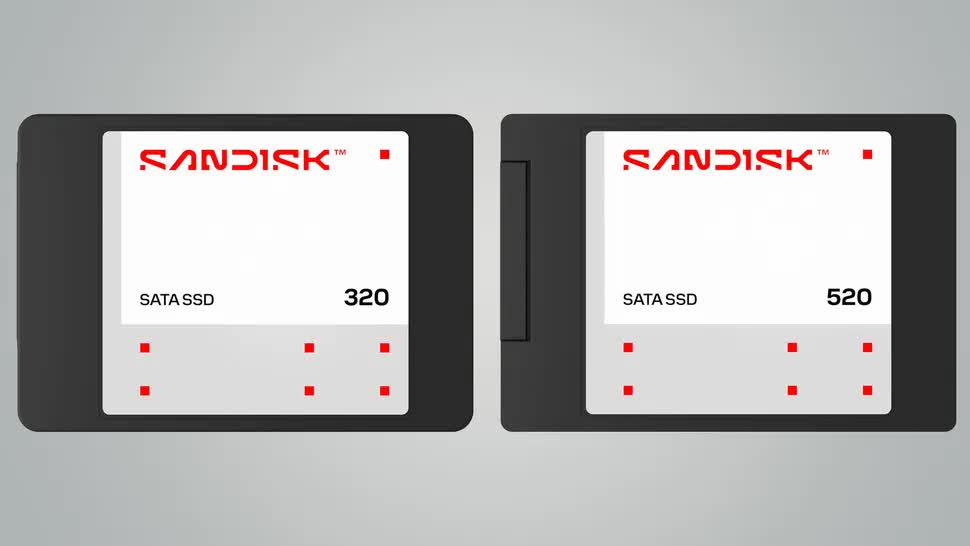
Winners & losers: In what some may see as a case of desperate times calling for desperate measures, Sandisk is releasing a couple of products that may save those clamoring for more storage but unwilling to pay current M.2 NVMe prices: the Sandisk 320 and Sandisk 520 SATA drives.
Spotted by hardware leaker momomo_us on Amazon UK, both drives use the familiar 2.5-inch, 7mm-thick format, making them suitable for a wider range of PCs and laptops. The Sandisk 320 is the mainstream model, with capacities from 250GB to 2TB and sequential speeds of up to 545 MB/s read and 525 MB/s write. The Sandisk 520 ranges from 500GB to 4TB, with reads up to 560 MB/s and the same 525 MB/s write ceiling. The 4TB version has a 1,000 TBW rating. No word on what controller is being used.
– 188号 (@momomo_us) May 27, 2026
It's worth remembering that this is still SATA. Even a good SATA SSD is limited by the interface, which tops out around 600 MB/s. A typical PCIe 4.0 NVMe drive can deliver 5,000 MB/s to 7,400 MB/s sequential reads, while PCIe 5.0 models go much higher. SATA also means cables in a desktop, a 2.5-inch bay, and no easy upgrade path for many modern ultrabooks or consoles that rely on M.2 slots.
For a boot drive in a modern gaming or workstation PC, these aren't especially exciting. For replacing a hard drive, adding bulk storage, reviving an old laptop, or keeping a Steam library somewhere that does not need top speeds, they make more sense – assuming the price is right.
Storage has become another casualty of the AI hardware boom, with NAND and SSD supply squeezed by data center demand. Tom's Hardware notes that even SATA SSD prices have risen 10% to 20% over the past year: 250GB models start around $42, 500GB drives at $101, 1TB models around $204, and 4TB drives reach $329.
Sandisk has not confirmed US pricing for the drives, and there doesn't appear to have been any update since the original report, though the UK listing seems to have been removed. One Dutch retailer reportedly lists the 520 with a June 3 arrival date.
Thanks to the AI-driven memory apocalypse, the older technology of Sandisk's new drives is now being positioned as the practical option for many buyers. If the 320 and 520 do undercut NVMe pricing by enough, they could be a welcome alternative. If they land too close to faster M.2 drives, they'll just be another reminder of how broken the storage market has become.