Satya Nadella argues that Microsoft's AI bet is paying off as Copilot usage nearly triples

Skye Jacobs

Posts: 1,912   +58
Staff
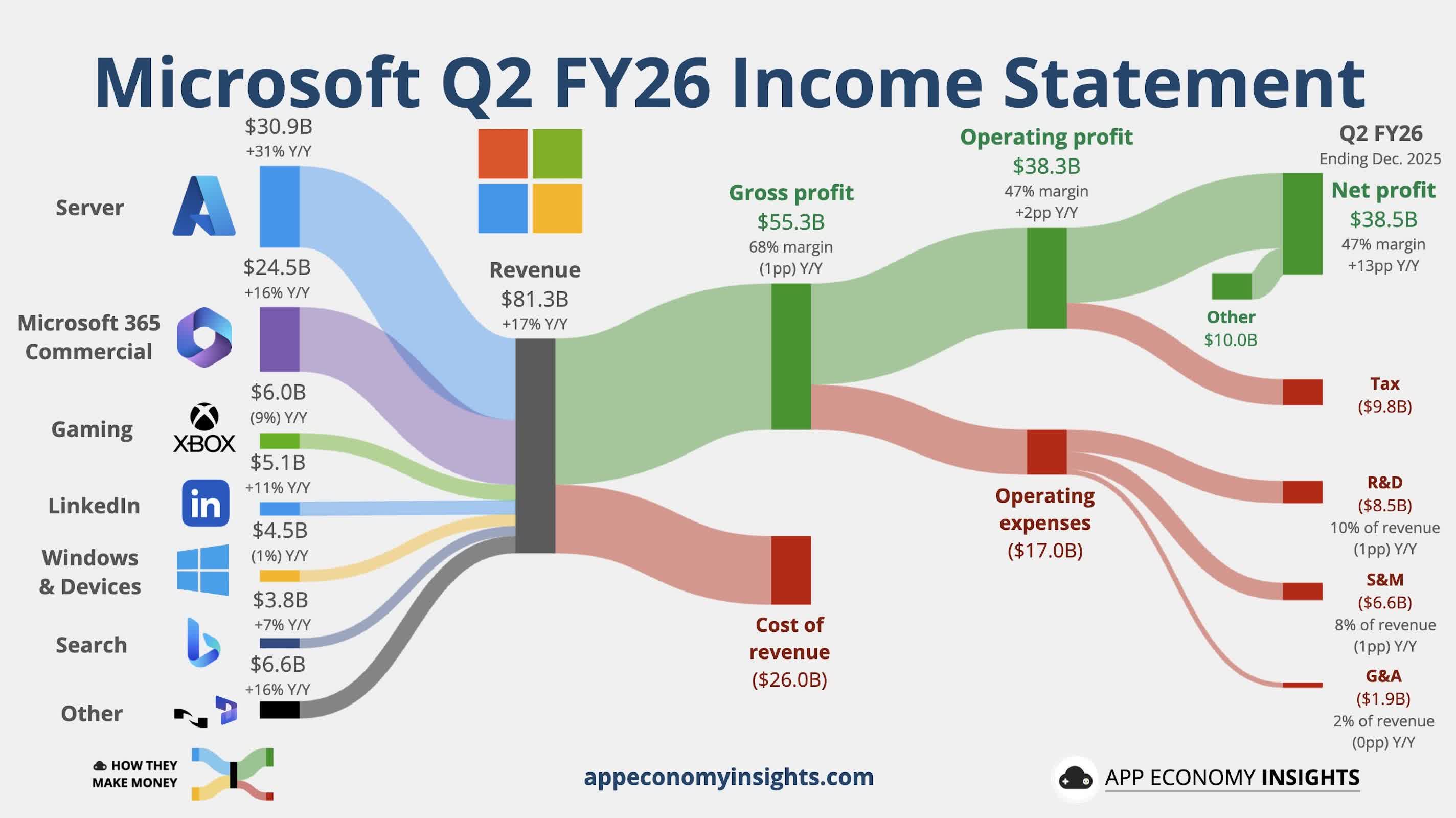
In context: Microsoft reported another strong quarter, with revenue rising 17 percent to $81.3 billion and net income increasing 21 percent to $38.3 billion. The company also reached a symbolic milestone: its cloud business generated more than $50 billion in a single quarter, the highest in its history. Yet despite these headline numbers, the market responded coolly. Shares fell on Thursday as analysts questioned whether the company's escalating spending on AI infrastructure might be stretching resources too far, too fast.

The concern stems from Microsoft's capital expenditures, which have soared to near-record levels. The company spent $88.2 billion last fiscal year and $72.4 billion in the first half of the current fiscal year.

Most of this spending is aimed at building new data centers and high-performance computing infrastructure to support AI workloads for enterprises and major research partners, including OpenAI and Anthropic. The strategy is clear: saturate the market with capacity before demand peaks. What remains uncertain is how quickly that demand will convert into sustained profits.

Wall Street's ambivalence reflects growth in Microsoft's core platforms. Azure, the company's enterprise cloud division, and Microsoft 365, its productivity suite, both posted solid but slightly slower expansion than investors had anticipated.
UBS analyst Karl Keirstead described the underperformance as the key factor weighing on sentiment, though he still rated the stock a buy. The slower growth doesn't signal weakness – overall expansion remains strong – but it contrasts with Microsoft's image as the primary beneficiary of the AI boom.

During the earnings call, CEO Satya Nadella sought to reframe the narrative, spending considerable time explaining how Microsoft's AI initiatives are driving user engagement.

Nadella said adoption of Copilot, Microsoft's flagship consumer AI assistant, has nearly tripled in daily usage compared to a year ago. He did not disclose exact user numbers but highlighted its integration across Microsoft's ecosystem – from search and news feeds to the Windows operating system. The company's last publicly reported figure was 100 million monthly active users across both consumer and business segments.

More concrete details were provided for GitHub Copilot, Microsoft's AI coding assistant. The service now has 4.7 million paid subscribers, a 75 percent year-over-year increase. Including free users, GitHub reported a total Copilot user base of 20 million last year, making it one of the most widely adopted developer AI tools to date.

Meanwhile, Microsoft 365 Copilot has secured 15 million paid enterprise seats – a fraction of its 450 million total business customers – but a sign that corporate adoption is accelerating.

Nadella also highlighted a quieter success story in Microsoft's healthcare division. Dragon Copilot, the company's AI agent for medical professionals, now serves 100,000 providers and processed 21 million patient encounters this quarter, tripling usage from a year ago.

The product competes in a rapidly growing space that includes startups such as Harvey and reflects Microsoft's strategy to expand AI into specialized verticals beyond its core enterprise base.
Behind these metrics lies the rationale for Microsoft's enormous capital push. Both Nadella and CFO Amy Hood noted that AI demand is already exceeding current data center capacity, leaving new compute infrastructure effectively booked the moment it comes online.

The implication is that Microsoft's data center expansion is not speculative spending but a response to existing utilization. That framing may reassure investors, though the numbers suggest that even "booked to capacity" could involve billions in sunk costs before operating margins catch up.

For now, Microsoft's results illustrate a company redefining scale in the cloud era. Market skepticism may fade if its data infrastructure gamble translates into consistent AI-driven revenue across its portfolio. But with capital spending already approaching last year's record, and only halfway through the fiscal year, Microsoft is betting heavily that global demand for AI compute will grow faster than even its vast supply capacity.

Permalink to story:

 
Usage has tripled because you're almost forced to use it anytime you make an interaction with your computer and sometimes you accidentally use it without realizing it because of how baked into everything it is.

I'm sure usage has tripled, but not because people WANT to use it. He's cooking the books on AI use.
 
Usage has tripled because you're almost forced to use it anytime you make an interaction with your computer and sometimes you accidentally use it without realizing it because of how baked into everything it is.

I'm sure usage has tripled, but not because people WANT to use it. He's cooking the books on AI use.

This, very much. Renaming Microsoft365 (which itself was a rename to fudge numbers) to Microsoft 365 Copilot App, along with subscriptions that were forced into Copilot version and you had to cancel to get the non-copilot version, is evidentiary of proving those numbers are, at the very least, suspect and not entirely genuine. If not at least suspect, Satya would not have been so compelled as to address the "slop" with some of the most trite wording I've read in some time, likely written from AI itself.

Microsoft's count of use would include accidental activation and even possibly proximity. Considering they cannot even produce an OS that doesn't contain some type of serious maligned update, every single month, for years now, this only rings to possible investors whom I would hope would see past this.

Ah well. Alternatives abound more than ever today.
 
I have so completely removed copilot from my PC and my workflow that I forgot it was an option.

And that’s as someone that uses Claude, nano banana, and occasionally ChatGPT.

Simply buy Office (not 365) and run Github's Win11Debloat (works on Win 10 too).
 
There's two kinds of people. Those who pretend copilot is useless and those who have used it.

You don't have to like it, but anyone still pretending a manual Google search is better than copilot is being disingenuous.
 
There's two kinds of people. Those who pretend copilot is useless and those who have used it.

You don't have to like it, but anyone still pretending a manual Google search is better than copilot is being disingenuous.
You forgot the third kind: those who think copilot is useful because they can't figure out how to format a web search query.
 
There's two kinds of people. Those who pretend copilot is useless and those who have used it.

You don't have to like it, but anyone still pretending a manual Google search is better than copilot is being disingenuous.
This sort of feels like a false dichotomy, yes? I have used it, and have not found it to be very accurate. I also don't appreciate it being forced. If it was truly utilitarian, it would not need to be thrusted with such fervor, I would think.

What is an AI search if not the search bot pulling sources the same as Google and summarizing it. We can say an AI may be slightly faster, at the cost of potential inaccurate information. In the searches I require, which admittedly isn't the masses, it's a rarity any AI will correctly return valid or correctly summarized info. That, and I generally prefer to understand the problem and the solution, rather than rely on a solution just handed to me.
 
There is a gigantic gap between what tech CEOs say AI can do and what it can actually do.

Just today I tried using Copilot to automate payment reporting for my wife's small medical firm. Copilot couldn't make heads or tails out of the information in a file I gave it, even with extended hand holding.
Even if it did eventually work, I wouldn't trust it to automate routine tasks because it is a black box. It reported different numbers from an identical file based on slightly different prompts. How can I make sure that it processes this month's and next month's files the same way?

Tech CEOs want you to believe that AI can save everyone significant time and money. In my experience, the benefits of AI are severely limited, and it often cannot replicate the skill set of a mediocre intern.
 
There's two kinds of people. Those who pretend copilot is useless and those who have used it.

You don't have to like it, but anyone still pretending a manual Google search is better than copilot is being disingenuous.
As someone who’s recently been given a full Copilot license at work, so I’m trying to use it more to see what it can (and cannot) do, search I’m finding it to be actually pretty bad at.

It confidently lies to you, I’ve asked questions on Veeam, WiFi frequencies, VMware, Synology as examples, and it has outright just given me completely false information.

Ask it questions around Microsoft services and products, sure, it’s pretty good, get going on a power shell script? Pretty good. Ask it basic questions like “how to elevate a command in Linux” it’s just as quick as a normal search but since copilot is in bloody everything, it saves me having to open a tab to do the search.

I’m not 100% sure it writing emails for me based on prompts saves me any time at all, as I still have to read through what it’s done and change stuff anyway.

It’s pretty good at writing fluff for documents and presentations, depends on what you’re writing about though, as this has the same issue as asking it similar questions I’d put into google search, copilot will just come up with nonsense.

Overall, I don’t find copilot is really any quicker than using Google search, unless its a Microsoft product/service or super simple questions, it lies too frequently to actually trust it (yet).

Truthfully, for search purposes anyway, you wouldn’t pay for an AI assistant when Google Search is there for free. Unless you’re really bad at using Google somehow.
 
There's two kinds of people. Those who pretend copilot is useless and those who have used it.

You don't have to like it, but anyone still pretending a manual Google search is better than copilot is being disingenuous.
And the third type that has used Claude and found it significantly better.

And Claude wasn't shoved into everything so I don't hate it out of the gate.

Double win.
 
I enjoy working with github copilot. It doesn't solve everything but I find it helpful with some of the tedious tasks.

I will agree with others on that I do not want copilot integrated with my OS. It should be optional extension and should not be installed by default.
 
Back