Oracle cuts 21,000 jobs, admits AI is reducing its workforce

midian182

Posts: 11,708   +177
Staff member
A hot potato: As tech executives' narrative around AI-related job losses becomes one of "things aren't that bad" and even "what job losses?" Oracle has reduced its workforce by 21,000 people this fiscal year while acknowledging that AI played a big role in the cuts.
The eliminations led to $1.8 billion in severance payments and other restructuring costs for Oracle, significantly higher than the $374 million restructuring costs it faced in the previous financial year. The software and cloud computing giant employed 141,000 people as of May 31, 2026, compared to 162,000 one year earlier, representing a 13% decline.

There are several factors behind the cuts, according to Oracle's SEC filing. These include management and product changes, performance issues, strategic shifts, and acquisitions.

A shortage of cash is also playing a part – Oracle's capital expenditures came to $55.7 billion in fiscal 2026 as it builds data center capacity. But there are no prizes for guessing one of the major driving forces.

According to Oracle's SEC filing, "the adoption and deployment of AI technologies across our operations have resulted, and may continue to result, in reductions to our workforce."

According to Layoffs.fyi, 121,462 tech employees have been laid off at 197 companies in 2026 so far. That's just 3,000 short of the entire number of cuts during the whole of 2025.

The list of companies making layoffs as a direct or indirect result of AI keeps growing: Block, Cisco, Intuit, Snap, Amazon, Meta, Microsoft, Dell, Google, HP, and IBM, to name just a few.

What's surprising is the sudden change in position from many tech executives and analysts. OpenAI CEO Sam Altman recently said he was "delighted" his AI jobs apocalypse prediction hasn't come true, which might say more about his definition of an apocalypse than the state of the job market. Even Anthropic boss Dario Amodei, who once said AI could erase half of all entry-level white-collar jobs, has softened his stance.

Possibly the most surprising revelation came from top Apollo economist Torsten Sløk, who said there was "zero evidence" of job losses because of AI, despite there being an awful lot of evidence to the contrary – including, most recently, Oracle's SEC filing.
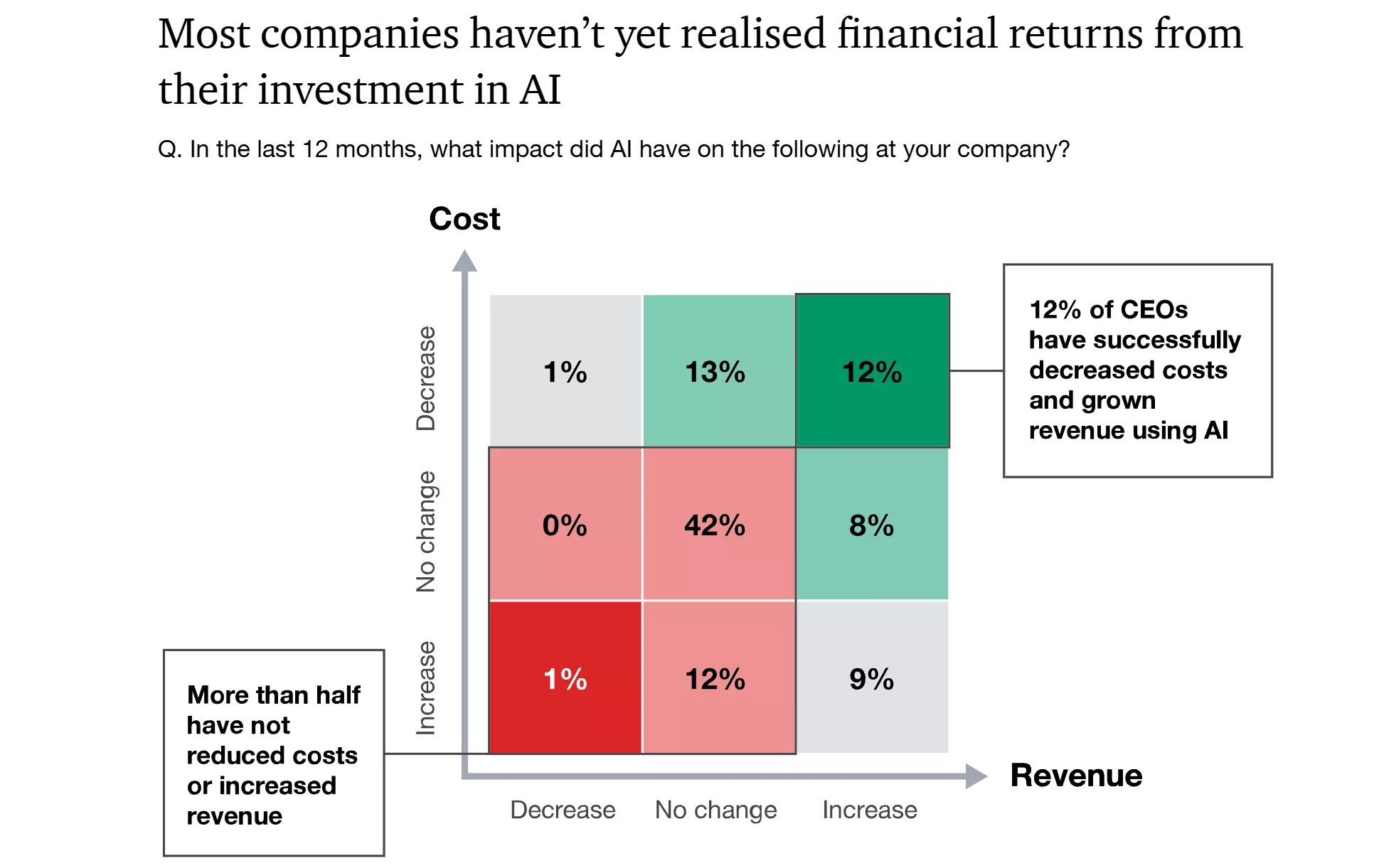
There is a potential bright spot, though. With multiple reports showing AI investment isn't resulting in the sort of returns or cost-cutting (if any) that were expected, a recent study found that around a third of companies that attempted to replace workers with AI have either rehired some of them or expressed regret over the decision. They'll likely regret it even more if – or when – the AI bubble bursts.

Permalink to story:

 
But I remember seeing here by the A.I apologists that A.I wouldn't displace people out of their jobs but just help them be more efficient....

mmm. How quickly the messaging has changed.
 
And what would those people that have nothing to back their claims and only hot air even amounted to ?
Hot air !

 
What I find appalling is that they make a mockery of employees by firing and then rehiring them simply because HR made a mistake. These companies deserve to be snubbed and unable to get those former employees back—employees whom I hope find something better than these slave drivers.
 
But I remember seeing here by the A.I apologists that A.I wouldn't displace people out of their jobs but just help them be more efficient....

mmm. How quickly the messaging has changed.
Once again you've been gullibly gaslit by yellow journalism. The US unemployment rate is the same as it was two years ago: clearly large masses of jobs are not being shed. Some firms lose headcount from AI, others gain it, and still other entirely-new firms start up, creating jobs totally dependent on AI.
 
But I remember seeing here by the A.I apologists that A.I wouldn't displace people out of their jobs but just help them be more efficient....

mmm. How quickly the messaging has changed.
No. You didn’t. Whining for populism-points.

Every major technological revolution follows a predictable two-step pattern:

* Short-term displacement: tasks are automated, reducing the need for specific roles.

* Long-term creation: lower production costs stimulate the economy and create entire new industries.

Economic data shows that AI is currently mirror-imaging this historical shift:

* Evolving roles: many jobs are moving from “doing the task” to “managing the AI that does the task.”

* New fields: high demand has emerged for data labelers, prompt engineers, and AI ethics compliance officers.

* Productivity gains: companies using AI are often expanding operations, leading to net-new hiring in non-tech departments like sales and strategy.

The actual challenge here is not a lack of jobs, but a mismatch of skills. The only people facing 'doom' are the ones sitting around whining instead of learning how to use the new tools.

The computer did the exact same thing to accountants, typists, and travel agents.

This is not an apocalypse. Stop weaponizing routine corporate restructuring to justify laziness. Every technology kills tasks and creates better jobs for people who actually bother to adapt.
 
We have yet to see proof that any of these big tech layoffs are redundancies created by AI. Most of it is just the usual overhire-overfire cycle.

I personally believe that big tech is actively promoting the "AI is coming for most of your jobs" bogeyman as a way to scare the remaining people into working harder for the same pay.
 
My favorite interaction with Oracle was when I asked my driver to slow down long enough to show the entire west-facing side of their HQ both of my middle fingers.
 
Once again you've been gullibly gaslit by yellow journalism. The US unemployment rate is the same as it was two years ago: clearly large masses of jobs are not being shed. Some firms lose headcount from AI, others gain it, and still other entirely-new firms start up, creating jobs totally dependent on AI.
Here is a source for this. You can change the timeframe to go much further back, but indeed since February 2025 (after temporary holiday work ended) the unemployement rate is nearly identical: https://www.bls.gov/opub/ted/2026/unemployment-rate-unchanged-at-4-3-percent-in-may-2026.htm

The vast majority of labor variability is those from ages 16-19 (which makes sense). People from ages 20+ barely had a increase in unemployment in the first half of 2025, but otherwise unemployment has been flat/barely down since then.
U.S. Bureau of Labor Statistics said:
In May 2026, the unemployment rate was unchanged at 4.3 percent. The unemployment rate has remained in a narrow range of 4.3 percent to 4.5 percent since July 2025. The number of unemployed people, at 7.3 million, changed little over the month.

Among the major worker groups, the unemployment rates showed little or no change in May for adult men (4.0 percent), adult women (3.8 percent), teenagers (14.7 percent), and people who are White (3.8 percent), Black (6.6 percent), Asian (3.8 percent), or Hispanic (5.0 percent).
 
We have yet to see proof that any of these big tech layoffs are redundancies created by AI. Most of it is just the usual overhire-overfire cycle.

I personally believe that big tech is actively promoting the "AI is coming for most of your jobs" bogeyman as a way to scare the remaining people into working harder for the same pay.

Actually, in this case, it's actually worse than that. While some of this is overhire, the vast majority of these layoffs is actually mentioned in the article....cashflow. AI is a very, very, expensive hobby. When these companies dump obscene amounts of money into data centers and AI R&D, the money has to come from somewhere. Since it's now obvious that this whole sector of the economy was built without any idea of how to monetize it, the bills are now coming due. The quickest, easiest, and most impactful source of expenses that can be recovered is LABOR.

While AI leaders are correct that these jobs were not "replaced" by AI, does it matter when AI is still the direct cause? Is it any less of a black eye to these CEOs or the industry?

The bigger question is: "When/if will this giant investment pay off enough to cover costs, much less turn a profit?

The only AI turning a profit are actually the re-labeled ML systems in medical, defense, industry, etc. that have been improving for quite some time. The LLM's that caused the gold rush still seem to be lost in woods as far as finding a purpose outside of entertainment, programming, and a few corner cases.
 
Once again, this has nothing to do with AI. It would be nice if the author pointed out that Oracle, under the direction of Larry Ellison, has issued well over $100 billion in bonds (read: debt) to fund its AI dreams, and now it is having issues servicing that massive loan and is cutting jobs to save money. We discussed capital expenditure but not debt. Why is that?

https://fortune.com/2026/03/09/oracle-earnings-layoffs-debt-cloud/


Also, as always, look at covid hiring. In 2019 oracle had 136,000 employees. At the end of 2025 they had 162,000. So after the layoffs, once again, this corpo still employs more people then they did pre coof.

EDIT: this also isnt new. Investors were raising concerns back in 2024


So the article should read "Larry Ellison, CEO of Oracle. who was warned about taking on too much debt, is now being felted by its debt in a move everyone but the rich CEO saw coming".
 
Last edited:
And yet restaurants are having a hard time hiring and keeping servers.
Plus my favorite Bistro is losing 2 of its 3 chefs the end of this month. :(
 
Oracle laid off 13% of its workforce in the last year, but during the same period they lost 20% of their market cap. Oracle is losing customers, and needs less employees to serve the reduced amount of customers. AI has nothing to do with it.

21K people * 100K average annual tech salary results in "savings" of ~2 billion / year. Oracle invested 55+ billion in datacenter infrastructure for the last year. It's preposterous to imply the purpose of the layoffs was to redirect the money to infrastructure
 
Oracle burned $23.7 billion in cash last year while raising $43 billion in debt and equity...

"It's AI why we're firing 21k people"

Suuuure.
 
Oracle is not losing employees because AI is replacing them. It's losing employees because it's still pouring money into an AI blackhole and it's divesting itself of it's arms and legs in a all-or-nothing Hail Mary on being the company that works out how to make AI pay for itself.
 
Oracle laid off 13% of its workforce in the last year, but during the same period they lost 20% of their market cap. Oracle is losing customers, and needs less employees to serve the reduced amount of customers. AI has nothing to do with it.

21K people * 100K average annual tech salary results in "savings" of ~2 billion / year. Oracle invested 55+ billion in datacenter infrastructure for the last year. It's preposterous to imply the purpose of the layoffs was to redirect the money to infrastructure
Now include the cost of benefits, 401k retirement matching, maintaining office space, software licenses, ece ece and you're likely closer to $5-6 billion a year.
 
Oracle is one of the most disgusting corporations alive. They are also heavily involved in zionist schemes, putting aside all their efforts throughout history in going out of their way to work surveillance related contracts.
 
Back