Highly anticipated: Scientists at the University of Arizona have demonstrated a method to capture and manipulate quantum uncertainty in real time using rapid pulses of light, marking what they describe as a major advance in quantum physics. Published in Light: Science & Applications, the research shows how ultrafast "squeezed light" can be precisely controlled, a step that could accelerate the development of secure quantum communications and next-generation optical systems.

Squeezed light is a specialized form of light in which quantum fluctuations are redistributed between two complementary properties. According to quantum theory, light is characterized by two interdependent parameters that reflect its particle-like behavior: one related to its position or phase, and the other to its intensity.
Due to the Heisenberg uncertainty principle, these two values can never be known simultaneously with perfect precision as improving the measurement of one always comes at the cost of greater uncertainty in the other.
Ordinary light maintains a balanced distribution of uncertainty between these variables. Squeezed light, however, deliberately alters that balance, minimizing uncertainty in one property while increasing it in the other. The result is a light wave capable of higher precision for specific measurements without violating quantum limits.
The trade-off has already proven useful in gravitational-wave detectors, where squeezed light helps instruments filter out cosmic background noise and detect faint spacetime distortions billions of light-years away.
While conventional squeezed light experiments rely on laser pulses lasting milliseconds, a team from the University of Arizona explored whether this phenomenon could be achieved using bursts millions of times shorter – on the order of femtoseconds, or one quadrillionth of a second.
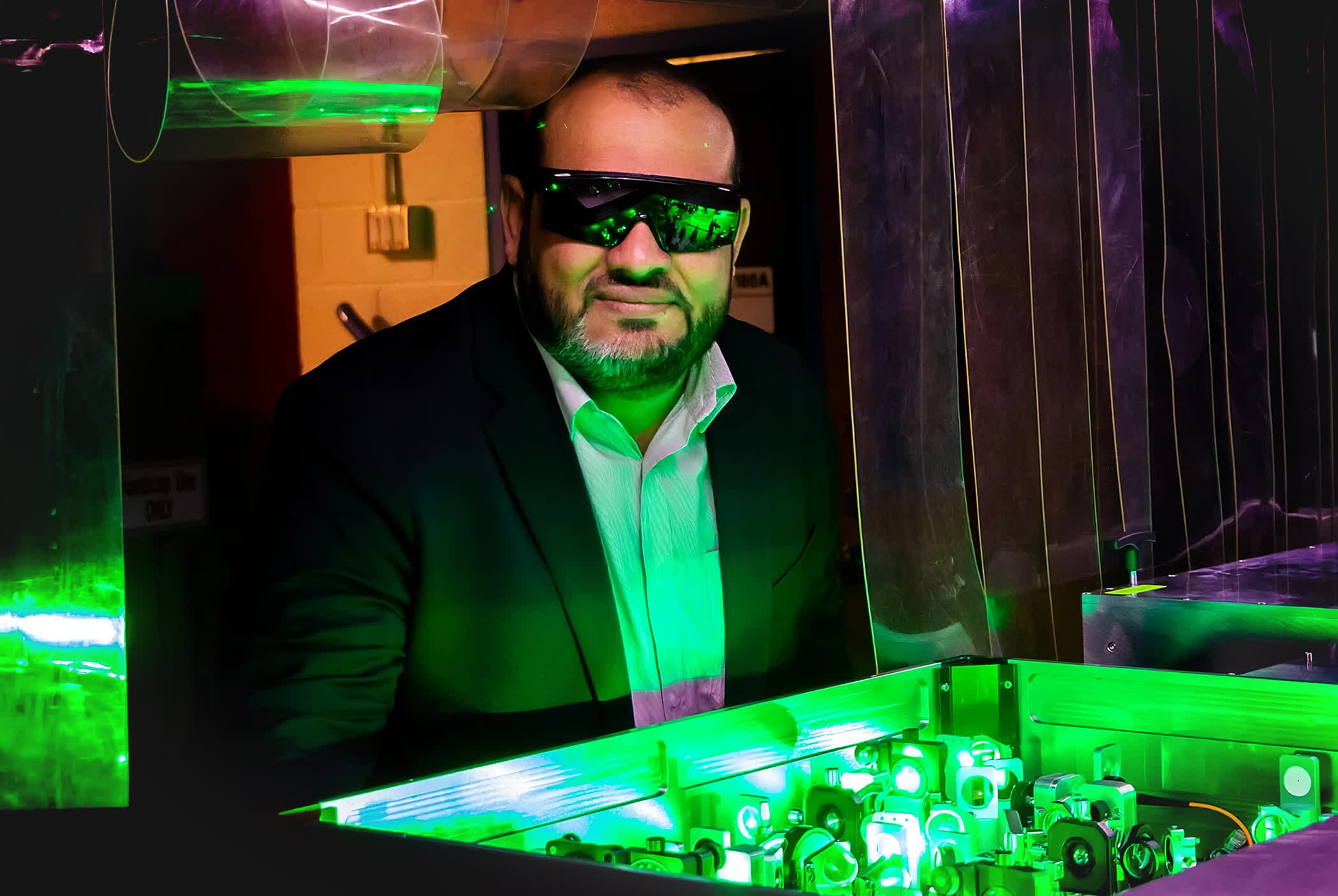
Mohammed Hassan, senior author of the research paper studying the phenomenon.
Achieving this feat, said Mohammed Hassan, the paper's senior author and associate professor of physics and optical sciences, required overcoming one of quantum optics' most persistent technical obstacles: phase matching between lasers of different wavelengths.
Traditional setups demand complex alignment to synchronize multiple light sources, but Hassan and his team developed a simpler method building on their prior work in ultrafast photonics.
Their approach uses a process called four-wave mixing, in which light waves interact within a medium and combine to form new frequencies. The researchers began by splitting a single laser into three identical beams and directing them into fused silica. The resulting nonlinear optical interactions produced ultrafast squeezed light, the first time such a state had been both generated and controlled at this timescale.
Unlike earlier efforts that targeted a photon's phase, the Arizona researchers focused on squeezing intensity, or the amplitude of the light wave. By making small adjustments to the orientation of the silica relative to the laser beams, they discovered they could shift the squeezing behavior from intensity to phase and back again. Perpendicular alignment allowed photons to arrive together, while a slight change in angle introduced a timing delay that determined where in the waveform the uncertainty compression occurred.
"This is the first real-time control of quantum uncertainty using ultrafast light," Hassan said. "It brings together two previously separate domains – quantum optics and ultrafast science – into what we now call ultrafast quantum optics."
The group has already tested how the technique can enhance data security. Quantum communication systems typically rely on light-based keys that reveal any interception attempts, since external interference disrupts the quantum state. The team's method adds another layer of protection.
Because their ultrafast squeezed light varies in amplitude as well as phase, any intruder would need not only the cryptographic key but also the exact amplitude conditions for each pulse. Any disturbance alters the squeezing ratio, scrambling the encoded data and rendering intercepted information useless.
Hassan believes the implications extend well beyond communication. Ultrafast quantum light could enable more sensitive biological imaging, improved environmental sensing, and precision spectroscopy techniques that reveal molecular behavior at unprecedented speeds. Potential applications include real-time chemical monitoring and early-stage drug discovery, where capturing fleeting molecular interactions is critical.
The work was conducted with graduate student Mohamed Sennary, who serves as the paper's lead author, along with co-author Mohammed ElKabbash, an assistant professor of optical science. Additional collaborators include scientists from the Barcelona Institute of Science and Technology, Ludwig Maximilian University of Munich, and the Catalan Institution for Research and Advanced Studies.
Scientists achieve real-time control of quantum uncertainty using ultra-fast light


