
Why it matters: A new approach to quantum computing may sidestep one of the field's biggest bottlenecks – scalability. Researchers at EeroQ, a Chicago-based startup, have demonstrated a system that traps individual electrons floating on the surface of liquid helium, forming the basis for a highly stable, easily manufactured qubit.

Quantum computing's biggest challenge is no longer proving the concept works – it is figuring out how to make the technology practical at scale. Today's qubit architectures, whether based on superconducting loops or trapped ions, are sensitive, expensive, and difficult to mass-produce. Many require ultra-cold environments near absolute zero. Some systems also need miles of control wiring to manage just a few hundred qubits. EeroQ's approach could eliminate some of those obstacles by relying on mature semiconductor processes and a medium that naturally provides the necessary stability.
"If you bring a charged particle like an electron near the surface, because the helium is dielectric, it'll create a small image charge underneath in the liquid," said Johannes Pollanen, EeroQ's chief scientific officer.
Liquid helium's unusual properties make this setup even more appealing. The element becomes a superfluid at cryogenic temperatures, flowing through microscopic channels without friction. As a result, the helium can glide smoothly across a chip etched with narrow trenches that hold and transport electrons. Using a tungsten filament, the researchers created a reservoir of electrons on the helium surface and directed them into electromagnetic "traps" on the chip's surface. By adjusting each trap's energy barriers, they could fill it with dozens of electrons, then gradually release them until only one remained.
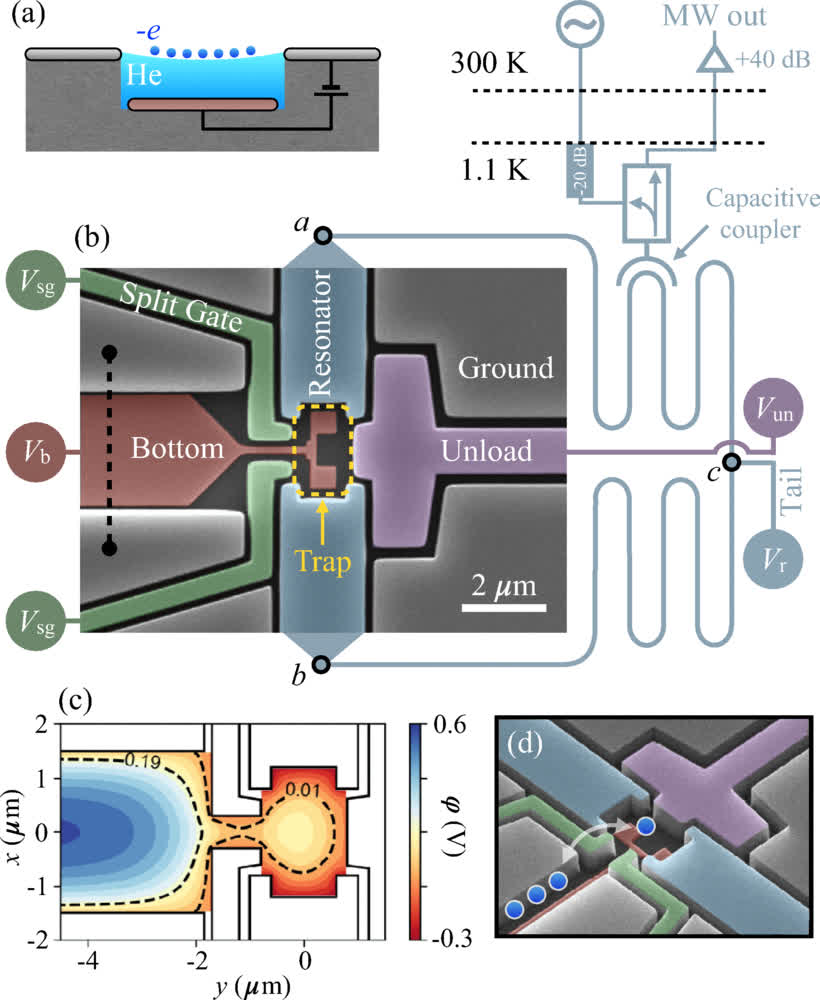
The electron trap is formed by the set of electrodes shown in, which are arranged to create a controllable potential well. Image credit: EeroQ
The concept behind EeroQ's system dates back more than half a century, to early experiments showing that electrons could hover above liquid helium rather than sink into it. When a negatively charged electron approaches the surface of the liquid, the helium induces a weak positive "image charge" beneath it. The electron is drawn toward this image but cannot enter the liquid, leaving it suspended just above the surface. The result is a stable, isolated electron hovering in a near-perfect vacuum.
Detecting and controlling that single electron is what turns the physics into a qubit. Electrodes flanking the trap form a resonator whose frequency shifts depending on the number of electrons present. Measuring the shift confirmed that the researchers could isolate a lone electron indefinitely. The next step is to encode information in the electron's spin – the property that defines its orientation in a magnetic field. Researchers have already tried similar techniques in quantum dots and silicon impurities, but those materials introduce noise and interference.
"The spin coherence of the electron is going to be fantastic," Pollanen said. "It can't be worse than what's in silicon."
EeroQ's design also takes advantage of the same CMOS processes used to build conventional chips. Engineers can fabricate the traps, electrodes, and control circuits using relatively mature technology rather than cutting-edge nanolithography. Pollanen said this could enable arrays containing millions of qubits on a single wafer while keeping the control wiring compact enough to extend digital addressing to individual devices. That combination of scalability and simplicity is what sets the design apart from more complex qubit systems.
The technology remains unproven in practical application, and significant work still lies ahead to demonstrate functional qubits, gate operations, and large-scale integration. The company ultimately plans to encode each qubit using two electrons with opposing spins to reduce decoherence caused by magnetic irregularities.
"If we move electrons around, they'll experience some inhomogeneous magnetic fields from the magnet that we need for the spin quantization," Pollanen, told Ars Technica. "But if you create a qubit out of two electrons with opposing spin, any decoherence that happens to one will be canceled in the other."
Engineers can then move the electrons around the chip to perform logical operations and entanglement – interactions essential for quantum computation. Earlier research has already shown that a single electron can travel considerable distances (over a kilometer) without losing stability, suggesting that EeroQ's mobile architecture could be feasible.
Image credit: Quantum Circuits
Scientists have discovered a potential candidate for a more scalable qubit


