Snapdragon X2 laptops launch with up to 18 cores, 5.0GHz clocks, and 80 TOPS NPU

Skye Jacobs

Posts: 2,018   +59
Staff
First look: Qualcomm's latest Snapdragon-powered Windows on Arm laptops are arriving in premium configurations, focusing on performance and power efficiency rather than serving merely as showcase devices. By prioritizing higher-spec machines over experimental prototypes, this generation of hardware is meant to compete directly with mainstream x86 laptops. Snapdragon X2 laptops arrive with premium specs, pushing Windows on Arm into the mainstream
Snapdragon X2 is Qualcomm's second-generation Windows PC platform, introduced in September 2025, with devices expected in the first half of 2026. The family includes the Snapdragon X2 Elite and the higher-tier X2 Elite Extreme, which targets more demanding workloads.

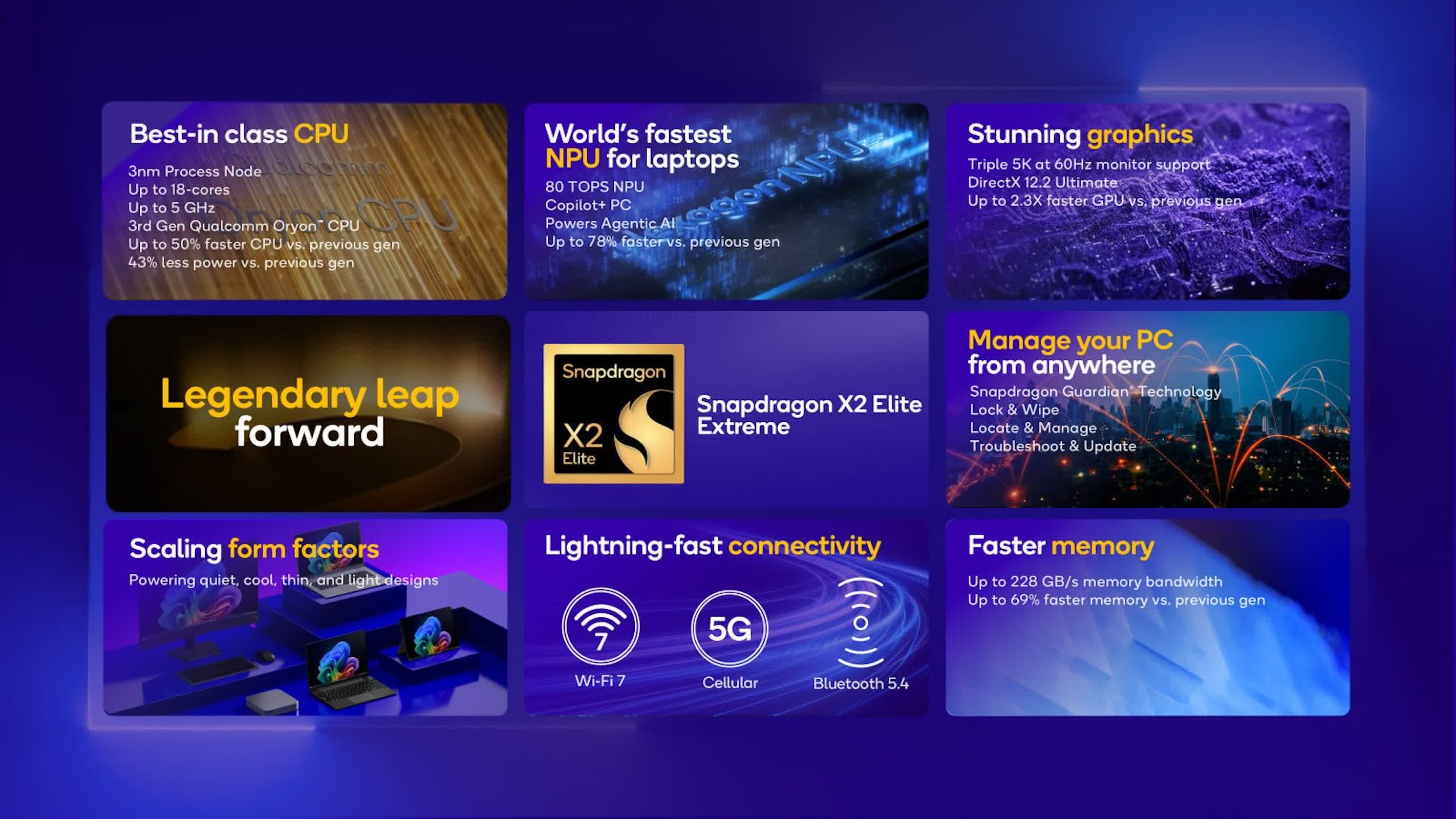
Qualcomm is positioning these chips for thin-and-light Copilot+ laptops featuring an 80 TOPS NPU. The company claims the Snapdragon X2 Elite can deliver up to 31% higher ISO-power performance while reducing power consumption by as much as 43% compared with the previous generation.

The branding encompasses multiple configurations. Qualcomm's current product page lists the Snapdragon X2 Elite Extreme with an 18-core CPU reaching up to 5.0GHz, alongside X2 Elite variants that scale down to 18 or 12 cores with clocks up to 4.7GHz.

Asus offers the 16-inch Zenbook A16 with the X2 Elite Extreme, while the 14-inch Zenbook A14 uses the standard 18-core X2 Elite but retains the 80 TOPS NPU.
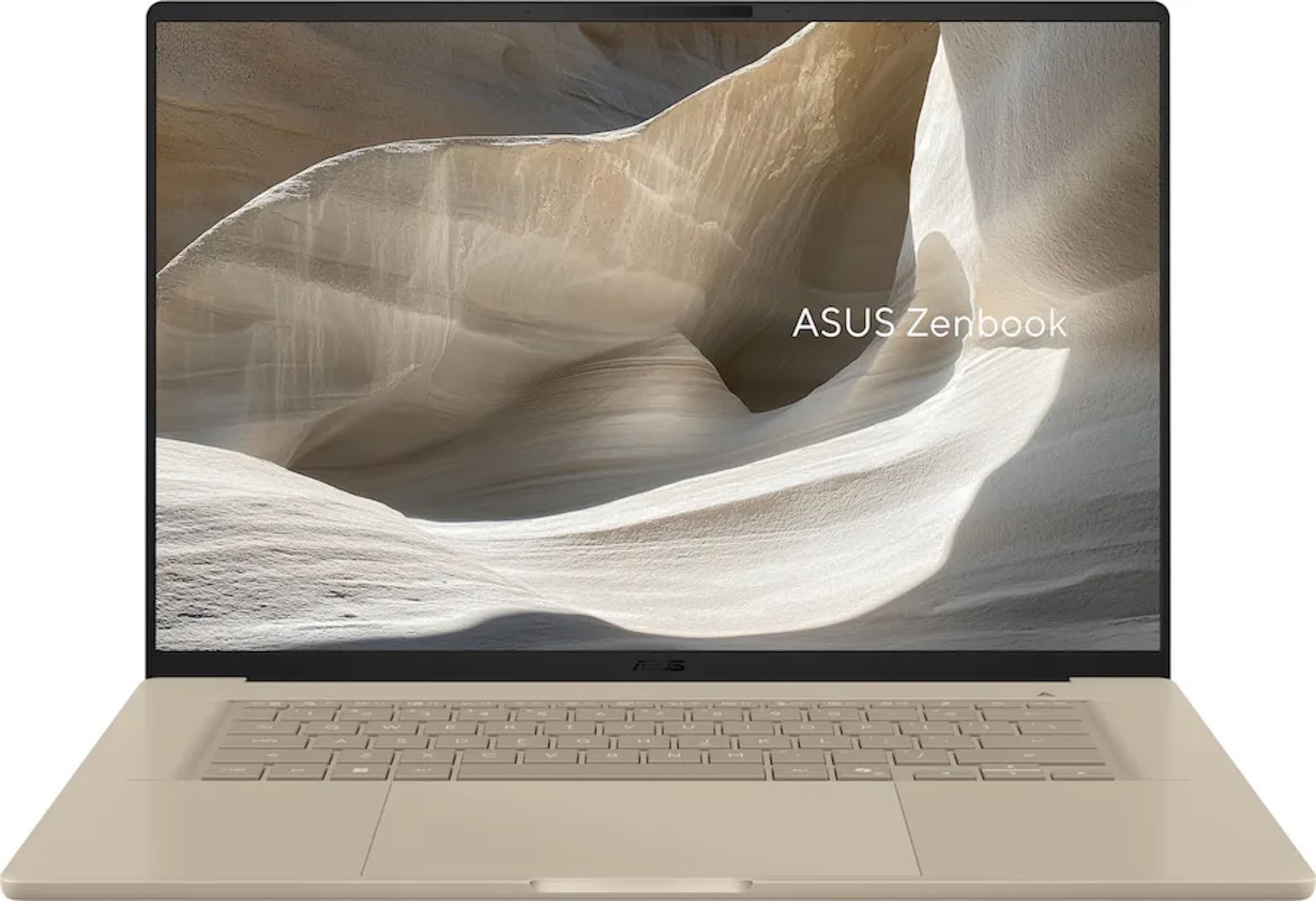
These chips are no longer just slide-deck concepts. Qualcomm's Snapdragon X2 laptop rollout has now reached retail, with Best Buy listing the Asus Zenbook A16 configured with the Snapdragon X2 Elite Extreme starting at $1,699.99.

HP's OmniBook Ultra 14 joins the launch lineup with a Snapdragon X2 Elite, 32GB of RAM, 1TB of storage, and a price of $2,049.99.

For early adopters comparing specs and pricing, the Zenbook A16 currently looks like the more aggressive option. At $1,699.99, it matches Qualcomm's top X2 tier with a 16-inch 2,880 × 1,800 OLED 12 Hz touch display and 48GB of RAM. That memory capacity is notable in this first Copilot+ wave, where higher-memory configurations have typically carried significantly higher price tags.

These stronger baseline specs give this first retail wave a different profile compared with the earliest Copilot+ PCs, which often paired new NPUs with conservative memory and storage choices.
Instead, Qualcomm and its partners appear to be betting that high-memory, high-refresh OLED designs in thin-and-light systems will better showcase what a second-generation Arm PC platform can achieve under sustained load, particularly with demanding AI and content-creation workflows.

If that bet pays off, the X2 family's combination of 80 TOPS NPUs, up to 18 CPU cores at 5.0GHz, and more generous RAM configurations could redefine expectations for Copilot+-class Windows laptops in 2026, rather than repeating the cautious spec sheets that characterized many of last year's launches.

Permalink to story:

 
Seeing how ARM has been treated on phones and tablets, I don't want a laptop with ARM in it. Unless Valve can get proton working on ARM chips as well it can on these "notebooks", I don't really want one. They aren't good outside of office work and ARM gaming is almost all MTX filled garbage designed to milk as much out of the player as possible.
 
Nice Zenbook. They should offer it with 16GB RAM and a more attractive price.
I think if they shave off that remaining RAM, it could be a killer laptop for work
at an unbeatable price.
 
Seeing how ARM has been treated on phones and tablets, I don't want a laptop with ARM in it. Unless Valve can get proton working on ARM chips as well it can on these "notebooks", I don't really want one. They aren't good outside of office work and ARM gaming is almost all MTX filled garbage designed to milk as much out of the player as possible.
Mobile gaming is not a requirement for ARM. IDK how you managed to connect a CPU architecture to a platform (and BTW there were x86 phones too....soooooo).

Also did you forget Apple runs on ARM? Is CP2077 a mobile MTX game now? What about games run through parallels on Mac?

Proton can already run on ARM via linux. And Windows software runs automatically through translation software. It's not 2005, CPU translation isnt the crazy black box it used to be.
 
Mobile gaming is not a requirement for ARM. IDK how you managed to connect a CPU architecture to a platform (and BTW there were x86 phones too....soooooo).

Also did you forget Apple runs on ARM? Is CP2077 a mobile MTX game now? What about games run through parallels on Mac?

Proton can already run on ARM via linux. And Windows software runs automatically through translation software. It's not 2005, CPU translation isnt the crazy black box it used to be.
what you fail to understand is that ARM is attractive to developers bcause of MTX and even if it isn't the dominant system on ARM(IT is), developers will fight tooth and nail to keep it that way. That's why we find very few free and opensource ARM systems. ARM isn't from free and open arcitexture that everyone can use, it's something that's mostly abused by devs to bleed profit margins out of customers by using terms like "sideloading" and "jailbreaking" not to mention I can't use any of my bank, email or work apps if I decided to jailbreak my phone so I'm suck letting google go in dry without a pillow to bite on.
 
what you fail to understand is that ARM is attractive to developers bcause of MTX and even if it isn't the dominant system on ARM(IT is), developers will fight tooth and nail to keep it that way. That's why we find very few free and opensource ARM systems. ARM isn't from free and open arcitexture that everyone can use, it's something that's mostly abused by devs to bleed profit margins out of customers by using terms like "sideloading" and "jailbreaking" not to mention I can't use any of my bank, email or work apps if I decided to jailbreak my phone so I'm suck letting google go in dry without a pillow to bite on.
ARM has absolutely nothing to do with micro transactions. You seem to lack a fundamental understanding of what software is and what hardware is

What you are looking for is PLATFORM. it's Android and iOS that are attractive to developers, providing a closed garden and access to normal consumers with low demands. Arm, x86, PPC, none of that matters.
 
Last edited:
Hard pass until I see proof positive Qualcomm has gotten serious about drivers and I don't have to use emulation ever.

The sad thing is, Panther Lake has much better battery life.

If we could put MacOS or Linux on this it would be a lot more appealing.
 
Hard pass until I see proof positive Qualcomm has gotten serious about drivers and I don't have to use emulation ever.

The sad thing is, Panther Lake has much better battery life.

If we could put MacOS or Linux on this it would be a lot more appealing.

At 1700 base you might as well get the macbook
 
ARM has absolutely nothing to do with micro transactions. You seem to lack a fundamental understanding of what software is and what hardware is

What you are looking for is PLATFORM. it's Android and iOS that are attractive to developers, providing a closed garden and access to normal consumers with low demands. Arm, x86, PPC, none of that matters.
We've been conditioned that MTX are "normal" on mobile gaming and the vast majority of ARM "platforms" are full of MTX. You could go with some ARM based Linux distro that has almost no software support
 
With how well the Macbook Neo is selling, Windows on ARM needs to pickup or Intel needs to step up their game. IMO the current lineup of PC laptops is horrendous compared to the amazing build quality and performance of the Neo. For me there is absolutely no point in getting a windows laptop right now when compared with the neo, and this coming from a windows person myself.
 
With how well the Macbook Neo is selling, Windows on ARM needs to pickup or Intel needs to step up their game. IMO the current lineup of PC laptops is horrendous compared to the amazing build quality and performance of the Neo. For me there is absolutely no point in getting a windows laptop right now when compared with the neo, and this coming from a windows person myself.
Unless you need windows for gaming or a particular use case (Solidworks for example) there hasn't been a reason to get a windows laptop aside from price since the M1 Air launched. The Neo killed that final reason. With the current situation Microsoft would have to put up a lot of money to buy RAM and space at TSMC to sell a competing budget surface, I don't think any other company has the financials to compete with apple in the AI powered hardware hellscape.
 
With how well the Macbook Neo is selling, Windows on ARM needs to pickup or Intel needs to step up their game. IMO the current lineup of PC laptops is horrendous compared to the amazing build quality and performance of the Neo. For me there is absolutely no point in getting a windows laptop right now when compared with the neo, and this coming from a windows person myself.

ARM is to Apple as a 386sx is to a Strix Halo. Apple has so many custom parts in their SOC, and the software and OS is customized to use all of it to maximum effect, that people are giving far too much credit to the ARM cores themselves. If Qualcomm had done what they were tasked to do, which was to create an ARM SOC geared to run Windows and x86, instead of a killer ARM SOC for generic computing, they'd probably work better and sell better.
 
Yeah it's outrageous to see Apple as the value leader now, but I'm seriously looking at a second hand M4 Macbook Pro's at this stage. Still; I'd prefer the freedom of Linux.
Honestly you could go older. I got the M1 Pro 14" before the price bump that came with the next gen and it's still going strong nearly 5 years later
 
With how well the Macbook Neo is selling, Windows on ARM needs to pickup or Intel needs to step up their game. IMO the current lineup of PC laptops is horrendous compared to the amazing build quality and performance of the Neo. For me there is absolutely no point in getting a windows laptop right now when compared with the neo, and this coming from a windows person myself.
When Apple first introduced the M1, the right thing that they did at the time was to release the M1 MacBook Air at 999, if I am not wrong. By pricing it low at the start, good optimization at the get go, I recalled Apple sold a lot of MBA. Once it looks good, they started to slowly introduce the Pro, Max and Ultra models.

In the case of Qualcomm, they did the opposite, which I assume they thought they will have the same success as Apple from their bullish comments about ARM replacing x86 by so and so date. The initial devices cost a lot and optimization leaves a lot to be desired. With the second gen, they are still pricing it at a premium, so with the prior bad experience, I wonder if people will actually want to try again.

Pricing their product the same as a MacBook is going to be a problem. For me, the only upside when buying a Qualcomm PC over a MacBook is the upgradable storage. However, the fact that it is designed to run on Windows only, is a show stopper for me, period. Qualcomm should seriously consider optimizing for Linux.
 
Back