Underwater solar power sounds impossible, these new perovskite cells make it work anyway

Alfonso Maruccia

Posts: 2,724   +1,040
Staff
Sunlight from the Deep: A team of Chinese researchers has developed a novel approach to solar power generation in environments where sunlight is scarce. Perovskite solar cells can be treated to operate underwater, with surprisingly good results in terms of reliability and endurance.

A newly published study describes a "robust" strategy for reliably generating power underwater. Several Chinese researchers developed a new type of submerged perovskite solar cell that can operate a few meters below sea level and harvest solar energy for years while retaining high efficiency.

In recent years, perovskite-based cells have essentially hijacked research efforts focused on new solar power breakthroughs. First discovered in 1839 beneath the Ural Mountains in Russia, perovskite is a highly flexible class of compounds that is used in ultrasound machines, memory chips, solar cells, and more.

Moisture can have a destructive impact on perovskite cells, but the Chinese researchers have apparently found a way to make their underwater setup run reliably and efficiently for years. The team "tweaked" the chemical mixture of the perovskite cells, producing a material that can both absorb the dim wavelengths reaching the seafloor and withstand degradation in seawater.

The tweaked perovskite cells are also covered by a water-repelling layer, which should help keep moisture-related degradation in check. By using larger crystal configurations, the perovskite compound can also limit the material's breakdown and improve electricity production.
The researchers first tested the new material at a simulated ocean depth of 10 meters, where it was able to convert around 35% of the dim light into electricity. Meanwhile, silicon-based solar panels can usually convert around 20% of surface sunlight into electricity. According to the in-lab tests, the new panels could retain most of their original efficiency for more than five years.

After the lab tests, the team brought the new perovskite panel to the South China Sea. The cells were mounted on a small submarine device designed to reach and maintain a specific depth. The device also included some coin-cell batteries to test the panel's ability to actually generate electricity.

The researchers tested the perovskite compound at two meters, six meters, and 10 meters below sea level. They discovered that power generation fluctuated significantly at around two meters but became more consistent at greater depths. At 10 meters, the panel was able to generate less than a quarter of the electricity it generated eight meters above.

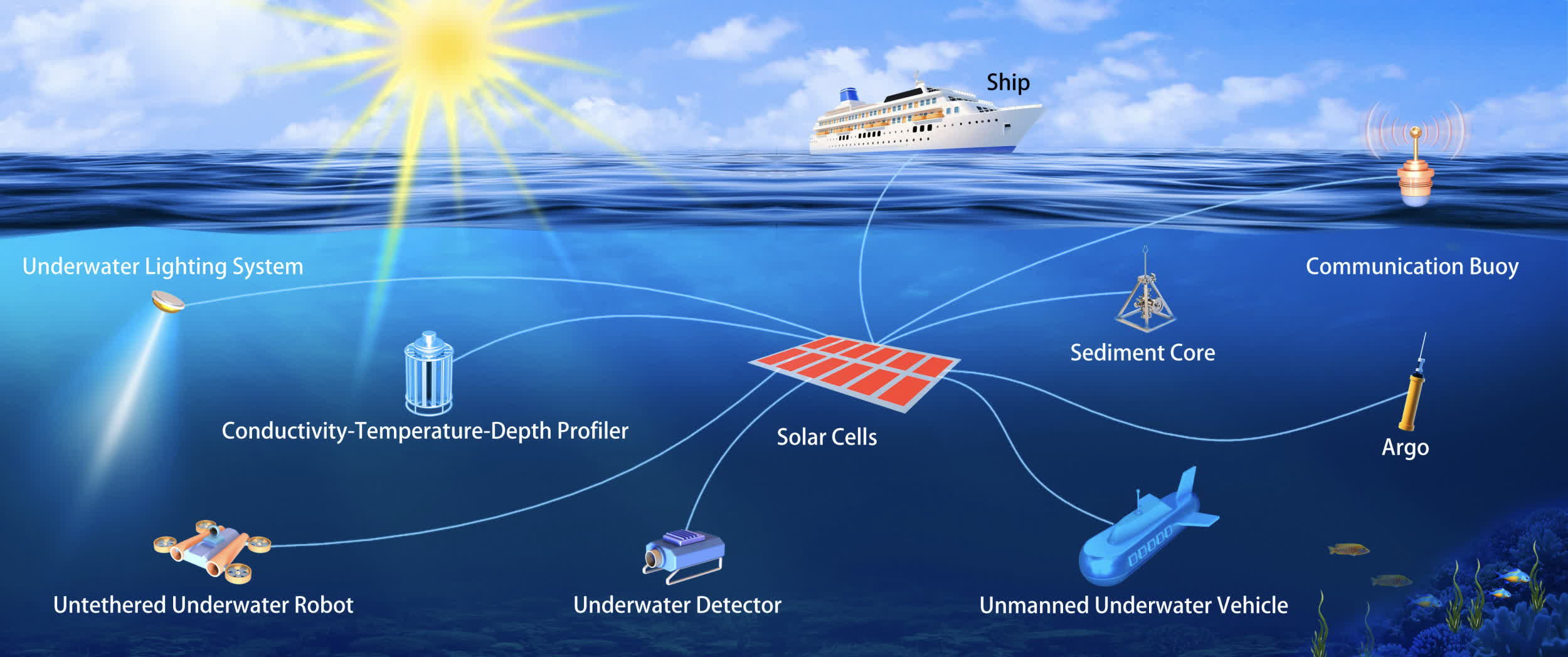
Despite the harsh environment and dim light conditions, the researchers think their new perovskite cells could one day solve the "challenge" of harvesting solar energy underwater. The study describes some hypothetical scenarios where this kind of power generation could be useful, including autonomous marine power systems and submerged Internet of Things infrastructure.

Permalink to story:

 
Someone should explain to these incredible minds the concept of a desert because I think focusing on former oceans- which have no water, over current oceans - which are very much filled with water, could do wonders for their costs.
 
Someone should explain to these incredible minds the concept of a desert because I think focusing on former oceans- which have no water, over current oceans - which are very much filled with water, could do wonders for their costs.
I think the point of this technology is for stuff that has to operate in the ocean. You wouldn't deploy a solar farm underwater to power a city or whatever that is on land.
 
At 10 meters, the solar panels were able to generate less than a quarter of the power as 2 meters? Here is a graph showing ideal amounts of light passing through clear water:


The amount of light at 10m should be 63% of what reaches 2m (52/83) but instead is 2.5x worse (63/25). That means at 2m instead of getting 83% efficiency, light absorption lowers that to 57.5% (100-[100-83]*2.5). Multiply that by ideal efficiency and you get 20% effective efficiency (35*0.575). That is what happens when you put solar panels under ocean water instead of clear water, but water reflectivity is not being considered here which will certainly lower efficiency to below 20%. That means the comparison being made to 20% efficient silicon solar panels at ground level must be wrong.

Anyways, this was studied in ideal conditions (in the South China Sea which is entirely in the tropics). As you get farther from the equator, as it gets closer to winter, and as it gets further from noon, the amount of power generated drops exponentially because of sharper angles. Light must travel more distance to reach the same depth, and the reflectivity of water increases as the angle increases (the latter is worsened by waves).

Here is the source on how much light penetrates water: https://manoa.hawaii.edu/exploringourfluidearth/physical/ocean-depths/light-ocean
 
Last edited:
I think the point of this technology is for stuff that has to operate in the ocean. You wouldn't deploy a solar farm underwater to power a city or whatever that is on land.

What are they doing out in the middle of the ocean that won't be sent back to land via a cable that also carries electricity? How much diesel do they burn to retrieve the solar-powered results?

They'd have to rely on satellites if not, and that requires a floating antenna with either a very specific alignment, or a constellation so large overhead that it doesn't matter.
 
What are they doing out in the middle of the ocean that won't be sent back to land via a cable that also carries electricity? How much diesel do they burn to retrieve the solar-powered results?
Huh? Ships have no problem communicating right now while bobbing on the waves and moving around without any cables dragged behind them.
 
Anyways, this was studied in ideal conditions (in the South China Sea which is entirely in the tropics). As you get farther from the equator, as it gets closer to winter, and as it gets further from noon, the amount of power generated drops exponentially because of sharper angles. Light must travel more distance to reach the same depth, and the reflectivity of water increases as the angle increases (the latter is worsened by waves).
Operating within the environmentally suitable conditions is not unheard of. For example, I believe polar research is vastly more often performed during the summer.
 
Huh? Ships have no problem communicating right now while bobbing on the waves and moving around without any cables dragged behind them.

Current pre-starlink style systems like satcom use substantial power for all that long distance radio gear, often on motorized pedestals that correct for the movements of the ship. It certainly wouldn't come from solar. Starlink is phased array and uses a different architecture that doesn't need as much juice to hit those LEO targets, but it's still around 300 watts for a connection and still requires a floating antenna. Even then it would get pretty lively on the waves, tethered to a little buoy or what have you.

If were trying to overcome that challenge, I'd deploy them in clustered situations connected to a more central stable platform, even then... if it's the ocean? Wildcard.
 
Back