Study shows Tesla has the highest fatal accident rate of any car brand

Skye Jacobs

Posts: 2,012   +59
Staff
The big picture: While Tesla has yet to respond to the iSeeCars report, regulators and consumers will closely watch the company's next moves. As autonomous and semi-autonomous vehicles become more prevalent, it is clear that the industry must grapple with the technical challenges of creating safer cars and the human factors that continue to affect road safety.
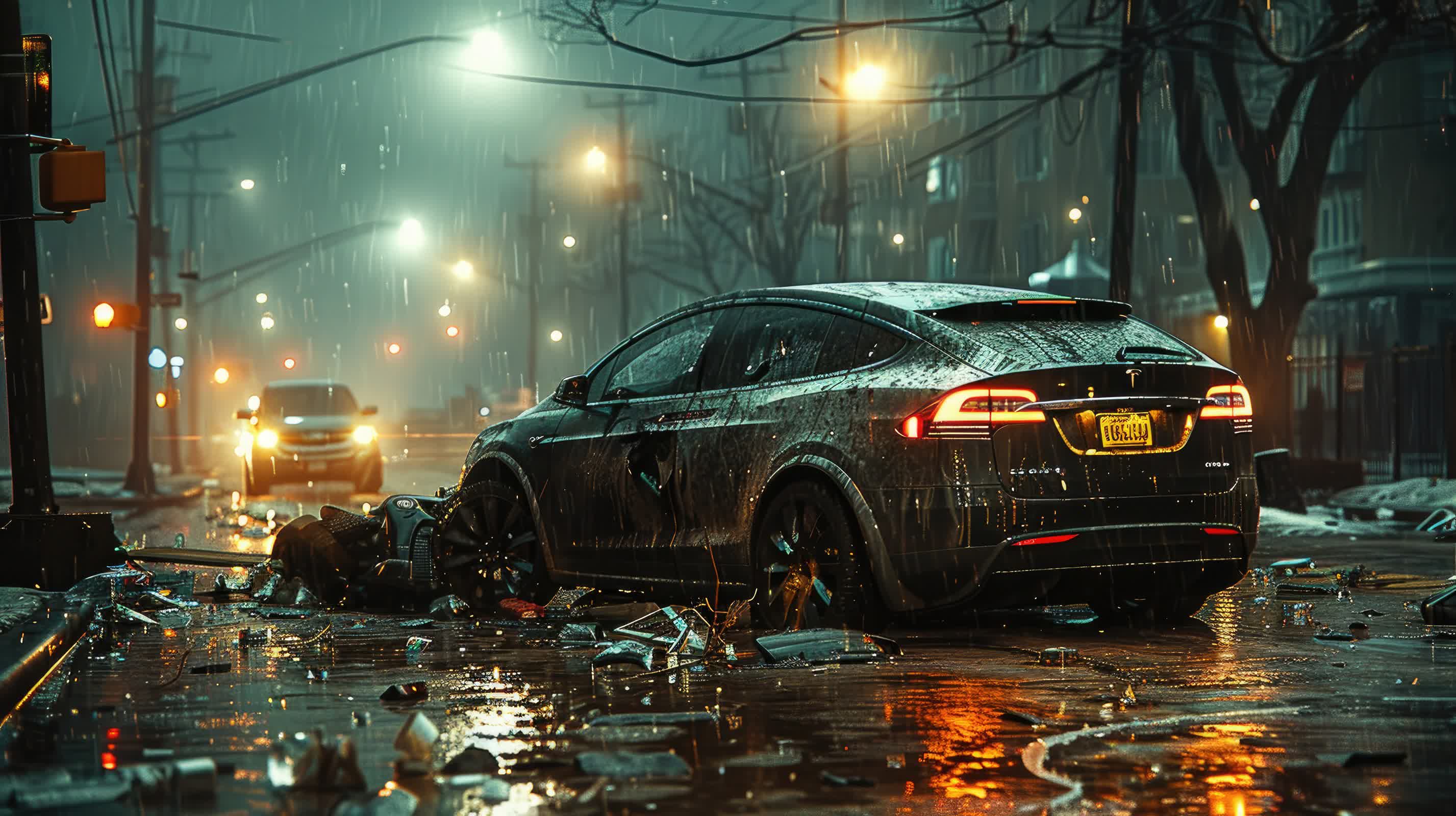
Tesla's long-standing reputation for producing the safest vehicles on the road has been called into question by a recent study from auto research firm iSeeCars. The report reveals that Tesla vehicles have the highest rate of fatal accidents among all car brands, contradicting the company's bold safety claims and challenging CEO Elon Musk's many assertions on the topic.

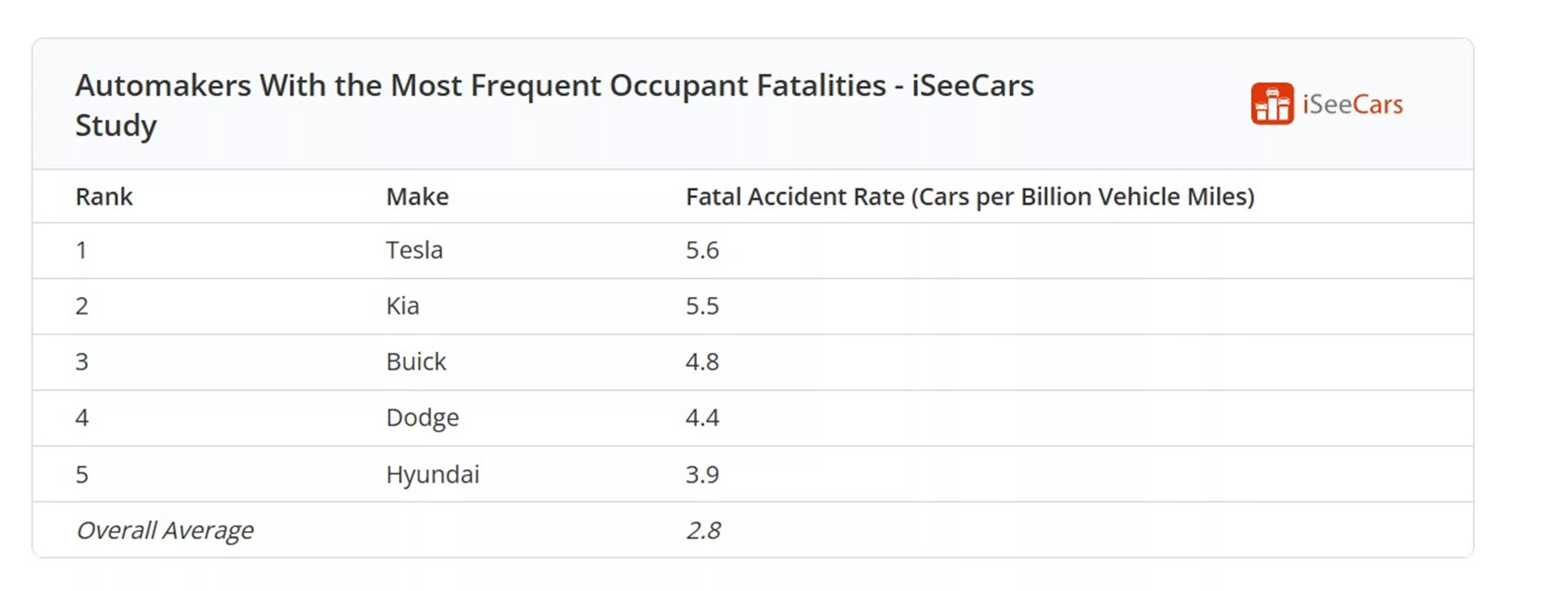
The study, which analyzed fatal collisions from 2017 to 2022 involving 2018 to 2022 car models, found that Tesla had 5.6 fatal accidents per billion miles traveled, narrowly surpassing Kia's 5.5 per billion miles. This statistic places Tesla at the top of the list for brands with the highest rate of deadly accidents.

Two Tesla models were singled out in the report. The Tesla Model Y ranked sixth among the most dangerous cars, with a fatal accident rate 3.7 times higher than the average car and 4.8 times higher than the average SUV. Meanwhile, the Tesla Model S showed a fatal accident rate double that of the average car.
These findings stand in stark contrast to statements made by Tesla CEO Elon Musk and the company's marketing materials. Musk has repeatedly claimed that Teslas are "the safest cars on the road," while the automaker markets its vehicles as "engineered to be the safest in the world."

The study's results are particularly noteworthy given Tesla's advanced driver assistance technologies, including Autopilot and Full Self-Driving (FSD). These systems are designed to reduce human error and enhance safety, yet the data suggests they may not be as effective as claimed.

Karl Brauer, an executive analyst at iSeeCars, told Rolling Stone that the elevated accident rates likely "reflect a combination of driver behavior and driving conditions" rather than inherent vehicle safety issues.

The discrepancy between Tesla's safety claims and real-world accident data has not gone unnoticed by regulators. Both the National Highway Traffic Safety Administration (NHTSA) and the Department of Justice are investigating whether Tesla misled customers about the capabilities of its Autopilot and FSD systems.

Critics argue that these advanced systems may lead to driver complacency or distraction, potentially contributing to accidents when manual intervention is required. Despite the concerning accident data and ongoing investigations, Elon Musk remains optimistic about Tesla's autonomous driving future.

In October, Musk unveiled plans for a steering wheel-free Robotaxi or Cybercab, predicting production would begin before 2027. However, industry experts remain skeptical about Tesla's ability to compete with established players in the autonomous taxi market, such as Waymo, a Google subsidiary with an active fleet already in operation.

The study also highlights a concerning trend across the automotive industry. While modern vehicles are equipped with increasingly advanced safety features, rising accident and death rates suggest these improvements are being offset by distracted driving and higher speeds. Data from the study serves as a reminder that even the most advanced vehicle technologies cannot fully compensate for human behavior behind the wheel.

Permalink to story:

 
Teslas tend to be quite affordable for the performance they offer so they sell more of them. If you gave everyone a Ferrari then you'd expect to see more Ferrari fatalities. If you looked at the statistics for cars of a similar performance and then looked at fatalities as a percentage of sales then you might get a more honest indication of safety.
 
Looks like Tesla’s Autopilot might be doing a bit too much “autopiloting” for its drivers. Maybe the real danger isn’t the car but the people behind the wheel watching Netflix instead of the road.
 
Looking at what has been put forward, I’d question the intent of the report. The data range for a start seems misaligned with the age of the cars.

How the report got its milage would be interesting as well.
 
Take into account that a higher ratio of people who drive teslas love accelerating quickly or drag racing on public roads compared to other car companies. Its the type of people who drive a companies cars that makes a difference. I highly doubt it has anything to do with the car
 
No surprise to also KIA and Hyundai plumbing new lows.

I had to chuckle at the bit where it says Telsa have long been regarded as safest cars on the road. ROFLMAO.
 
Supercar acceleration.
Drivers are FSD beta testers.
Egos.
Everything accessed via a giant screen.
Musks' mission to reduce regulations.

What could possibly go wrong?
Oh....
Musk's mission has been to obliterate the NHTSA's testing. Remember when they broke their machine with the model S?

I guess that got removed from the NPC firmware at some point.
No surprise to also KIA and Hyundai plumbing new lows.

I had to chuckle at the bit where it says Telsa have long been regarded as safest cars on the road. ROFLMAO.
They have some of the safest rating of any new car. At some point, you have to accept that driving is a dangerous task, there is only so much you can do to absorb highway speed impacts on a human body that was never designed to travel that fast.
 
Looking at what has been put forward, I’d question the intent of the report. The data range for a start seems misaligned with the age of the cars.

How the report got its milage would be interesting as well.
There’s certainly an issue with the age of the cars. The Model S makes more sense, but the report includes data from 2017-2022. The Model Y (#6 on the list) began production in 2020, meaning it has only half the data period represented AND all of its drivers were new with 0-3 years of driving the vehicle. To exacerbate the problem, most miles of driving history will happen from commuting, and Covid began the same year the Model Y was released. And in its best selling market (California), lockdowns continued longer than in most other states.

There’s supporting evidence for this, which is the #1 and #5 “most dangerous” cars on the list have exactly the same problems: the Hyundai Venue and the Honda CR-V Hybrid. Note that these are all SUV’s, and they are at the top of the SUV list as well.
 
It is the same old argument about flying - it only comes out safest when judged by miles traveled. Most accidents on the road, just like flying, happen close to the start or end of the journey.
 
Looks like Tesla’s Autopilot might be doing a bit too much “autopiloting” for its drivers. Maybe the real danger isn’t the car but the people behind the wheel watching Netflix instead of the road.
Agreed. And I think the article itself strongly suggests this is the actual problem. I note the article does not delve into crash test statistics. This is the category which would actually address the structural safety of Teslas. I'm very skeptical about the whole concept of autopilot vehicle systems in general. Even if the technology itself was perfect, you are putting it on the road with other vehicles operated by imperfect people, whose range of possible decisions and actions is practically infinite and, therefore, cannot be perfectly anticipated even by AI.
 
Last edited:
Interesting that all this data comes around after Musk sides with Trump. They swore they'd take him down one peg at a time.
 
This is really more of a commentary on the shortcomings of autonomous driving systems than it is on Tesla safety. I would like to see the stats on Tesla safety vs. other manufacturers who produce autonomous driving system vehicles. And I would also like to see safety stats on nonautonomous driving vehicles vs. autonomous driving vehicles.
 
If you gave everyone a Ferrari then you'd expect to see more Ferrari fatalities.
The stats are per mile driven (number of fatalities per billion miles) - I.e. Ferraris are safer than Teslas in terms of fatalities per mile.

You're right that if Ferraris were as affordable as Teslas and everyone could have them - things would maybe change. Maybe. Who would want a Ferrari if it could cost as little as Tesla? 🤔
 
This is really more of a commentary on the shortcomings of autonomous driving systems than it is on Tesla safety. I would like to see the stats on Tesla safety vs. other manufacturers who produce autonomous driving system vehicles. And I would also like to see safety stats on nonautonomous driving vehicles vs. autonomous driving vehicles.
First source link for the study named in the article.
 
First source link for the study named in the article.
And as I pointed out, the study is extremely flawed. No one should trust it. There are 3 SUVs (Hyundai Venue, Honda CR-V Hybrid, Tesla Model Y) that are among the most "unsafe" vehicles listed at the top of the report... Aren't SUVs supposed to have a natural advantage due to their size and mass?

Here's why it's flawed: its data comes from 2017-2022 and the most unsafe SUVs were basically introduced right around when Covid started (they were new models) and primarily in California (including the Model Y). With the way lockdowns were there, there was little commute happening and therefore few miles recorded, causing most miles to be driven leisurely. Meanwhile for other vehicles existing pre-Covid, they had all the commute/repeated route driving data included as well.

If you want to run a quick sanity check, then why don't you compare the Honda CR-V Hybrid with the Honda CR-V? They can't be that different in design... But the Honda CR-V is not even listed, so it's at least 3x less deadly. Before anyone can trust/cite this report, I want to see an explanation of why that is. Otherwise we might as well just write articles about how unsafe Honda's hybrid technology is.
 
Looking at what has been put forward, I’d question the intent of the report. The data range for a start seems misaligned with the age of the cars.

How the report got its milage would be interesting as well.
Its probably fake big oil news but haters and paid posters will gobble any Tesla hate they can find...
From the official crash tests in many many countries Tesla ranks N1 in safety. This is real data you can trust.
 
Back