
Forward-looking: Modern data storage has a short lifespan. Hard drives fail, SSDs wear out, and even magnetic tape needs periodic rewriting to avoid degradation. Now, an ambitious technology is aiming to change the status quo with storage media designed to last not decades or centuries, but literally billions of years.
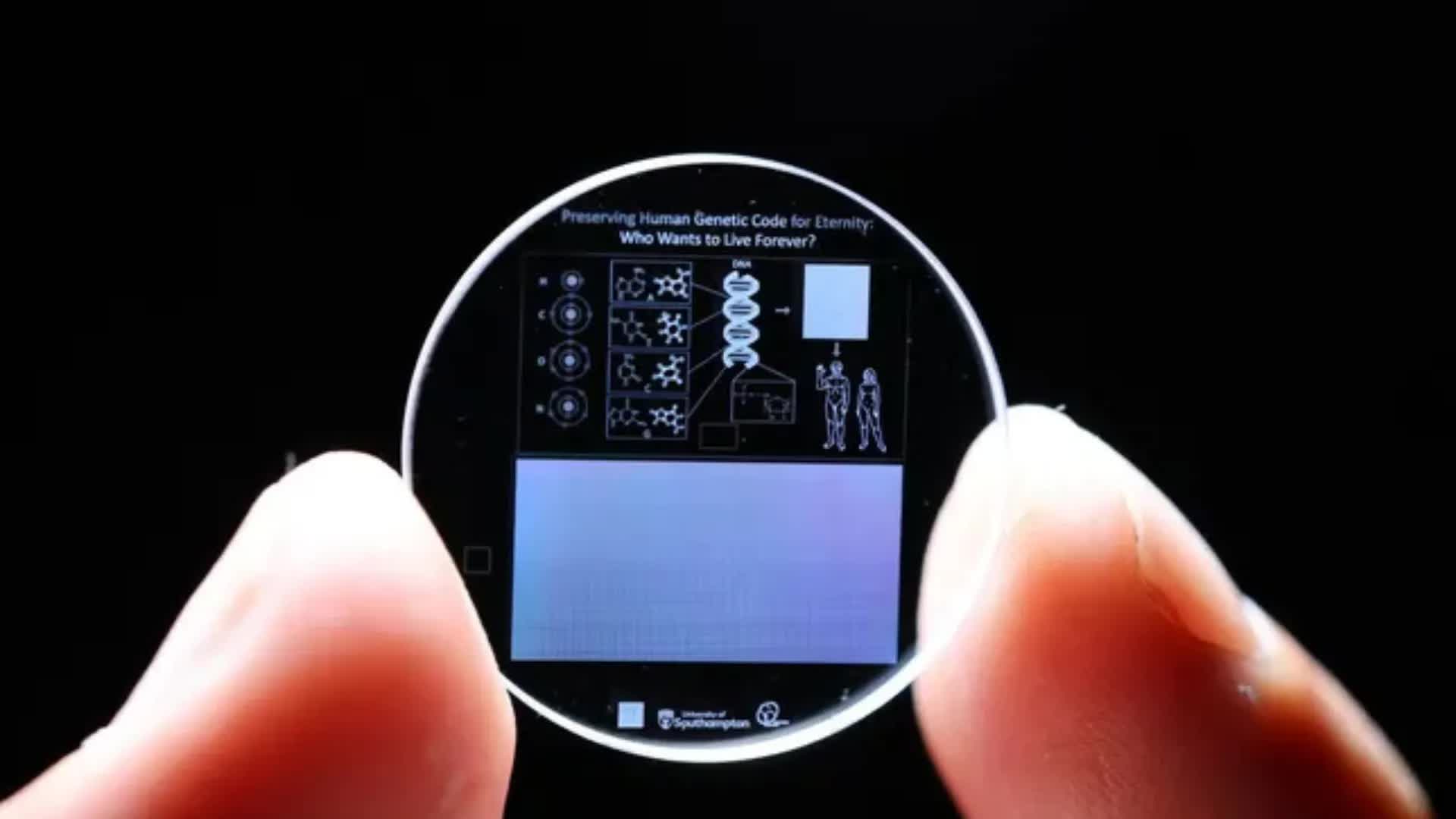
UK-based startup SPhotonix was formed in 2024 to commercialize what's known as 5D optical data storage, often referred to as "memory crystals." Essentially, the technique encodes vast amounts of data inside ultra-durable glass using lasers so precise they can manipulate matter at the nanoscale.
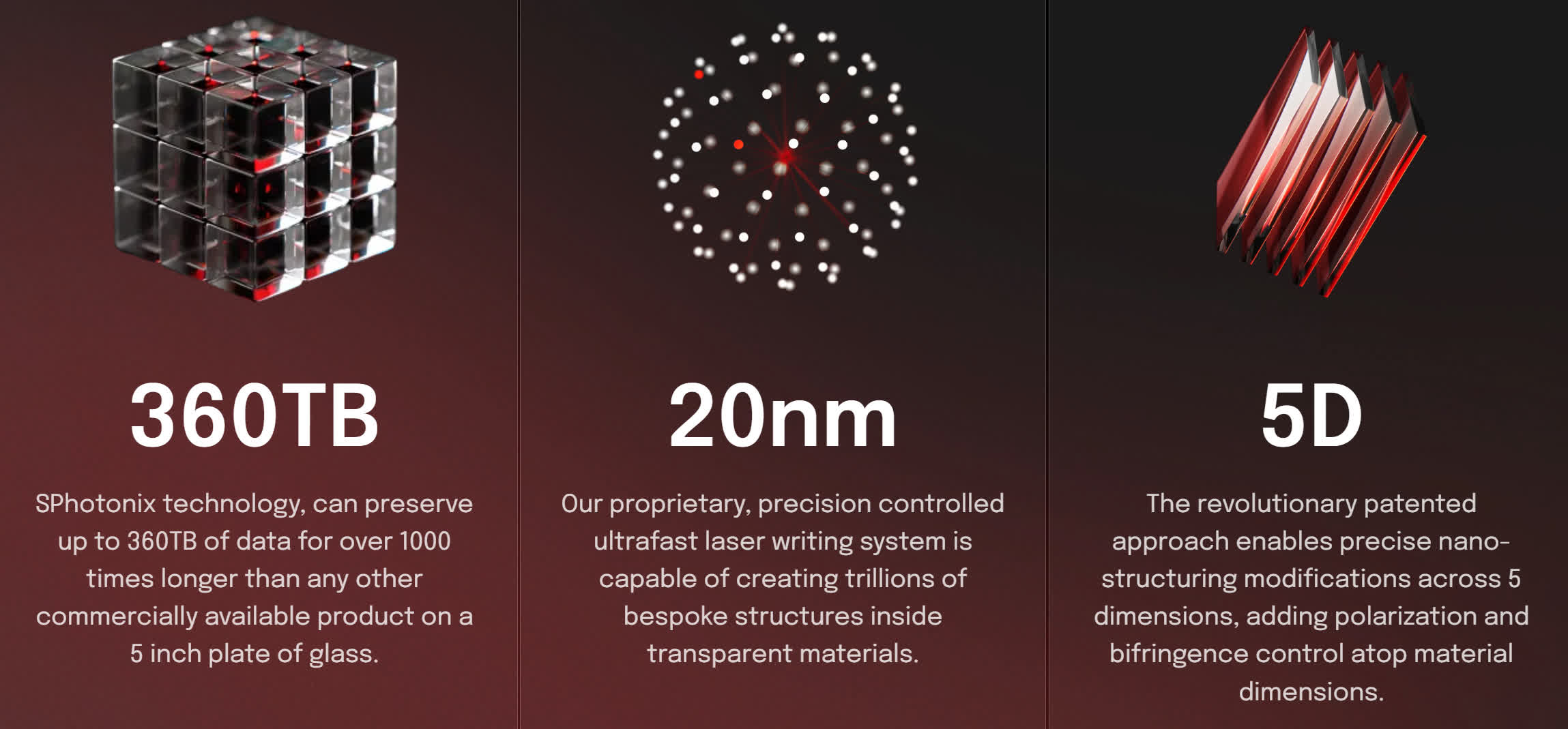
Instead of storing bits on a surface, SPhotonix uses femtosecond lasers to write data throughout the volume of a fused-silica glass disc. Information is encoded across three spatial dimensions, plus two additional optical properties – the orientation and strength of the laser-induced nanostructures. Together, those five dimensions dramatically increase storage density while making the data incredibly resilient.
The company claims a single glass disc roughly the size of a traditional optical platter could hold up to 360 terabytes of data. But it's the lifespan that's making headlines: under normal conditions, the medium should remain readable for 13.8 billion years, roughly the age of the universe. The glass is resistant to heat, radiation, electromagnetic interference, and physical decay – all the usual enemies of long-term storage.
There are trade-offs, of course. Current prototypes are nowhere near competitive with modern SSDs or even hard drives in terms of speed. Write performance is around 4 MB/s, with reads topping out at around 30 MB/s. That puts 5D glass firmly in the "deep archive" category, suited for data that may be accessed rarely but must never be lost. However, SPhotonix's roadmap targets sustained read and write speeds of 500 MB/s within three to four years.
It's obviously not a cheap system, either. SPhotonix estimates it will cost $30,000 for a writer and $6,000 for a reader. It expects a field-deployable reader will be ready in about 18 months.
The current limitations haven't stopped interest from data center operators. As global data creation accelerates, hyperscalers and research institutions are facing rising costs – not just financial, but environmental – associated with keeping petabytes of cold data powered, cooled, and periodically refreshed. A storage medium that requires no power, no maintenance, and no rewriting once written is an enticing proposition.
SPhotonix recently secured several million dollars in funding to move its technology beyond laboratory validation and into pilot systems designed for real data-center environments.
The company is targeting archival use cases such as scientific data, cultural records, legal archives, and historical datasets – information that must survive far longer than the hardware used to create it. 13.8 billion years should certainly meet that requirement.
This 5D "memory crystal" glass storage could preserve data for 13.8 billion years


