Forward-looking: Columbia University researchers have developed a compact photonics chip capable of producing dozens of laser wavelengths from a single high-power source, a breakthrough that could transform how data centers handle the staggering information demands driven by artificial intelligence. The work, led by Professor Michal Lipson, demonstrates how a complex optical system once confined to laboratory benches can now fit on a single silicon chip.

The technology hinges on what physicists call a frequency comb, a laser that emits many distinct colors, or wavelengths, evenly spaced across the optical spectrum. Each wavelength serves as a stable channel for data, enabling multiple streams to transmit in parallel without interference.
In optical communication networks, this principle – known as wavelength-division multiplexing – allows light of different colors to carry separate signals through a fiber at the same time, multiplying bandwidth.
Until now, creating such a frequency comb required bulky, high-cost laser setups. Lipson's team managed to integrate one directly into a silicon photonics chip using a multimode laser diode, a powerful but noisy light source common in industrial and medical applications.
The challenge lay in refining the raw, unstable light into a coherent beam that could form evenly spaced wavelengths. To do this, the researchers used a feedback technique known as self-injection locking. By routing a fraction of the laser's output back into the device through micro-resonators etched onto the chip, they stabilized and purified the beam. Once cleaned, the nonlinear properties of the chip material transformed the single laser line into a comb of sharp, stable frequencies.
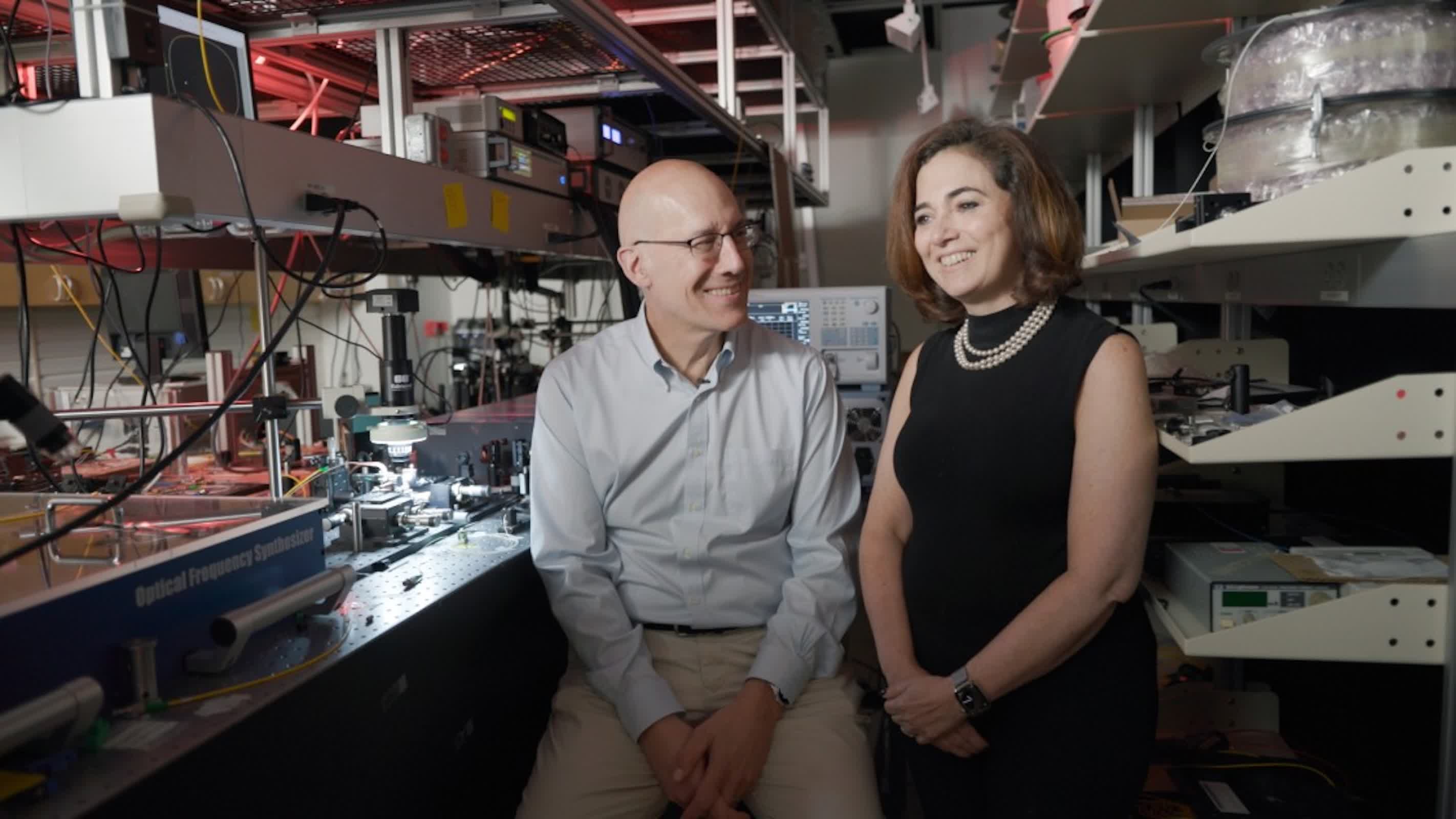
Alexander Gaeta (left) and Michal Lipson, in the Gaeta lab at Columbia University
The result is a miniaturized, high-power optical source that can replace entire racks of individual lasers in high-speed communication systems. Andres Gil-Molina, a principal engineer at Xscape Photonics and a co-author of the study, said the device converts one powerful laser into dozens of clean, high-power channels on a chip. This drastically reduces size, cost, and energy consumption. In data centers, this could mean faster communication between processors and memory, where energy-hungry AI operations increasingly strain existing infrastructure.
The advance builds on the growing field of silicon photonics, which seeks to integrate optical components like waveguides, modulators, and detectors into chips in a similar way that transistors are integrated in electronics. Lipson's lab at Columbia has long worked to push the boundaries of this integration. By integrating a stable, multi-wavelength laser source with other photonic and electronic components on the same chip, the new design simplifies optical network architecture and significantly reduces the power required for data transfer.
Beyond computing applications, compact frequency-comb chips may enable other precision technologies, including portable spectrometers, chip-scale optical clocks, quantum communication systems, and advanced LiDAR sensors for autonomous vehicles. For Lipson, the achievement underscores a larger goal in photonics research: moving versatile, high-performance light sources out of specialized labs and into real-world devices.
This silicon chip creates dozens of laser beams from one source – and could reshape data centers


