Forward-looking: By demonstrating a chip that can produce multiple frequencies without adjustment, a Maryland research team has brought photonic integration closer to parity with the semiconductor revolution that transformed electronics decades ago. Instead of relying on bulky optical benches or external lasers, future systems could draw on a spectral toolkit from a thumbnail-sized chip – an incremental yet essential step toward practical quantum networks and precision optical instruments.
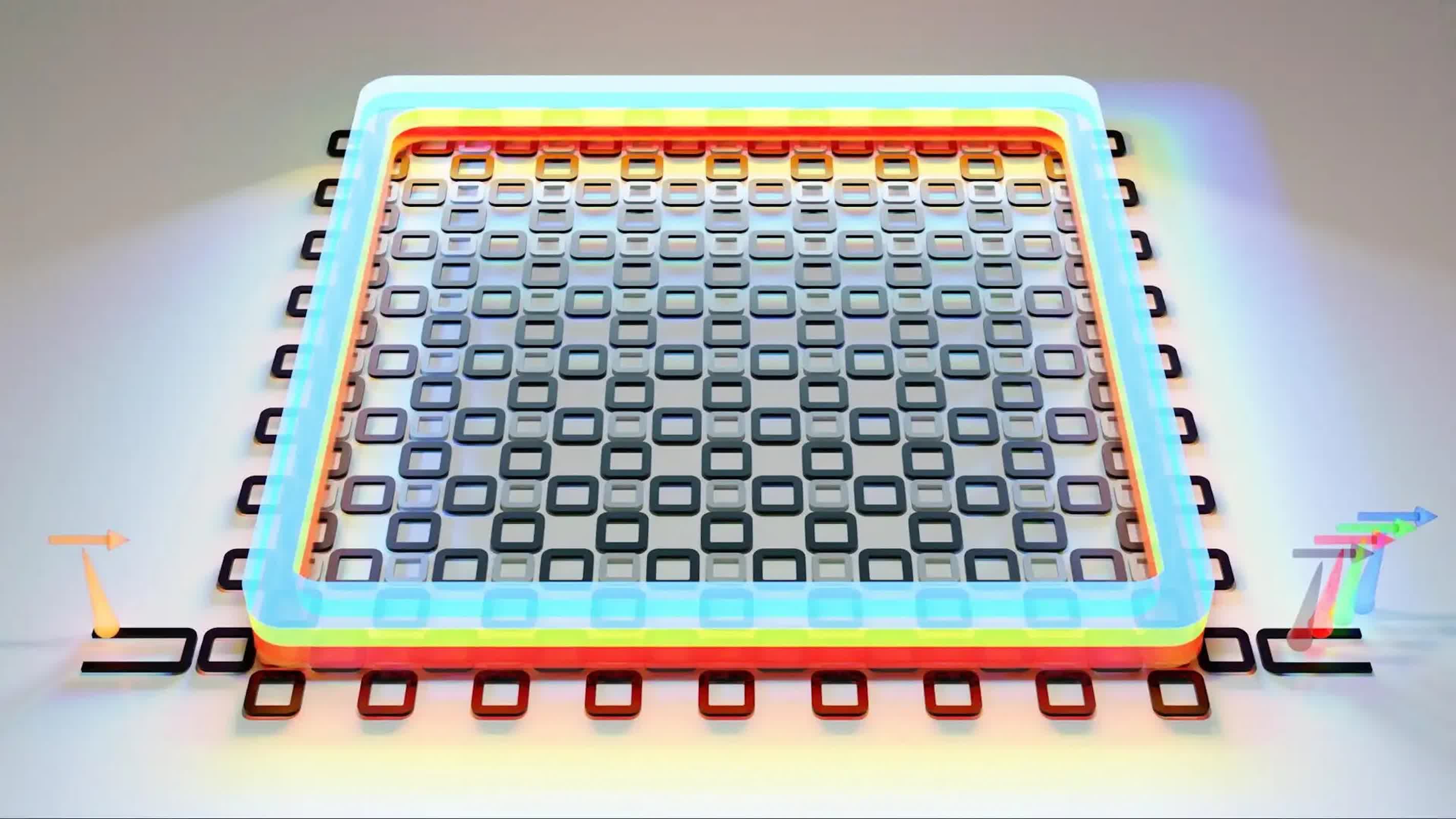
For decades, scientists have sought ways to compress the tools of optical science – lasers, lenses, mirrors – onto chips that fit on a fingertip. Such miniaturization is key to unlocking faster communication systems, ultra-precise atomic clocks, and scalable quantum computers that rely on light rather than electronic signals. But one persistent obstacle has been the difficulty of turning a single stream of laser light into multiple new colors within a compact chip, a process central to many photonic and quantum technologies.
A research team at the Joint Quantum Institute (JQI) at the University of Maryland has now achieved that milestone. The group developed a chip that can transform a single color of laser light into three distinct frequencies, without active inputs or painstaking fine-tuning. Their findings, published in Science, demonstrate a reliable route to producing complex optical signals directly on-chip – something previous designs struggled to deliver consistently.
Unlike ordinary optical elements such as prisms, which separate existing colors, the JQI chips generate new ones that weren't contained in the original beam. Creating new optical frequencies requires nonlinear interactions – phenomena that arise only when light is so intense that it changes a material's own optical properties, which then feed back to alter the light itself. These nonlinear effects were first observed more than sixty years ago, but for most of that time, they have been too weak to exploit efficiently.
The 1961 discovery of "second harmonic generation" illustrated just how subtle these processes were; the key signal in the data was nearly mistaken for a printing blemish. Since then, researchers have strengthened nonlinear effects through artificial design rather than brute-force laser power.
Today's integrated photonic devices use microscopic resonators that trap light in repeating cycles, allowing a single photon to circulate millions of times. Each pass slightly boosts the nonlinear interaction, and together they build into a strong, measurable effect.
Even with such resonators, tuning a chip to produce a specific color combination has been notoriously unstable. Slight variations in geometry, temperature, or fabrication can throw off the balance of frequencies. JQI's approach overcomes that problem by designing resonators that inherently favor the desired interactions, eliminating the need for continuous adjustments.
According to JQI Fellow Mohammad Hafezi, who led the project, the reproducibility of these chips is as necessary as their performance. The devices consistently yield the same spectral output without active control, a feature that simplifies integration into larger optical systems.
Hafezi, also a professor of electrical and computer engineering and of physics at the University of Maryland, describes this as a meaningful advance toward "scalable and reliable integrated photonics."
Eventually, reliable frequency generation on-chip may serve as an enabling technology for quantum computing architectures that use light to encode and transmit quantum information, as well as portable clocks that measure time with unprecedented precision. Every color of light corresponds to a specific frequency, and combining multiple frequencies with atomic-level stability allows hypersensitive detection of phase, distance, and time.
This microscopic chip turns one beam of light into three – and it could reshape quantum computing


