This tiny space mission wants to reach Alpha Centauri, in about 80,000 years

Shawn Knight

Posts: 15,852   +202
Staff member
In brief: A small team of engineers and scientists have announced what they are describing as humanity's first mission to another star. It's an ambitious mission, but one that'd barely put a dent in the budgets of major space players like NASA or SpaceX.
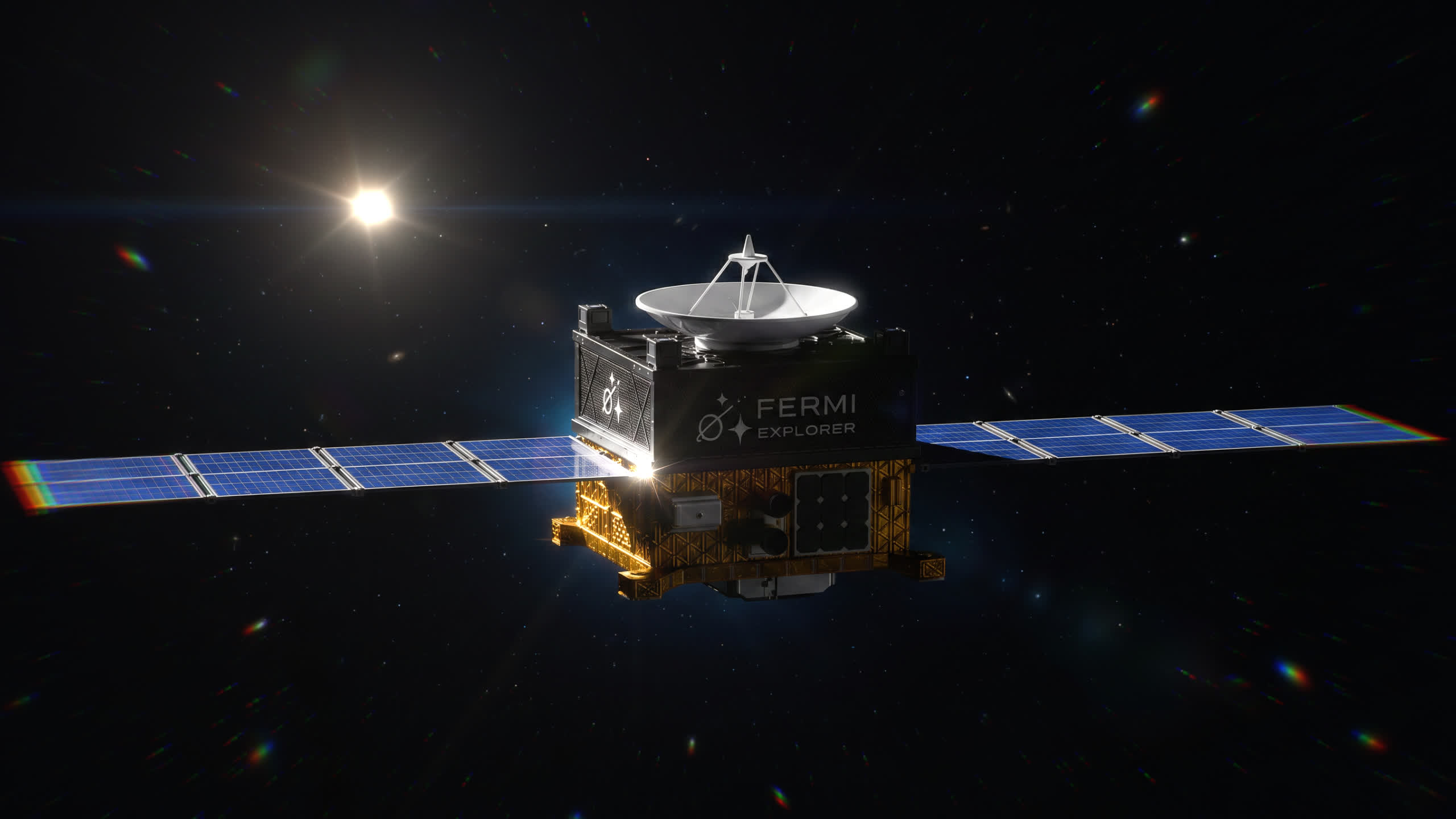
The Fermi Explorer Mission aims to launch in just three years and arrive at Alpha Centauri in roughly 80,000 years at a cost of less than $15 million – an absolute bargain, relatively speaking. The non-profit is co-founded by Philip Johnston, Ezra Feilden, and Adi Oltean, who recently brought startup Starcloud to life. An 81-page PDF is available to download, outlining the full mission plan and analysis.

The team expects its spacecraft to be the first to set sail but the last to actually arrive at its destination. Advances in technology should allow humanity to build spacecraft in the not-too-distant future that can travel through space at much faster speeds. Even with the head start, Fermi Explorer will lose the race by a wide margin.
Why bother with the mission at all if craft built just 50 years from now will get there first? Well, someone has to be first, and the mission could spark interest from other groups with deeper pockets and better technology. There's also something to be said about the spirit of human exploration and our thirst for knowledge. A project like this certainly scratches those itches.

The non-profit is soliciting donations via a crowdfunding model, complete with typical reward tiers. A donation of $10 will get your name on a website as an official mission supporter, while a minimum contribution of $100 is needed for your name to be engraved on the craft. There's also a merch store where you can purchase branded swag to support the effort.

The next step in humanity's exploration of space involves returning humans to the Moon and eventually, sending them to Mars. A crewed mission to our nearby satellite is targeted for 2028; no date is yet set for our first trip to the Red Planet.

Permalink to story:

 
Here is the abstract:

This report assesses the feasibility of delivering a vehicle with a payload of at least 1 kg to within 2,600 AU of
Alpha Centauri within 500,000 years, launched by the end of 2029 on a rideshare to low Earth orbit (LEO), without
gravity assists, for a program cost under $10M. Four conclusions follow, in decreasing order of certainty. Trajectory-
class feasibility holds: an explicitly integrated solar-electric trajectory, verified by independent re-integration to 0.29%,
reaches the required cruise speed by multi-revolution perihelion pumping without nuclear power. No trajectory found
closes the 100 kg concept from a LEO start; this verdict is conditional because the search cannot exclude closure below
the 22.26 km s−1 heliocentric crossover within the 12-year operational horizon. The reference interval’s lower end
sits 0.6 km s−1 above the crossover, the best trajectory found at the design thrust level (23.98 km s−1) sits 1.7 km s−1
above it, and the best found at four times the design thrust (22.66 km s−1) sits 0.4 km s−1 above. The concept meets the
specification at 100 kg from a geostationary transfer orbit (GTO) start (a delivery-orbit deviation from the ground rule)
or at roughly 150 kg from a LEO start with fragile margins, and the end-2029 launch date is conditional on a propulsion
qualification campaign within the demonstrated gridded-ion component class. The program cost exceeds the initial
$10M cost target under conventional practice (median near $16M). The gap is programmatic: bus, operations, and
margin. It is not physical. An independent implementation recomputed every headline kinematic quantity from first

principles; the worst-case discrepancy is below 0.5%.

It’s going to take 500,000 years… anyone else smell “scam”?
 
Here is the abstract:

This report assesses the feasibility of delivering a vehicle with a payload of at least 1 kg to within 2,600 AU of
Alpha Centauri within 500,000 years, launched by the end of 2029 on a rideshare to low Earth orbit (LEO), without
gravity assists, for a program cost under $10M. Four conclusions follow, in decreasing order of certainty. Trajectory-
class feasibility holds: an explicitly integrated solar-electric trajectory, verified by independent re-integration to 0.29%,
reaches the required cruise speed by multi-revolution perihelion pumping without nuclear power. No trajectory found
closes the 100 kg concept from a LEO start; this verdict is conditional because the search cannot exclude closure below
the 22.26 km s−1 heliocentric crossover within the 12-year operational horizon. The reference interval’s lower end
sits 0.6 km s−1 above the crossover, the best trajectory found at the design thrust level (23.98 km s−1) sits 1.7 km s−1
above it, and the best found at four times the design thrust (22.66 km s−1) sits 0.4 km s−1 above. The concept meets the
specification at 100 kg from a geostationary transfer orbit (GTO) start (a delivery-orbit deviation from the ground rule)
or at roughly 150 kg from a LEO start with fragile margins, and the end-2029 launch date is conditional on a propulsion
qualification campaign within the demonstrated gridded-ion component class. The program cost exceeds the initial
$10M cost target under conventional practice (median near $16M). The gap is programmatic: bus, operations, and
margin. It is not physical. An independent implementation recomputed every headline kinematic quantity from first

principles; the worst-case discrepancy is below 0.5%.

It’s going to take 500,000 years… anyone else smell “scam”?

I smell a whole bunch of billionaires having a cat fight over who can get the alpha centari first.
 
Sending a tiny capsule into the Alpha Centauri system a few hundred thousand years from now gets no profits… how long until we can send mining ships :)
We can mine the astroid belt long before we need to worry about going outside our solar system. They'll probably try to record the fast speed heading to AC before it oulls a Voyager and has trouble communicating back.
 
We can mine the astroid belt long before we need to worry about going outside our solar system. They'll probably try to record the fast speed heading to AC before it oulls a Voyager and has trouble communicating back.
But they got special crystals there that you can’t find anywhere else!
 
We should be working on, importantly, suspended-animation technology so that humans could be sent on a ship and woken up at some distant point in the future—for exploration and as a continuation of our genetics. (Whether the Earth survives the Sun's giant phases, life will long be extinguished before then, so sooner or later, we will have to leave.)

The Alcubierre drive might turn out to be a possibility too, making travel easier.
 
Last edited:
If the average lifespan in 2026 is roughly ~70 years old, then 80,000 years is about 1,143 human lifetimes―a whole-as* millenium and a quarter of births and deaths (assuming society doesn't end entirely in the next 200 years). To give a sense of how long that is, from 0AD until this year is ~56% as long as that same amount of human lifetimes will occur, over the span of 80,000 years.

If humanity is alive that long, not a single person alive today will be remembered by anyone that far into the future. We would be to those people what ancient civilizations are to us―interesting curiosities and historical explorations, but truly neither remarkable nor noteworthy enough to be anything other than "fixtures of their time". To draw any other conclusion and believe we will matter that much is hubris of the highest order.
 
If the average lifespan in 2026 is roughly ~70 years old, then 80,000 years is about 1,143 human lifetimes―a whole-as* millenium and a quarter of births and deaths (assuming society doesn't end entirely in the next 200 years). To give a sense of how long that is, from 0AD until this year is ~56% as long as that same amount of human lifetimes will occur, over the span of 80,000 years.

If humanity is alive that long, not a single person alive today will be remembered by anyone that far into the future. We would be to those people what ancient civilizations are to us―interesting curiosities and historical explorations, but truly neither remarkable nor noteworthy enough to be anything other than "fixtures of their time". To draw any other conclusion and believe we will matter that much is hubris of the highest order.
It is part of the mystery, irony, and sorrow of the human condition when set against the vastness of the universe and its merciless scales. Truly, we are a speck of dust "suspended in a sunbeam."

To our credit, though, miniscule as we are, we have found the equations of the space-time fabric, particles and light, and the subatomic forces.
 
Back