
Forward-looking: Lithium-ion batteries are everywhere, but their cost, supply chain issues, and potential to fail in fiery ways make them less than ideal for grid-scale energy storage. Chinese researchers say they have taken a major step toward an alternative in the form of an all-iron flow battery built from cheap, abundant materials and a water-based electrolyte that cannot explode.
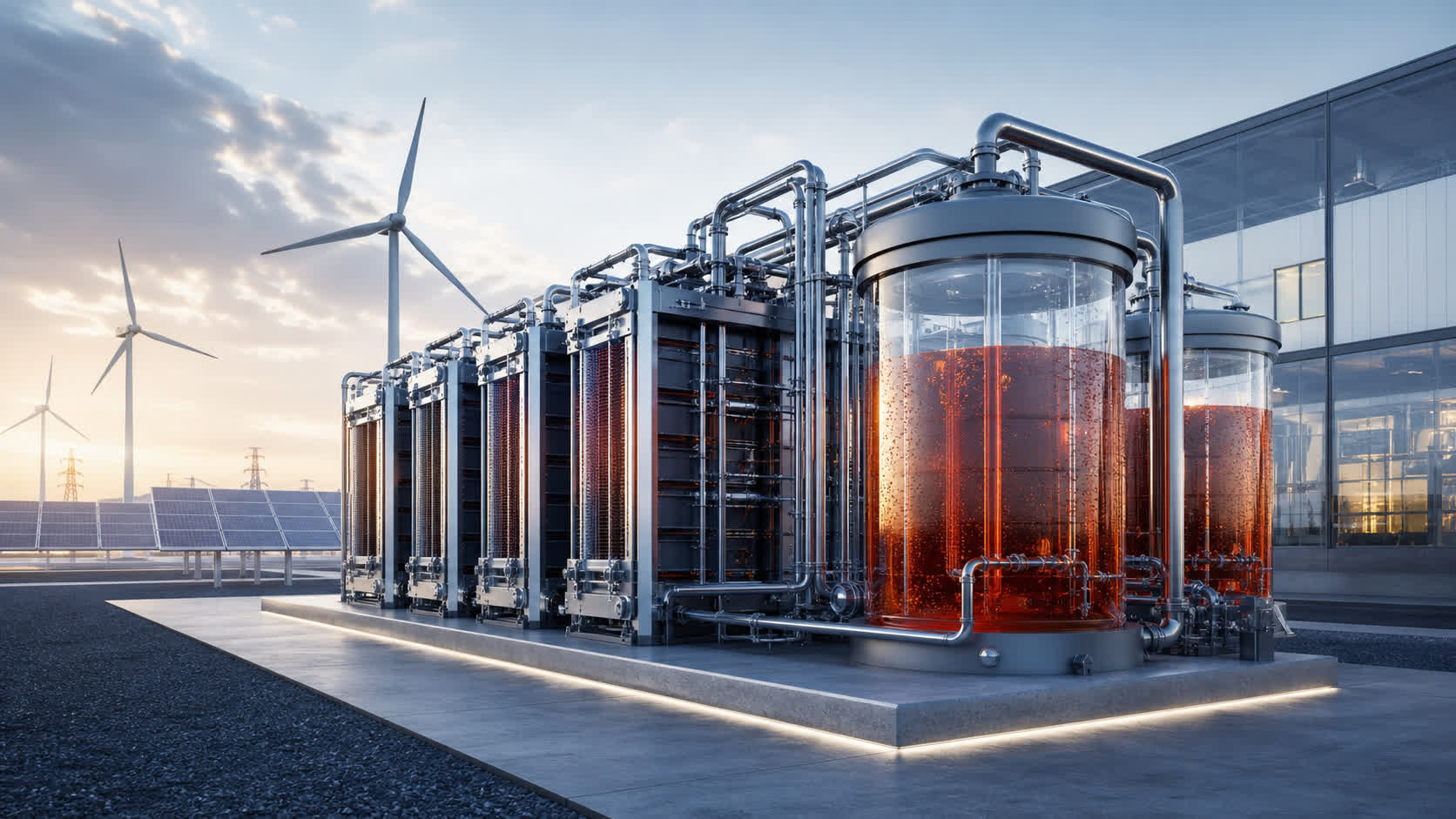
Researchers at the Chinese Academy of Sciences have developed an alkaline all-iron flow battery capable of more than 6,000 charge-discharge cycles without measurable capacity decay, according to a paper published in Advanced Energy Materials. The team estimates that performance is equivalent to around 16 years of daily use.
Iron is one of the most abundant elements on Earth and is nearly 80 times cheaper than lithium in its raw form. That doesn't mean a finished iron-flow system would be 80 times cheaper than a lithium-ion equivalent, though. Tanks, membranes, pumps, and power electronics still cost money, but it could slash one of the biggest material expenses in long-duration storage.
Flow batteries work differently from the cells in laptops, smartphones, or EVs. They use liquid electrolytes held in external tanks and pumped through a cell stack. Increasing capacity can be as simple as building bigger tanks, making the technology more attractive for solar and wind farms than anything that needs to fit inside a phone.
In February, we heard about another water-based battery concept, one that runs on tofu brine – the mineral-rich solution left behind after pressing soy curds.
All-iron flow batteries have been explored for years, but they have struggled with degradation, poor reversibility, and electrolyte crossover, where active materials migrate through the membrane and gradually undermine performance.
The researchers tackled the problem by redesigning the negative electrolyte at the molecular level. They started with 12 organic ligands, created 11 iron complexes, and identified a compound known as [Fe(HPF)BHS]^4- as the most stable candidate. Its bulky structure protects the iron center, while negatively charged groups help repel hydroxide attack and reduce crossover.
In testing, the battery ran at 80 mA cm⁻² for more than 6,000 cycles with an average coulombic efficiency of 99.4%. Under heavier loads, it reached a peak power density of 392.1 mW cm⁻² while maintaining 78.5% energy efficiency.
The water-based electrolyte avoids the flammable organic solvents used in lithium-ion batteries, removing the thermal risk responsible for battery fires and explosions.
As with most battery breakthroughs, caveats apply. Lab results don't always translate well into commercial systems, and there's no announced pilot project or manufacturing roadmap yet. However, if the chemistry scales, dirt-cheap iron could become a serious contender for storing renewable power when the sun isn't shining and the wind isn't blowing.
This ultra-cheap, water-based iron battery could last 16 years without degrading


