
Looking ahead: Are you tired of your social media feeds being filled with AI-slop videos and images, many of them claiming to be real? TikTok recently revealed that over 1.3 billion AI-generated videos have been uploaded to the platform to date, so now it's introducing a feature that lets users see less (or more) AI content in their feeds. The app will also start adding invisible watermarks to improve the feature's effectiveness.

TikTok is now testing its new AI-generated content slider alongside the other topics currently in the Manage Topics section.
The section currently lets you control how much content you see related to Creative Arts, Dance, Fashion & Beauty, Food & Drinks, Health & Fitness, Humor, Lifestyle, Nature, Pets, Sports, and Travel. Users can select one of five levels for each topic: two levels for fewer, two for more, and a default level.
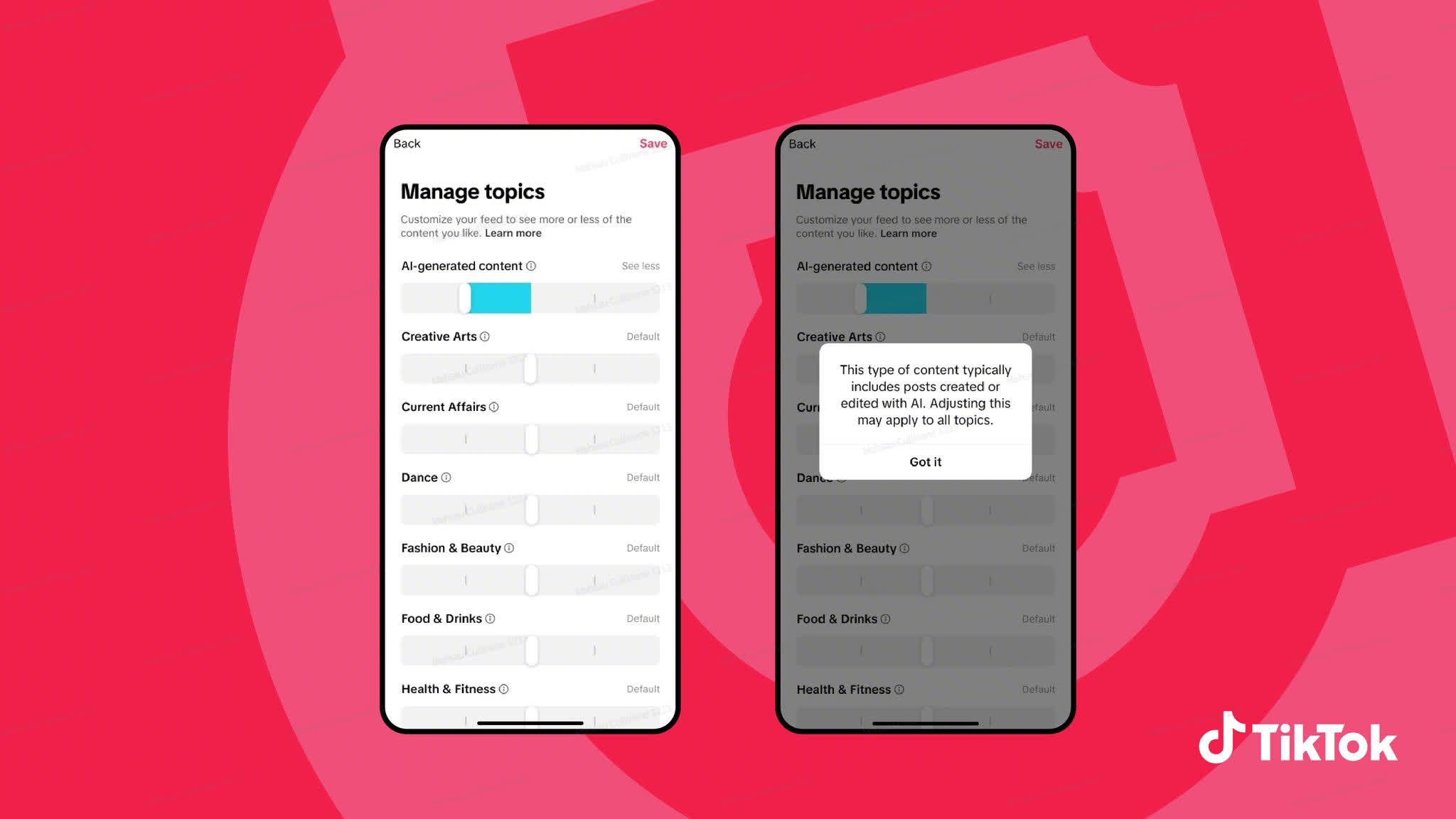
Moving the AI slider to the lowest setting won't completely remove all AI generated clips from your feed; you'll just see noticeably fewer of them.
To actually make the slider work as intended, TikTok is working to improve its AI detection methods. The company require users to label realistic AI-generated content, but it acknowledges that these can be removed when the content is reuploaded or edited elsewhere. As such, it will introduce invisible watermarks that only TikTok can read, making it more difficult for others to remove.
TikTok will start adding the invisible watermarks to AI-generated content made with the app's tools, such as AI Editor Pro, as well as content uploaded with C2PA Content Credentials – the industry authentication standard.
Users failing to label a realistic AI clip could see it removed. TikTok also bans harmful deepfakes of public figures or crisis events.
TikTok said it is also launching a $2 million AI literacy fund for experts and organizations such as GirlsWhoCode to create content that teaches people about AI literacy and safety.
TikTok doesn't seem averse to using AI behind the scenes. In August, it laid off hundreds of content moderators and replaced them with AI, marking the second time it had taken such an action. It laid off 500 employees in Malaysia last year, replacing them with AI in what was framed as a consolidation of certain regional operations.
While other platforms like Instagram let users block specific words, phrases, and emojis, most people would probably prefer a slider that reduces how much AI-generated slop they see. But given how heavily Meta has invested in AI, it's hard to imagine the company following TikTok's lead.
Image credit: Swello
TikTok is adding a slider to avoid AI junk, and invisible watermarks to make it work


