Time passes slightly faster on the Moon, scientists clock the difference

zohaibahd

Posts: 976   +19
Staff
Chrono conundrum: As humanity looks to establish a real presence on the lunar surface, an important question has arisen: how do we keep accurate time on the Moon? It turns out the answer is a bit complex, thanks to Albert Einstein's theory of relativity.
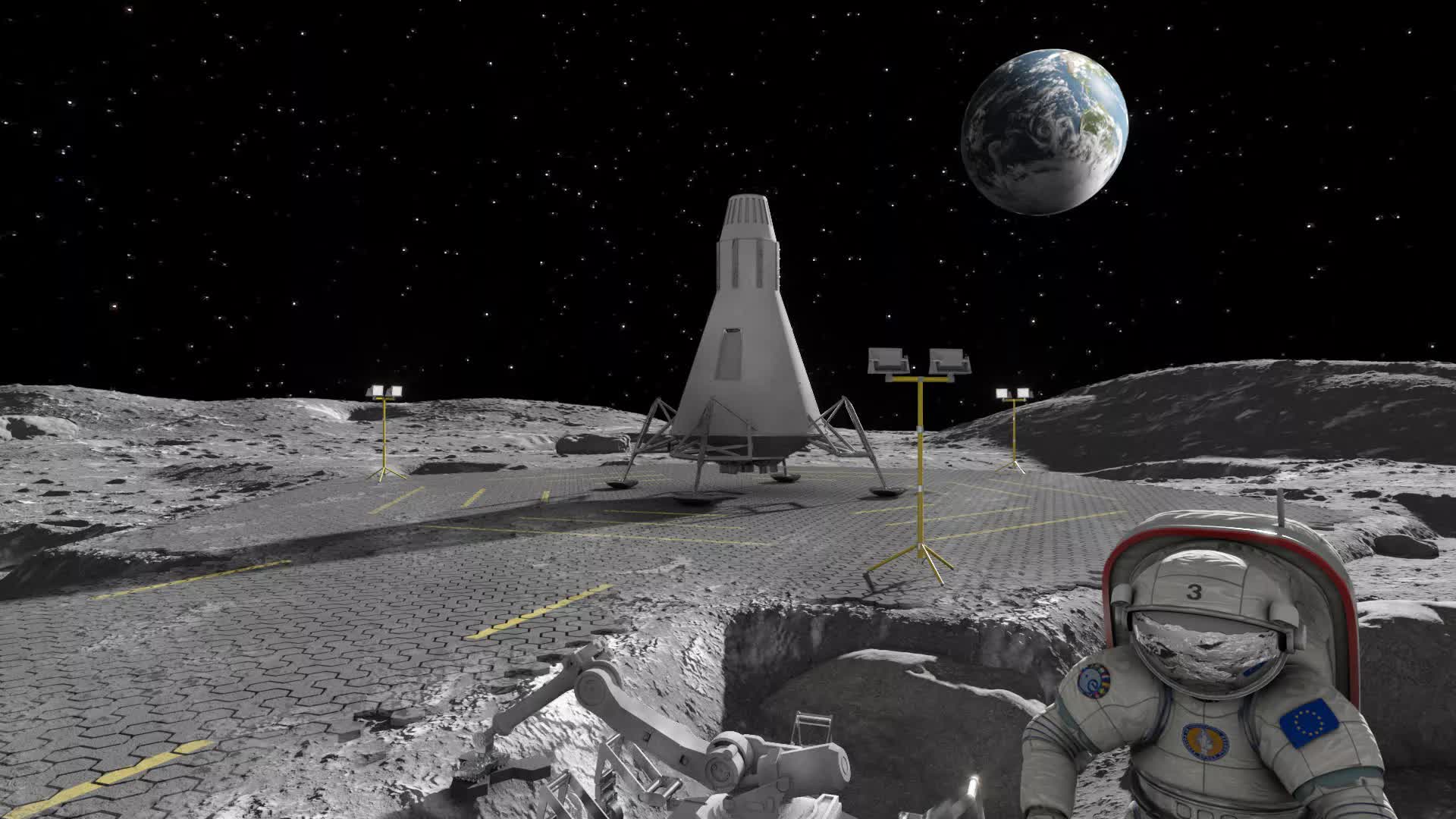
Back in April, the White House issued a challenge to scientists to develop a lunar time standard to support future moon bases and increase traffic between Earth and our celestial neighbor. You'd think just setting up some atomic clocks on the Moon would do the trick, but things are not so simple.

The problem stems from the fact that time flows at different rates in different environments with varying gravitational forces and motions relative to the observer, as Einstein theorized.

Scientists have already gotten a taste of this phenomenon back in 1969 with the Apollo 11 mission. When Buzz Aldrin returned to Earth, it was reported that Aldrin's personal Omega Speedmaster Professional, the official NASA-certified chronograph for crewed spaceflights, went slightly out of sync.
Now, as reported by Eos, researchers at the National Institute of Standards and Technology performed some calculations and found that lunar clocks run just a tiny bit faster. According to their results, published in the Astronomical Journal, the Moon's motion slows its clocks compared to Earth's, but its lower gravity speeds them up, resulting in a net 56-microsecond daily drift. This figure is supposedly an improvement over previous analyses.

While a 56-microsecond delay may seem negligible for everyday life, taking it into account is critical for the precision required by space navigation and communications as human exploration of the Moon ramps up. Failing to do so could lead to navigational errors as large as 17 kilometers per day, far exceeding the 10-meter requirement for Artemis missions.

The solution is implementing a lunar timing system carefully accounting for all relativistic effects like the Moon's rotation, orbital motion, gravitational forces from both bodies, and fluctuations caused by the Sun and other planets' tidal influences.

Though still years away from being essential, experts recognize the importance of establishing a timing standard well before it's actually needed to support a human presence on the Moon in the decades ahead.

"The community has done us a great service by publishing all this work. Now we have something to bring to the whole international community of timing experts and say, 'Is this the model that we can standardize for the Moon?'" Cheryl Gramling, an engineer at NASA's Goddard Space Flight Center, told Eos.

The Artemis II mission is set to take off sometime next year, building upon the success of the uncrewed Artemis I mission in 2022. It will be the first crewed flight of the Orion spacecraft and Space Launch System (SLS) rocket around the Moon.

Permalink to story:

 
Scientists have already gotten a taste of this phenomenon back in 1969 with the Apollo 11 mission. When Buzz Aldrin returned to Earth, it was reported that Aldrin's personal Omega Speedmaster Professional, the official NASA-certified chronograph for crewed spaceflights, went slightly out of sync.
Just to be clear, this is not a established scientific fact. We have been to the moon and back many times and no other astronaut has seen this effect. The Buzz story is more embellishment than scientific fact of the time difference between the earth and moon. Buzz was on the moon for less than a day, and thus 50 us or so would not have had a measurable effect on his watch.

This is pretty cool that we have such a precise understanding of time. Over one year, the time difference between the earth and the moon is about 0.02 seconds (20 milliseconds).

Failing to do so could lead to navigational errors as large as 17 kilometers per day, far exceeding the 10-meter requirement for Artemis missions.
Where did this number come from and in what context? I have a hard time comprehending that this tiny discrepancy leads to 17km or error.
 
Where did this number come from and in what context? I have a hard time comprehending that this tiny discrepancy leads to 17km or error.
I suppose it depends on how/what equipment is used for navigation. If you multiply the speed of light by 50 microseconds, you get 15 kilometers of distance.

The article doesn't go into detail, but let's use GPS as an example, where relativistic effects are already important enough that they have to correct their clocks in order for GPS to work.

GPS works by sending signals out from satellites. The receivers pick up those signals, which encode information such as which satellite sent the signal and when the signal was sent. By comparing the timestamp of when the signal was sent to when the signal was received, the receiver can calculate the distance that light traveled to get to the receiver. With multiple satellites, the receiver can triangulate its position. But, if the clocks are wrong, the location that the receiver calculates will be wrong, since it thinks that light traveled a different distance than it actually did. Since the satellites are further away from Earth than we are, their clocks tick slightly faster than ours do, so a correction has to be made.

There's a whole article on Wikipedia about error correction for GPS, including a quite detailed section on how relativity plays an important role, if you are interested.

Time is a construct. Without a sentient consciousness to observe and experience it's elapsation, it doesn't exist.
You could say the same about space or anything else, really. That philosophy is a valid one, but it isn't scientifically useful. Also, where does consciousness come from, if the building blocks in the world are not conscious themselves? If existence is predicated on a conscious entity observing it, then how do unconscious entities (which don't exist until observed) form to create a conscious one? Not debating/disagreeing with you per se, but I find it fun to poke holes in philosophical thought experiments like this.
 
Time is a construct. Without a sentient consciousness to observe and experience it's elapsation, it doesn't exist.
This is incorrect. If this was true, you could place a fruit int he middle of nowhere and leave it unobserved for years, and it wouldn't rot or get dirty. It would just remain suspended in time until t was observed again.

Now, the interpretation of time, THAT is the construct. You could wipe out all knowledge of time as we know it and go to a 10 base system or something like calling it meerkats instead of seconds, and our interpretation of time would indeed change. But time itself would not.
 
This is incorrect. If this was true, you could place a fruit int he middle of nowhere and leave it unobserved for years, and it wouldn't rot or get dirty. It would just remain suspended in time until t was observed again.

Now, the interpretation of time, THAT is the construct. You could wipe out all knowledge of time as we know it and go to a 10 base system or something like calling it meerkats instead of seconds, and our interpretation of time would indeed change. But time itself would not.

Actually the fruit in the middle of nowhere is not degraded by time it is degraded by environmental Interaction, so if you were to put an object undegradable in the middle of nowhere and leave it unobserved for years it actually would remain timeless. Your example works given the correct item, you see how pcnthuziast is actually substantiated by your counter example. However planets and stars are the only currently observable objects that do not cycle through life and death or assembly/disassembly they are timeless. If you could ask the Earth what time it is what do you think it would say?
 
Back