Walmart secures two AI pricing patents, raising dynamic pricing concerns

Skye Jacobs

Posts: 1,998   +58
Staff
What we know so far: Walmart is developing algorithmic tools to shape how it sets prices, even as US lawmakers intensify scrutiny of data-driven pricing in grocery and retail. The retailer has secured two US patents this year covering automated markdowns and machine learning-based demand forecasting, adding to a broader portfolio of nearly 50 US patents granted to the company so far in 2026.
Walmart says the new systems are not designed for surge or individualized pricing, but their capabilities arrive at a moment when lawmakers are moving to restrict precisely those practices.

One of the patents, issued in January, describes what Walmart calls an "end-to-end price markdown system" for its e-commerce platforms, including Walmart.com. According to the filing, the system would dynamically and automatically update item prices to implement markdowns based on data such as predicted demand and consumers' price sensitivity.

The company's e-commerce business generated more than $150 billion in sales last year, and the new tools are meant to fine-tune discounts across that volume rather than change base prices in real time. Walmart told the Financial Times that this patent is unrelated to dynamic pricing and is limited to markdown activity.

A second patent, granted last week, outlines a "demand forecasting and price recommendation" engine that uses machine learning to suggest prices that will move inventory within specific time frames, such as a week, a month, or a quarter. The filing describes a system that can ingest data on purchases, historical prices, methods of payment and customer identifiers such as passport or driver's license numbers, and then generate recommendations for merchant teams.
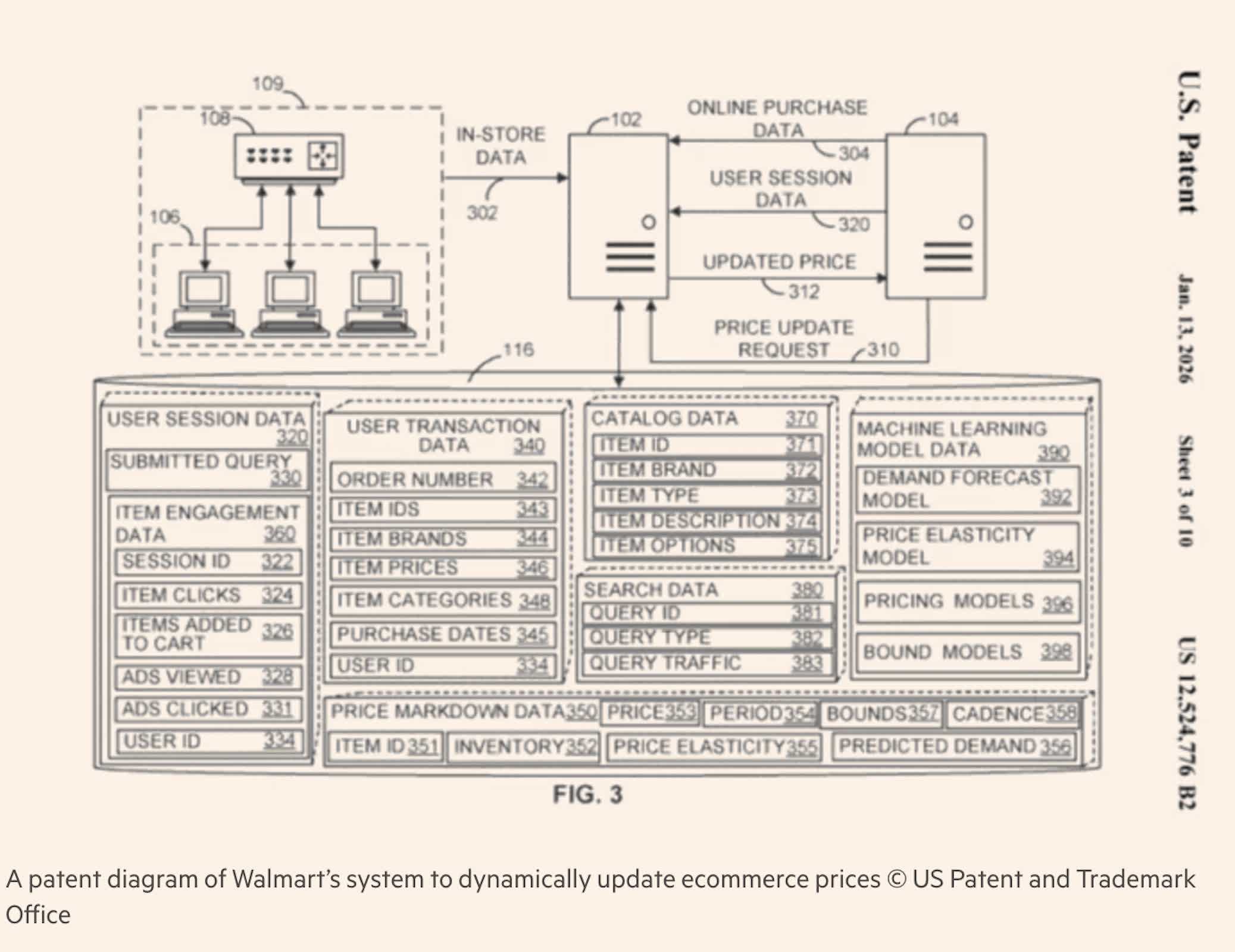
Image credit: Financial Times

The tool is designed to work across a wide range of categories, including food, outdoor equipment, clothing, housewares, toys, workout equipment, vegetables and spices, according to the patent. Walmart says that the second patent is intended to support merchant decision-making rather than automatically execute price changes. "We don't participate in surge pricing," a Walmart spokesperson said. The company has characterized its new pricing tools as mechanisms to manage markdowns and inventory more efficiently.

Those assurances come as algorithmic pricing in grocery and consumer goods becomes a political target. Lawmakers in Maryland, Pennsylvania and Minnesota have introduced measures aimed at banning or limiting dynamic pricing in supermarkets and other grocery outlets, reflecting concerns that prices could jump in response to demand spikes or individual shopper data.

According to state officials, Maryland governor Wes Moore has proposed the Protection from Predatory Pricing Act, which would prohibit both dynamic pricing and the use of surveillance data to inform individualized food prices. Consumer advocates and unions have warned that retailers could eventually adjust prices at the individual shopper level, even though industry groups argue there is little evidence of that happening today.
The debate over Walmart's patents is sharpened by the company's long-standing "everyday low price" positioning. Founder Sam Walton built the chain around the idea of keeping prices consistently below rivals rather than leaning on short-term promotions. Research by Morgan Stanley has found that Walmart's grocery prices have historically been 10 to 25% lower than those of conventional supermarkets.

At the physical store level, Walmart is rolling out electronic shelf labels across all 4,600 US stores within the next year, a move that could enable faster, more centralized pricing changes. The company has already installed digital tags in roughly half of its US locations and says the system will replace thousands of paper labels and reduce pricing errors. The electronic labels allow prices to be updated remotely, which has fueled fears among some policymakers and labor groups that they could eventually support algorithmically driven price changes inside stores.
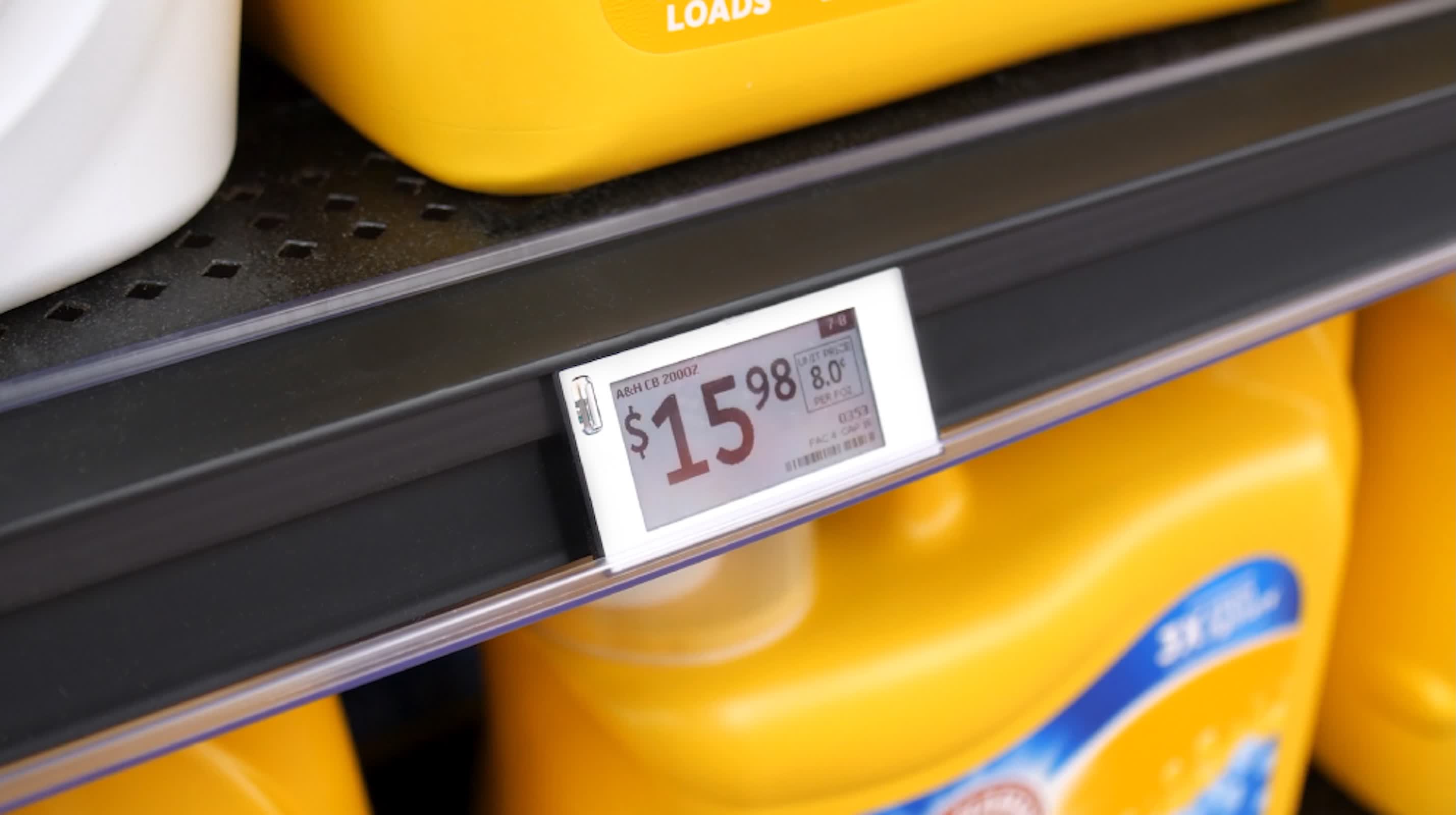
Two Democratic US senators have introduced legislation to bar electronic shelf labels in large grocery stores, a proposal backed by the United Food and Commercial Workers International Union, whose members could see some pricing and labeling tasks automated away.

Critics have argued that digital tags could be used to mislead shoppers by changing prices too often or in ways that are difficult to track, according to the Retail Industry Leaders Association's summary of the debate. However, the trade group has said fears about widespread misuse remain hypothetical, noting that there is little concrete evidence of retailers using the technology for aggressive dynamic pricing today.

Walmart has pushed back on claims that its shelf-label rollout is a step toward algorithmic price discrimination. In a statement this month, the company said electronic labels simply make it easier to keep shelf tags accurate and up to date, and that store prices are "consistent regardless of demand, time of day or who is shopping."

Permalink to story:

 
Was that a bad joke? You want government to control when and under what terms a company can set the price of its own products? How about a government agency to control what price you're allowed to sell your own home for, too?
Do you want to pay 40% more for your groceries because an AI has determined you live in sufficient housing or looked up a new recipe this morning?
 
Do you want to pay 40% more for your groceries because an AI has determined you live in sufficient housing or looked up a new recipe this morning?
I want to live in a free society. As I live in an affluent area, the stores here *already* charge significantly more than those in a depressed downtown sector miles away from me. So what?

You also forget to mention that, there's an equal likelihood that this "evil AI" may decide to lower the price 40%, to attract my business that it would otherwise lose.

The free market. To paraphrase Churchill, it's the worst possible system ... except for everything else we've ever tried.

Dynamic pricing is essentially price gouging based on how much corporations know about you and needs to be illegal.
Do they no longer teach economics in schools these days?
 
By the time you get to the register the price changes. I wonder if have you take a picture of every item to make sure it's stays the same or at least improves on your behalf. Haha imagine someone using image generator to make up their own price and say the price changed look. Some Laws require you honor that price. Fight ai with ai!🤪
 
There is no such thing as a "free market" when corporations are allowed to have free reign, just replace the word government with corporations, and you have the perfect dystopian world where mega corporations are allowed to spy on you, charge whatever they want, or sell you unsafe products. We're already headed towards that future in the name of record profits and higher margins.
The government regulates water so you can safely take a shower, and airplanes so they aren't crashing into each other, but I guess that's bad because " but free market".
 
I want to live in a free society. As I live in an affluent area, the stores here *already* charge significantly more than those in a depressed downtown sector miles away from me. So what?
So most people dont want to shove even more money into the pockets of corporations just because an AI said so. What part of that is hard to understand?
You also forget to mention that, there's an equal likelihood that this "evil AI" may decide to lower the price 40%, to attract my business that it would otherwise lose.
That never happens. Dynamic pricing has unilaterally led to higher prices. Thats why people oppose it. Only the naive believe a corporation would allow prices to go down for certain people, especially for necessities. You think they're going to reduce pricing for people struggling? Corpos DGAF about you, only money.


The free market. To paraphrase Churchill, it's the worst possible system ... except for everything else we've ever tried
And your paraphrasing would be wrong. Churchill was talking about Democracy, not a financial system. Do they no longer teach history in schools these days?

Most people would agree that a truly free system, in which corporations can do anything they want to you, is a BAD thing. Thats why we have consumer protections, regulations on what can be made and sold, ece.
Do they no longer teach economics in schools these days?
Do you need an economics course to know that something that is used to excuse price increases to make corporations more profit is a bad thing?
 
I don't need a degree in economics to have the knowledge that dynamic pricing is a terrible practice. Even if you're filthy rich you shouldn't want the posh market in the wealthiest part of town charging as much as possible because they know you can afford it based on some AI model that has sucked up data from your phone in your pocket.

More context on why dynamic pricing is a very bad thing with this video.
 
So most people dont want to shove even more money into the pockets of corporations just because an AI said so. What part of that is hard to understand?
I understand you fail to understand basic economics, and hate the free-market system that's lifted billions out of crushing poverty. I understand you favor Soviet diktat-style policies that mean the monstrous inefficiency and overhead of a bloated government bureaucracy holding a two-year investigation every time the price of toothpaste changes by five cents a tube.

Dynamic pricing has unilaterally led to higher prices .. Only the naive believe a corporation would allow prices to go down for certain people
Inventing absurd lies doesn't make them true. Prices do drop, and as nearly as often as they rise (it would be closer to 50-50 if the government would stop printing new money).

It's also escaped your attention that stores routinely DO lower prices for entire classes of people: kids prices on tickets and meals, senior discounts, "early bird" shopper specials, and a million other examples leap to mind.

And your paraphrasing would be wrong. Churchill was talking about Democracy
Which is why I used the word "paraphrasing". Look up what that word means.
 
Even if you're filthy rich you shouldn't want the posh market in the wealthiest part of town charging as much as possible because they know you can afford it
News flash: the posh markets already do that. Try shopping in Rodeo Drive or London's New Bond Street if you believe otherwise.

You've also forgotten that the government itself routinely charges "those who can afford it" much more, on everything from property and income taxes to college tuitions.
 
Last edited:
I understand you fail to understand basic economics, and hate the free-market system that's lifted billions out of crushing poverty. I understand you favor Soviet diktat-style policies that mean the monstrous inefficiency and overhead of a bloated government bureaucracy holding a two-year investigation every time the price of toothpaste changes by five cents a tube.
so you didnt even bother to read what I wrote and instead invented a new ghost for you to box.
Inventing absurd lies doesn't make them true. Prices do drop, and as nearly as often as they rise (it would be closer to 50-50 if the government would stop printing new money).
I posted evidence that directly contradicts your claim. So did Hectate. Maybe you should try to find something that backs up your argument, beyond corporate slides?
It's also escaped your attention that stores routinely DO lower prices for entire classes of people: kids prices on tickets and meals, senior discounts, "early bird" shopper specials, and a million other examples leap to mind.
Ok....those are not dynamic pricing. Nice red herring, shame it doesnt help you at all.
Which is why I used the word "paraphrasing". Look up what that word means.
You clearly dont understand what it means either, since you seem to have a problem with people calling out a broken system doing something bad. You quoted Churchill to defend your argument that this is OK. It's not. Being the least bad doesnt make the systems actions good.
 
I posted evidence that directly contradicts your claim.
You can't even read your own links, and you wish to be taken seriously?

"...[a game purchaser] claimed the moment they signed into their PSN account, the [advertised] price jumped to £9.99. ... others claimed the price remained at £3.74 for them regardless of their login status. We tested this ourselves, and the price remained at £2.74. I must stress, this could be a glitch...."

Or more likely an outright lie.

As for Hecate's video, it merely notes that Instacart charges a premium over what retailers themselves charge for products, and that premium varies by user. Wow -- earth shattering news. Some get a higher price; some lower. You don't like it, don't use them.

I have a textbook on business economics on my shelves -- dating from the 1930s -- which details this strategy of varying prices slightly to collect data on profit optimization. So? Statistically, it means half the time the retailer discovers their price is too high for maximum profits. Nor does it change the basic economic reality that, if a price is set artificially high, supply outstrips demand, eventually forcing a lowered price. Period. Economics isn't rocket science ... though admittedly some people make it appear so.

If you don't like stores who do this, shop elsewhere. It's a free world. Let's try to keep it that way.
 
These comments remind of the joke about three business men asking each other why they are in prison.

1st businessman: I raised prices so they arrested me for price gouging.
2nd businessman: I kept prices the same so they arrested me for collusion.
3rd businessman: I lowered prices so they arrested me for predatory pricing.

The public's lack of basic economic knowledge makes it easy for politicians to lie us into a much worse country. But keep believing those bump sticker slogans as valid explanations for how things are.
 
It's a free world. Let's try to keep it that way.
In the modern world, freedom is an illusion bandied about by those that want to make you think the world is free so that you'll pour more money into their wallets.

No modern society is completely free, because, in general, humanity cannot be trusted to treat each other fairly, thus laws are needed whether anyone likes laws or not.

If everyone were Mother Theresa, anywhere in the world, perhaps some of humanity could be free; however, Mother Theresa is an extreme exception in humanity, not the rule.

IMO.
 
Price gouging can not exist in a free market. Both buyer and sellers can refuse to exchange. Dynamic Pricing can actually work to the advantage of the consumer by identifying product/service providers who are bringing value the consumer wants. It will also identify those who do not bring value.
 
When this happens, I hope some "journalist" does a report on this and does a little investigative reporting.
Go to the store, record prices of common everyday items such as a pound of beef, gallon of milk, toilet paper...every day things. Record them say on a Monday morning around 10am. Then go back to the store and record the prices of the same items, say on a Friday evening, weekend, Sunday, before a holiday weekend, before an incoming major winter event and see if the prices have stayed the same or gone up.
I suspect, being Walmart which isn't run by Sam Walton, but by his kids/CEO's etc.
 
I understand you fail to understand basic economics, and hate the free-market system that's lifted billions out of crushing poverty. I understand you favor Soviet diktat-style policies that mean the monstrous inefficiency and overhead of a bloated government bureaucracy holding a two-year investigation every time the price of toothpaste changes by five cents a tube.


Inventing absurd lies doesn't make them true. Prices do drop, and as nearly as often as they rise (it would be closer to 50-50 if the government would stop printing new money).

It's also escaped your attention that stores routinely DO lower prices for entire classes of people: kids prices on tickets and meals, senior discounts, "early bird" shopper specials, and a million other examples leap to mind.


Which is why I used the word "paraphrasing". Look up what that word means.
Give us examples in which dynamic pricing has led to lower pricing.
 
Give us examples in which dynamic pricing has led to lower pricing.
The other poster already did, though he failed to realize it: the link showing Instacart pricing. People weren't being charged more based on some determination of "how much they can afford to pay", but random groups: some charged less, some more. This is a classic scenario of a seller attempting to determine price elasticity: from your baseline price, test a couple points above and below on the demand curve. If elasticity is high, the seller drops his price; if low, they raise it.

This sort of thing has been going on since the dawn of time. An 18th Century London fishmonger gauged elasticity on an hourly basis; if his cart of fried cod -- worthless the next morning if any remain -- is selling poorly, he drops the price accordingly.

There's a gas station on my route home that invariably charges at least 20 cents/gal more than its competitors, due to it being over a mile from any other station. I marvel to see it daily ... but he's discovered that location causes enough price inelasticity to keep his pumps busy. Blame the drivers, not him, unwilling to wait even another 2 minutes to fill up.
 
Last edited:
The video showed clearly why dynamic pricing is bad. Thus your argument is based on scammers (corporations) stating "Trust me bro".
 
People need to settle down. I don't like the idea, but if it's going to happen, you're not going to be able to stop it by complaining about it here. If you find you're getting charged more because of your demographics than someone else at the same store, complain to the corporations that use dynamic pricing. Stop shopping at the companies. Or... Use it to your advantage. I can think of a way to.
 
It's very rare indeed that I find myself stooping so low as to shop at Walmart. Walmart, USED to be a good store. Low prices (catered to lower end consumers) and they touted choice. Well, that went away about twenty years ago.
 
Back