Why Apple can't easily move iPhone production to the US: 2,700+ parts, 187 suppliers, 28 countries

midian182

Posts: 11,726   +177
Staff member
In a nutshell: The Trump administration has big ambitions for iPhone production: it wants Apple's handsets to be completely manufactured in the US. But moving production to the United States is a near impossibility for a device whose components come from 187 suppliers in 28 countries.

Donald Trump believes the huge tariffs implemented on goods imported from China and other countries will encourage US firms to manufacture their devices domestically. That's easier said than done for a lot of firms, especially Apple, which relies heavily on China for iPhone production.

In a deep dive into the iPhone's manufacturing process, the Financial Times writes that new models consist of around 2,700 different parts, and that Apple uses 187 suppliers in 28 countries. China makes most of these components – only 30 Apple suppliers operate entirely outside of the country – though some of the high-end parts are made in Taiwan, and a few key elements are manufactured in South Korea and Japan.

There are some iPhone components made in the US, but less than 5% of the total are manufactured domestically, including the glass casing and the lasers that enable Face ID. However, certain elements of these parts, such as the backlit display and layer that enables user interaction, are made in China.

The FT writes that the 74 tiny screws that hold the iPhone together are primarily made in China and India – and fixed in place by hand.

Earlier this month, US secretary of commerce Howard Lutnick said that the "army of millions and millions of people screwing in little, little screws to make iPhones, that kind of thing is going to come to America."

Lutnick: "The army of millions and millions of human beings screwing in little screws to make iPhones – that kind of thing is going to come to America."

[image or embed]

– Aaron Rupar (@atrupar.com) 6 April 2025 at 15:52

Then there's the assembly. Apple ships the equivalent of 438 iPhones every minute, 85% of which are assembled by Foxconn, which has dozens of locations in China.

In total, there are more than 700 production sites making iPhone components.

With so many moving parts in the supply chain and all the components involved, the fact that most of the manufacturers are located in China makes the production process easier.

"There are a lot of advantages to co-locating the activities in the supply chain, in terms of speed and quality of communication and innovation in the product and process design," Andy Tsay, a professor at Santa Clara's Leavey School of Business, told the FT.
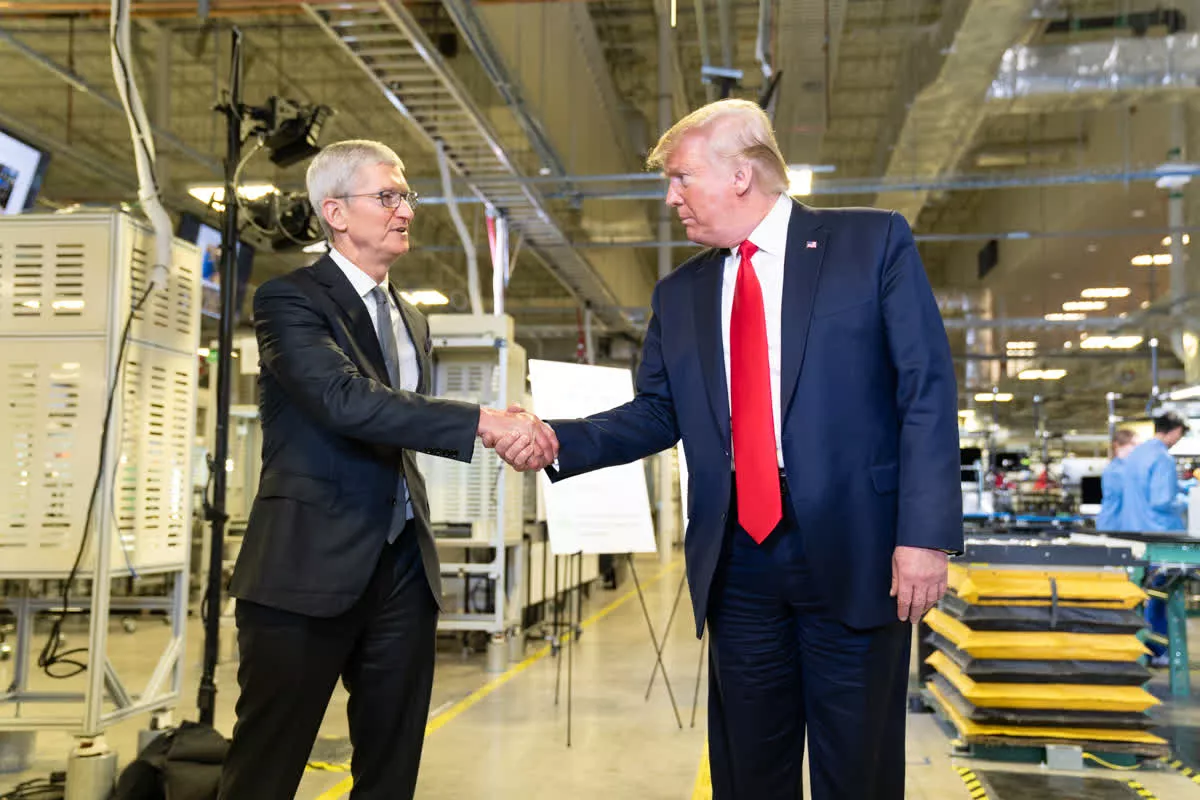
While overseas companies used to go to China for cheap labor, the attraction now is the skill and type of skills available in one location.

"It is like the products we do require really advanced tooling and the precision that you have to have in tooling and working with the materials that we do are state-of-the-art, and the tooling skill is very deep here," Apple CEO Tim Cook said in 2017.

Apple is currently racing to move all assembly of iPhones destined for the US market from China to India by the end of 2026, further emphasizing that a 100% US-made iPhone isn't going to happen. And even if Apple were somehow able to do it, the move would take years and would likely result in a much more expensive iPhone price tag – some predict as much as $3,500.

Permalink to story:

 
I’m willing to bet you won’t get 2000 employees willing to assemble iphones for a monthly paycheck ranging from 1500-2000 USD within the US - knowing well that labor in China is probably as low as the 500 USD mark
 
US secretary of commerce Howard Lutnick said that the "army of millions and millions of people screwing in little, little screws to make iPhones, that kind of thing is going to come to America."
Imagine thinking this a win.

Even Lutnick seems to register this on some level as he hurriedly adds well we'll automate the screws bit of course and then the jobs are for the "tradescraft" Americans who will work on the robots. So triple the cost of iPhones to bring dozens of jobs the US. Hurray!

The added irony is that tradespeople already do quite well as there is a shortage of them here because politicians fed people the lie that college was a right creating an overabundance of baristas with a useless social activism degree and $60K of student loan debt. We should be funding trade schools instead of trying to remake the world's economy for a handful of jobs.
 
We spent 50 years moving manufacturing OUT of the US, who actually thinks that this will happen overnight?

This in a nutshell.

Not to mention the labor market in the US is significantly more expensive and lacks the dense, specialized supply chain found in Asia, especially in China.

While Apple has begun limited efforts in the US, such as chip production with TSMC in Arizona and some Mac assembly in Texas, these moves are primarily driven by political pressure and strategic diversification rather than any benefits to Apple.

In the near future, they may increase US production on some other devices, but large scale iPhone assembly in the US? No, it will remain overseas for the foreseeable future.

People need to realize that these manufacturing jobs didn’t disappear overnight, and they won’t reappear quickly just by imposing tariffs.

People need to stop, close their mouth, settle their emotions and think about what is going on and the ramifications all of this is going to have, good and bad.

 
We spent 50 years moving manufacturing OUT of the US, who actually thinks that this will happen overnight?
these people

giphy.webp
 
Imagine thinking this a win.

Even Lutnick seems to register this on some level as he hurriedly adds well we'll automate the screws bit of course and then the jobs are for the "tradescraft" Americans who will work on the robots. So triple the cost of iPhones to bring dozens of jobs the US. Hurray!

The added irony is that tradespeople already do quite well as there is a shortage of them here because politicians fed people the lie that college was a right creating an overabundance of baristas with a useless social activism degree and $60K of student loan debt. We should be funding trade schools instead of trying to remake the world's economy for a handful of jobs.
I agree, (isn't that surprising ;) ) with most of what you said, however, I don't think government can be "blamed" because a bunch of dolts chose to enter useless degree programs and then are not happy because they cannot get good jobs.

I'm an older adult who completed my BS in the past 10-years. As part of my "degree program planning" I was required to research my chosen field, and in the process, I found that at the time, future job prospects were good. Perhaps that kind of research would be good to add to the beginning of a degree program for any college/university. In other words, students go to college, research degree programs in the first semester, then commit to a degree program after they have completed the requisite degree program research.

"Degree planning" was a requirement for my school which is/was a non-traditional, self-study school, with one-on-one access to "mentors" who specialized in the subject matter of my self-study courses. I chose software engineering/mathematics at the time, however, I think if I had chosen a useless degree, I would have found out prior to committing to a useless degree that it was useless and would have been a waste of my time, and I would have chosen something else.

Back on topic, industry might facilitate bringing manufacturing back to the US if it returned to offering apprenticeship programs.
 
We spent 50 years moving manufacturing OUT of the US, who actually thinks that this will happen overnight?
IMO, it won't happen and is not at all likely to happen as long as the thrust in the dominant economic system is the relentless pursuit of profits while spending as little as possible to produce products.

I don't have an answer, however, pursuing profits while expecting to spend little to nothing on what any company manufactures is unrealistic and unsustainable.

While the current administration's viewpoint that other countries give themselves an unfair advantage in trade through manipulation of each country's own currency value may be correct, it, the current administration, seems to have no idea what really caused manufacturing to move out of the US over time. IMO, that's where the problem lies and is why, to me, anyway, bringing good manufacturing jobs back to the US is not as easily done as reverting to policies that once proved to be viable in some distant past.
 
It seems to me that a lot of people fixate on specific simple things: "Oh but we cannot assemble iphones here because it is too expensive."
Fine then. We do not need to assemble everything. But I do not believe that it applies to every goods produced elsewhere.
Not Iphones or many other things, but is it wise to not be able to make most things that we use and need a lot?
A simple example would be covid and realization that we do not even make essentials needed to keep hospitals open. It mean that countries who made masks could first supply their own people.
Oh but it is not viable to make them here, it is too expensive, and Americans won't work for...
See, what I mean? There is profitability and there is common sense.
It gets worse when we take in account military related industries.
It is not foolish to outsource them to China, it is insane. And it is still foolish to outsource them to countries nearby China. "But it is so convenient to ship them there, they are all close to each other making production so much cheaper and saving our taxpayers money..."
We need common sense. Unfortunately, in the last 10 years we saw that we have only on or off switch.
Neither is a good option. We need to bring back specific productions, but we do not need to bring them all back. At the end, we cannot be a nation that does not remember how to manufacture things. It is like a person that has no limbs. There are industries that can function here. And even though it could be painful to make these changes, they are needed.
 
I agree, (isn't that surprising ;) ) with most of what you said, however, I don't think government can be "blamed" because a bunch of dolts chose to enter useless degree programs and then are not happy because they cannot get good jobs.

I'm an older adult who completed my BS in the past 10-years. As part of my "degree program planning" I was required to research my chosen field, and in the process, I found that at the time, future job prospects were good. Perhaps that kind of research would be good to add to the beginning of a degree program for any college/university. In other words, students go to college, research degree programs in the first semester, then commit to a degree program after they have completed the requisite degree program research.

"Degree planning" was a requirement for my school which is/was a non-traditional, self-study school, with one-on-one access to "mentors" who specialized in the subject matter of my self-study courses. I chose software engineering/mathematics at the time, however, I think if I had chosen a useless degree, I would have found out prior to committing to a useless degree that it was useless and would have been a waste of my time, and I would have chosen something else.

Back on topic, industry might facilitate bringing manufacturing back to the US if it returned to offering apprenticeship programs.
Good degree planning should be required but isn't in large part because the professors of useless degrees won't allow it. It was surprising to learn how embittered underwater basket weaving professors are, but rather than blame their own life choices they blame the "evil" system. See, professors get paid based on what they could make outside the university because otherwise useful doctorates would never work at a university. But such simple concepts elude them because obviously pure knowledge in any subject is invaluable regardless of what the market says. This leads to a lot of turf wars between useless and useful majors/colleges as obviously the useful programs subsidizing the "pure" academic ones is the only way to correct the evil system. Universities aspire to teach "well rounded scholars" which is valid but often gets stretched to cover any non-useful subject as extra intellectual. And useful majors are usually more difficult and often include science or math so it's easy for students to swell the easy subjects because they don't understand the future consequences.

Add to that 18 year-olds don't know what they want to do (I don't blame them I changed majors my senior year) plus all the talk today of "follow your passion!" and we end up here.

We need to end the stigma of not going to college. There are many paths to success and only some of them require a 4+ year degree.
 
We spent 50 years moving manufacturing OUT of the US, who actually thinks that this will happen overnight?

-This is obviously a baited question. So I'll take the bait.

Donald thinks it will happen overnight.

Aside from insider trading, it's one of the only other rational explanations for his **** castle if a trade policy and clown car of trade policy execution.
 
It seems to me that a lot of people fixate on specific simple things: "Oh but we cannot assemble iphones here because it is too expensive."
Fine then. We do not need to assemble everything. But I do not believe that it applies to every goods produced elsewhere.
Not Iphones or many other things, but is it wise to not be able to make most things that we use and need a lot?
A simple example would be covid and realization that we do not even make essentials needed to keep hospitals open. It mean that countries who made masks could first supply their own people.
Oh but it is not viable to make them here, it is too expensive, and Americans won't work for...
See, what I mean? There is profitability and there is common sense.
It gets worse when we take in account military related industries.
It is not foolish to outsource them to China, it is insane. And it is still foolish to outsource them to countries nearby China. "But it is so convenient to ship them there, they are all close to each other making production so much cheaper and saving our taxpayers money..."
We need common sense. Unfortunately, in the last 10 years we saw that we have only on or off switch.
Neither is a good option. We need to bring back specific productions, but we do not need to bring them all back. At the end, we cannot be a nation that does not remember how to manufacture things. It is like a person that has no limbs. There are industries that can function here. And even though it could be painful to make these changes, they are needed.
You are right that many businesses overemphasized cost savings at the expense of supply chain resilience.

To be fair, no one foresaw a global shutdown that had never occurred before. Now, businesses are planning for such disruptions and expanding suppliers to multiple locations. Perhaps not perfectly, as one has to weigh the (guessed) odds of a disruption against the cost of multiple locations, but we are moving to a much better place with disruption risk factored into planning.

While some "strategic" things should always be made here, I disagree that we need to most things. Merely shifting production to more than one ally state rather than a single not-ally solves the problem.

It's worth pointing out that the global supply chain disruption was caused by overreacting politicians that wanted to be seen as doing something not a virus. Again today, our supply chain disruption is caused by overreacting politicians that want to be seen as doing something, yet in both cases people blame greedy businesses.
 
Earlier this month, US secretary of commerce Howard Lutnick said that the "army of millions and millions of people screwing in little, little screws to make iPhones, that kind of thing is going to come to America."

This is the funniest thing I read in quite a while. That's the kind of manufacturing job Americans want for sure, screwing in tiny screws 8-10 hrs a day for minimum wage. Fun fact, there are currently some 500,000 open factory positions available in America that companies are struggling to fill, because Americans don't want crappy factory jobs. But yeah, the solution is to bring back MORE low paying factory jobs that nobody wants. And at the same time deport all the immigrants who WOULD take those jobs and increase the value of American companies.

I can't stand the Orange Turd, but I absolutely LOVE his policies. Piss off every ally and neighbor in the world and make America even more hated on the world stage than it already is. Keep going, you're doing awesome!
 
It wasn't easy to go to the moon. America 1st.
Nobody cares about the moon, and nobody cares about America.

The only reason the ultra rich care about America is because there was money to be made there. Once that dries up thanks to the Orange Turd, all the investors will look elsewhere.

Americans have a naive world view of thinking they rule the world because everyone needs them, but empires rise and fall. There was a time when the Romans ruled the world and thought their reign of power would never end. Where are they now?

PS. - The US population makes up about 4% of the world population. You Americans would do well to remember that. Just because a big chunk of the world's wealth is invested in the US doesn't mean the other 96% of the world can't band together and stomp a mudhole in your fat American a$$.
 
A smartphone made in USA cost $2,199 !


A smartphone like that (Motorola} made in China sells for 1/10th of that on Amazon with much better specs.
 
People simply don't need an expensive flagship phone. They only think they do, and they have the money to waste on it. And have more money (or credit) waiting to buy the next one that claims to be even better. It's one small item in the big picture of needless consumerism, and waste.
 
Earlier this month, US secretary of commerce Howard Lutnick said that the "army of millions and millions of people screwing in little, little screws to make iPhones, that kind of thing is going to come to America."

This is the funniest thing I read in quite a while. That's the kind of manufacturing job Americans want for sure, screwing in tiny screws 8-10 hrs a day for minimum wage. Fun fact, there are currently some 500,000 open factory positions available in America that companies are struggling to fill, because Americans don't want crappy factory jobs. But yeah, the solution is to bring back MORE low paying factory jobs that nobody wants. And at the same time deport all the immigrants who WOULD take those jobs and increase the value of American companies.

I can't stand the Orange Turd, but I absolutely LOVE his policies. Piss off every ally and neighbor in the world and make America even more hated on the world stage than it already is. Keep going, you're doing awesome!
Could it be that they are totally ignorant of reality?
 
People simply don't need an expensive flagship phone. They only think they do, and they have the money to waste on it. And have more money (or credit) waiting to buy the next one that claims to be even better. It's one small item in the big picture of needless consumerism, and waste.
Entirely accurate. Yet I am still very grateful to live in a country where I can decide how to blow my own money. I do not want the People's Central Economic Committee to decide that all I really need is two potatoes and a landline, thank you very much.
 
PS. - The US population makes up about 4% of the world population. You Americans would do well to remember that. Just because a big chunk of the world's wealth is invested in the US doesn't mean the other 96% of the world can't band together and stomp a mudhole in your fat American a$$.
The attitudes of a population are not necessarily related to the attitudes of its leaders.

So, since you seem unable to make that disconnect - you non-americans would do well to remember that the current leader of America does not represent all Americans, any more than the attitudes of your country's leaders represent the attitudes of the entire country's population. Trump's attitude that he won the election by a landslide is yet another figment of his imagination.

And BTW, I know that you do not necessarily represent the opinions of all non-americans.

To be fair, there are a number of American a-holes who have little to no clue of what makes for ethics, much less an ethical leader. However, they are no more representative of all Americans than you are representative of all non-Americans. IMO, those same Americans are, for whatever reason, unable to see through the stack of lies that Trump has fed them for the past 8+ years.

As I said in my previous post, if anything is to blame its the dominant economic system in the world and people stuck in the "glory days" of antiquity.
 
Last edited:
IMO, it won't happen and is not at all likely to happen as long as the thrust in the dominant economic system is the relentless pursuit of profits while spending as little as possible to produce products.

I don't have an answer, however, pursuing profits while expecting to spend little to nothing on what any company manufactures is unrealistic and unsustainable.

While the current administration's viewpoint that other countries give themselves an unfair advantage in trade through manipulation of each country's own currency value may be correct, it, the current administration, seems to have no idea what really caused manufacturing to move out of the US over time. IMO, that's where the problem lies and is why, to me, anyway, bringing good manufacturing jobs back to the US is not as easily done as reverting to policies that once proved to be viable in some distant past.

After WW2, the USA was the "manufacturing hub" of the world. THEN greedy CEO's, stockholder and the like started looking for ways to make even more money. Rebuilding of Japan meant there were few jobs and Japan wanted them, so a lot of electronic manufacturing went there. For a while, I remember "made in Japan" meant junk, but they refined and got better at it, to the point "made in Japan" meant good stuff. As the people of Japan started demanding more and more wages, the CEO's and stockholders looked for cheaper labor, started moving to Taiwan, South Korea etc. As the people of those nations started demanding more wages, the CEO's and stockholders looked for another source of cheap labor, which has been China.
In 72, Nixon went to China to open up China. In 79, Carter gave China "Most Favored Nation" status, which was renewed every few years.
Since the Chinese people, for the most part, can't really stand up to anything, they can't really demand more wages, and through their indoctrination from birth to adult, they are the PERFECT "slave labor". Now with the backlash from stockholders, governments, the public, some are pulling out of China. It will take decades, if at all, to pull out of China.
I think over all, China has more to lose than the rest of the world.
 
Back