Why Silicon Valley is losing faith in the American dream

Skye Jacobs

Posts: 1,915   +58
Staff
Winners & losers: What began as a software revolution has turned into a hardware arms race: supercomputers custom-built for generative AI, model-training facilities running around the clock, and new types of networking silicon capable of moving data at unprecedented scale. Together, these components embody AI's promise of abundance and the economic fault line that may determine who ultimately benefits from it.
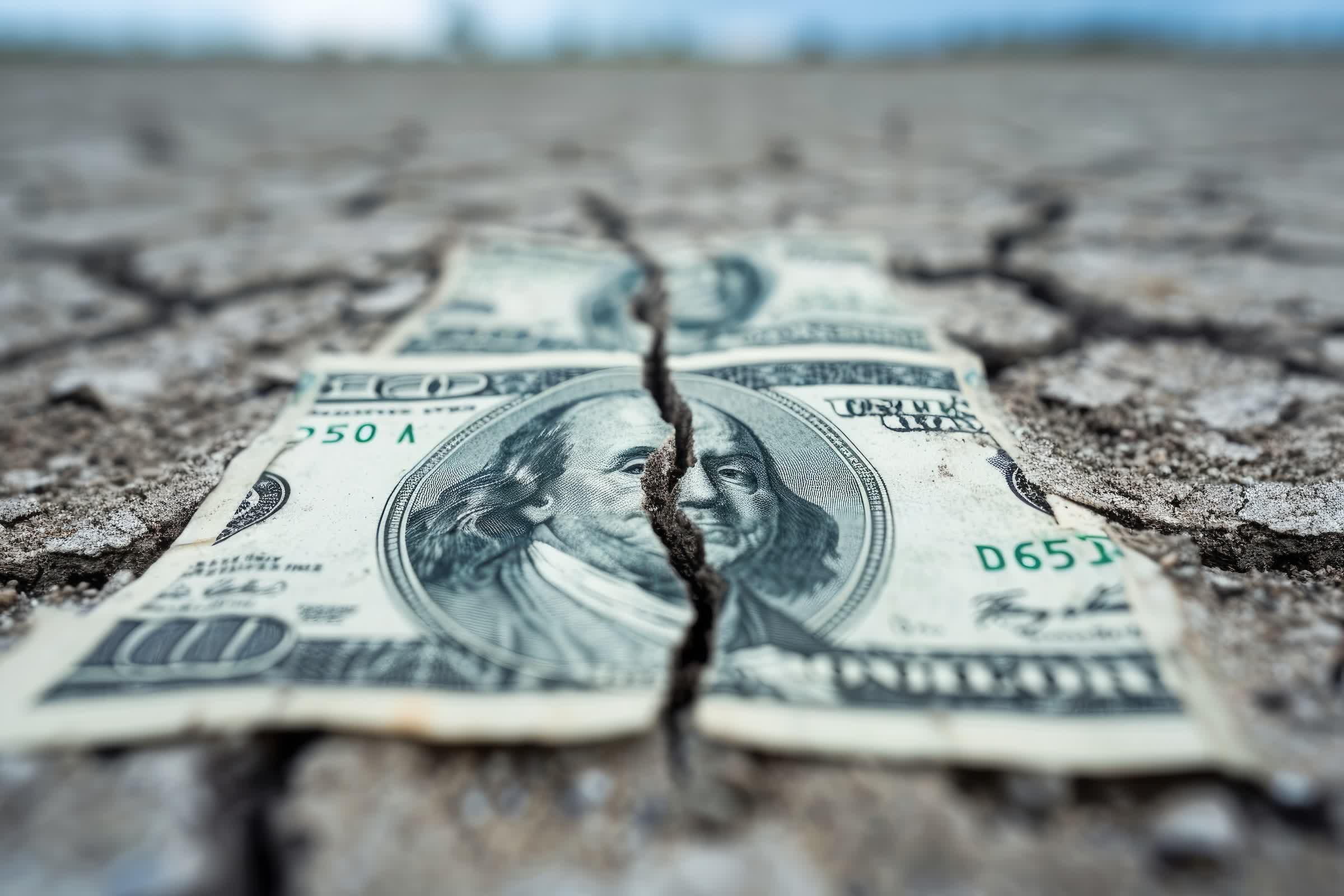
In Silicon Valley, the servers are humming again – and so is the unease. Massive data centers packed with Nvidia GPUs are fueling the artificial intelligence boom, generating extraordinary wealth for chipmakers, cloud providers, and startups racing to train large-scale models. But beneath the boomtime exuberance, investors and engineers increasingly doubt that this prosperity will reach beyond the small circle of companies building and controlling the technology.

This growing unease threads through conversations in co-working spaces, investor meetings, and podcasts. The concern isn't about whether AI will advance, but whether its success will accelerate inequality to levels unseen in previous technological cycles.

Elon Musk, whose ventures in robotics, self-driving cars, and neural interfaces span nearly all forms of automation, has warned of a "radical change" to employment patterns. On a recent podcast, he predicted "social unrest and immense prosperity" arriving side by side – a best-case scenario, in his view, for a world where intelligent systems handle most forms of human labor.

Musk envisions a post-scarcity economy, where abundance is guaranteed and "money has no real purpose." That vision, however, rests on an economic paradox: prosperity without participation.
OpenAI CEO Sam Altman sees the same disruptive power in AI but doubts that wealth redistribution alone will satisfy public expectations. Once a vocal proponent of universal basic income, Altman has since tempered his support, emphasizing the importance of individual agency.

He has argued that while AI could deliver immense productivity, it doesn't automatically provide meaning. A future in which citizens simply receive a dividend from algorithms, he said in a 2025 interview, may fail the deeper test of human purpose.

Altman's caution contrasts sharply with Musk's vision of "universal high income," yet both highlight a central tension: automation may undermine traditional work faster than any economic system can adapt to replace it.

Meanwhile, posts circulating across X and Facebook have amplified the mood, incorrectly claiming that Nvidia CEO Jensen Huang made similar remarks about a closing window for wealth creation.

While Huang never made that statement, the rumor highlights how closely AI progress has become tied to financial opportunity – and the fear of missing out. In reality, Huang has described automation as a potential equalizer, suggesting that as AI makes resources abundant, traditional measures of wealth could become less relevant.

The debate over automation's social impact is unfolding just as AI firms prepare for another defining moment: public offerings that could inject billions into the Bay Area economy. Companies such as OpenAI and Anthropic are reportedly exploring IPO plans that could rival the tech surges of 1999 and 2021.

Real-estate agents are already anticipating the ripple effects. One local entrepreneur, Rohin Dhar, publicly advised buyers to act quickly, predicting a surge in San Francisco property demand once newly minted AI millionaires enter the market.

The AI infrastructure being built today promises extraordinary efficiency – the ability to train models that can outperform humans in creative, technical, and analytical tasks. Yet those same advances raise the question lurking behind Silicon Valley's optimism: if intelligent systems can do everything humans can, faster and cheaper, what's left for the rest of us to build, or to own?

Permalink to story:

 
A post-scarcity economy is impossible without magical star trek replicators that cost next to nothing to build and run on next to nothing.

Even if AI makes us 10X more efficient than the internet that is all you have: more efficient production trying to satisfy unlimited wants.

100X more efficient? Some stuff likely gets weird but many things can't be made by software and the underlying fact is comparing us to 2000 years ago is way more efficient and common people have more luxuries, but the economy of doing something of value to trade for other valuable things didn't go away.
 
Money is a non-violent system for distributing power; when it disappears, power doesn’t—it consolidates and is enforced through authority and violence. Every attempt to abolish money has replaced market inequality with political domination, because scarcity never vanishes—it simply shifts to land, energy, infrastructure, and control of systems. I mean, we’ve been obsessed with that truism in stories forever—if I control the only water, I am your king.

Capitalism, though flawed, remains the most effective mechanism for diffusing power without violence. In a post-money or post-scarcity fantasy, personal agency erodes, coercion rises, and the means of force become paramount. Nobody wants that future because we’ve been there most of human history, and it sucks.

Thank god Elon Musk isn’t a prophet of the future—he’s just a twit-billionaire high on his own mythology (among other things), confusing science fiction with serious economics, and mistaking his bank balance for wisdom. Which, given his rhetoric here, is peak irony.
 
To compare us to 500 years ago

Us: excellent medicine, instant communication, global fast travel. Work 24/7 man and woman to juat survive and have a flat the size of a dog place. Food more resembles **** than eadibles.

Them 500 years ago: no medicine, communication takes days and weeks, world much smaller yet much larger. Work few days a week if at all, daylight only and man only. Flat the size of a football field and free of charge Natural real food.


Who has it better
 
"On a recent podcast, he predicted "social unrest and immense prosperity"
There will be unrest when 20 million healthy and energetic people have no jobs and no ways to provide for themselves besides a government handout.

In such situation, drastically upping taxes for very rich should be the first step to avoid or decrease unrest. The more poverty along with extreme wealth, the less happy people will be.

But I think there are things that we can do right now before this becomes our reality. For example, encouraging people to create businesses and jobs. Change laws to help small businesses, give them benefits.

We can easily predict that a lot of jobs will be gone. No need to wait till it happens, we should do smart things now.
 
Oh we are already screwed. You don't own anything. Everything is a subscription.
Heck, your own home, vehicle, property isn't really yours in a lot of places. You have
to pay TAXES or government (city,state, federal) comes along and takes it.
 
What even is this article. Breathless optimism about AI, proclamations by the vested taken at face value without critique. And trillions spent, still with no path to profitability.

And now there's rumours of AI IPOs. 'Hey plebs, you don't want to miss out! [Buy our shares and be the exit liquidity please.]'
 
I am sure AI will figure a fix.
Connect to Banks, distribute "wealth" corresponding to "merits"...
Scramble all traces etc...repeat as needed
 
If the very rich don't really want to share their wealth (and power based on that wealth) right now and just want more, why would they want to share (a substantial part) if people have no income because they have no jobs anymore?
Small sacrifice to keep the Status Quo.
 
If it were truly revolutionary, 5 years from "inception" for LLM's (or really the inception of the hype), it would already be having a huge affect in productivity and profits right across the world.

And it's hasn't, and it won't.

So I don't put much faith listening to the billionaires hoping the money train keeps flowing forever, and all human labour will soon become irrelevant.
 
Oh we are already screwed. You don't own anything. Everything is a subscription.
Heck, your own home, vehicle, property isn't really yours in a lot of places. You have
to pay TAXES or government (city,state, federal) comes along and takes it.
That just seems a bit overly cynical to me. Im sorry if you feel screwed, but I think we live in an amazing moment in history, where the vast majority of humans worldwide are better off than they were 50 years ago, or even 20.

Plenty of things aren’t subscriptions, and a lot of the things that are actually provide ongoing value that didn’t really exist before. There is far more choice today than there used to be.

And ownership still means something concrete: you hold title, you can sell it, inherit it, or borrow against it. Despite how prevalent subscriptions feel online, they’re a relatively small slice of total household spending. Most consumer purchases—furniture, tools, appliances, electronics—are still one-time buys that you can keep or resell indefinitely.

And taxes exist because societies collectively fund infrastructure, courts, emergency services, and defense. We all take advantage of those collective services and are expected to pay to fund them. Pretty sure that’s been true in every organized economy since money existed. I mean, you can absolutely disagree with tax rates or how the money is spent, but framing taxes as proof of some “you own nothing” scheme doesn’t really make sense.

It’s easy to look at tiny slices of things in the world today and be cynical. Our media doesn’t help one bit—there’s a reason the term “if it bleeds it leads” exists. But when I step back and objectively look at the progress that has been made over the last century in the world, the overall negativity toward things now just really isn’t justified IMHO. There will always be things to fix and there will always be suffering. That’s life. But man, there is a lot of good things in life out there :)
 
AI will put huge amounts of power and money in a few hands. And look at the hands it will end up in...
Jeff Bezos, Mark Zuckerberg, Elon Musk etc. Time and again these people have shown how utterly sociopathic they are. How they value only themselves and their own power and are incapable of forming any kind of relationship with others. Unless we have a radical rethink, this won't end well.

If we all stop buying Tesla's, shut our Facebook and Instagram accounts and look for open source alternative Social Networks. Stop buying tat from Amazon and use Ecosia and Linux rather Google and Windows we could wipe these companies off the map in a decade, but I can't see the great unwashed ever being persuaded out of their apathy so we sleep walk towards a more and more dystopian future.
 
Back