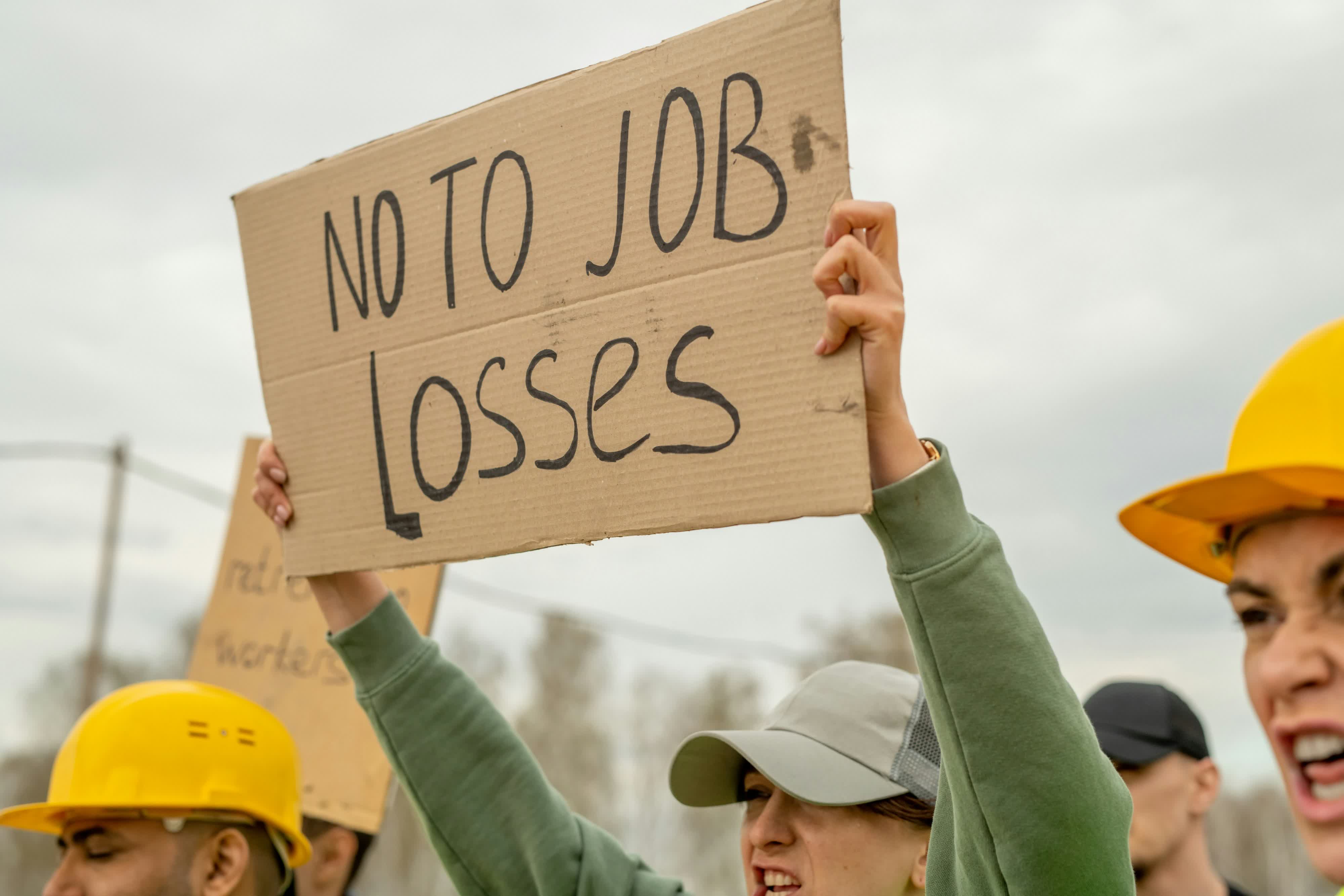
A hot potato: AI companies repeatedly claim their tools will transform the world for the better, making work less monotonous and more productive. Yet more than seven out of ten people in the US worry that the technology will put "too many people out of work permanently." Concerns also extend to its use by the government and military, its growing electricity demands, and even the rising number of people forming relationships with chatbots.
Warnings that the generative AI revolution would lead to job losses on a scale not seen since the industrial revolution have been around since ChatGPT started gaining users at an alarming rate in 2023.
While 71% of respondents in the Reuters/Ipsos poll said they were worried about AI making too many people permanently unemployed, we've not seen the sort of mass unemployment that many have warned of, at least not yet – the US jobless rate was just 4.2% in July
However, every day brings new stories of companies laying off staff as they focus more resources on AI investment. Microsoft has laid off around 15,000 people this year as it refocuses on AI infrastructure, increasing operational efficiency, and adapting workflows to prioritize AI capabilities.
Amazon, Oracle, Atlassian, Duolingo, IBM, Klarna, and others have also laid off employees in the hundreds or thousands, either directly or indirectly due to AI. And the trend doesn't appear to be slowing down.
Away from jobs, an even higher percentage of respondents (77%) said they were concerned about AI being used to stir up political chaos. With video and image generation becoming increasingly realistic and accessible, more people are posting media of events that never happened, sometimes claiming that they are real.
The military's adoption of AI is also worrying Americans, with almost half saying it should never be used to determine the target of a military strike. With drones, planes, turrets, and other weapons being given AI smarts, humans are increasingly getting left out of the picture.
The military has long said a human would always be part of the equation when it came to lethal autonomous weapons, but then Google always said it would never create an AI application that caused harm – until it removed that passage from its AI policy earlier this year. Just 24% of people said the government should allow AI to be used this way in the military, while 28% said they were not sure.
Mass electricity use stemming from generative AI concerned 61% of participants. Data centers are expected to account for 6.7% to 12% of US electricity use by 2028, with around half of that driven by AI. Still, at least people will be able to generate images of tri-breasted anime women as they search for work.

Finally, something that concerns two-thirds of respondents is people ending relationships in favor of AI companies. It wasn't too long ago that this was a jokey sci-fi trope seen in the likes of Futurama, but there have already been cases of people "marrying" chatbots.
And let's not forget the unhealthy attachment some people have with Character.ai bots, including the obsessed teen who ended his life. There's also the new waifu AI companion feature in Grok that is getting a lot of attention – one must wonder how Elon Musk thinks this will help the falling birth rate he's so desperate to end. Even former Google CEO Eric Schmidt thinks AI girlfriends are a concern.
The Reuters/Ipsos survey gathered responses online from 4,446 US adults nationwide and had a margin of error of about 2 percentage points.