
TL;DR: As rival chipmakers and AI developers weave ever-tighter financial and operational bonds, the pace and complexity of dealmaking shows no signs of slowing. While industry figures celebrate growth and technological promise, the market's interdependent structure is starting to invite doubts. For now, the sector remains gripped by one question: will today's investments transform the economy, or unravel a web of risk whose consequences are yet to be felt?
Artificial intelligence investment activity reached new heights this month, as OpenAI cemented strategic partnerships with both Nvidia and AMD, intensifying a trend that has seen billions of dollars cycle between a handful of industry leaders. The recent deals underscore mounting skepticism over the sustainability of the sector's rapid expansion and the intricacies of its business relationships.
OpenAI made headlines two weeks ago by signing a deal with Nvidia that could result in up to $100 billion invested in constructing vast data centers designed to fuel the continued growth of advanced AI models. As part of the arrangement, OpenAI committed to purchasing millions of Nvidia chips, raising questions about the nature and scale of their financial ties.
The momentum continued on Monday, when OpenAI and AMD announced a multi-billion-dollar partnership in which OpenAI will deploy tens of billions of dollars' worth of AMD chips and become one of the chipmaker's largest shareholders in the process. The channeling of enormous sums into hardware deployment marks a rapid escalation in both spending and ambition for companies whose profitability models remain largely untested.

Industry analysts have raised alarms regarding what they refer to as "circular financing" – business arrangements where money often cycles through investments and purchases between closely linked companies, potentially inflating market growth beyond fundamentals. "If we get to a point a year from now where we had an AI bubble and it popped, this deal might be one of the early breadcrumbs," Brian Colello, an analyst at Morningstar, told Bloomberg in reference to Nvidia's investment in OpenAI. Such concerns are amplified by OpenAI's continued cash burn and its expectation that it will not become cash-flow positive until the end of the decade.
Nvidia and OpenAI exemplify the pattern, having brokered additional arrangements with companies like Oracle. In a recent announcement, OpenAI confirmed a $300 billion deal with Oracle to build out US data centers using Nvidia and AMD chips. Oracle itself spent billions on Nvidia processors, with financial disclosures showing the company's cloud margins are slimmer than anticipated, heightening doubts about profitability for even established firms participating in the AI infrastructure buildout.
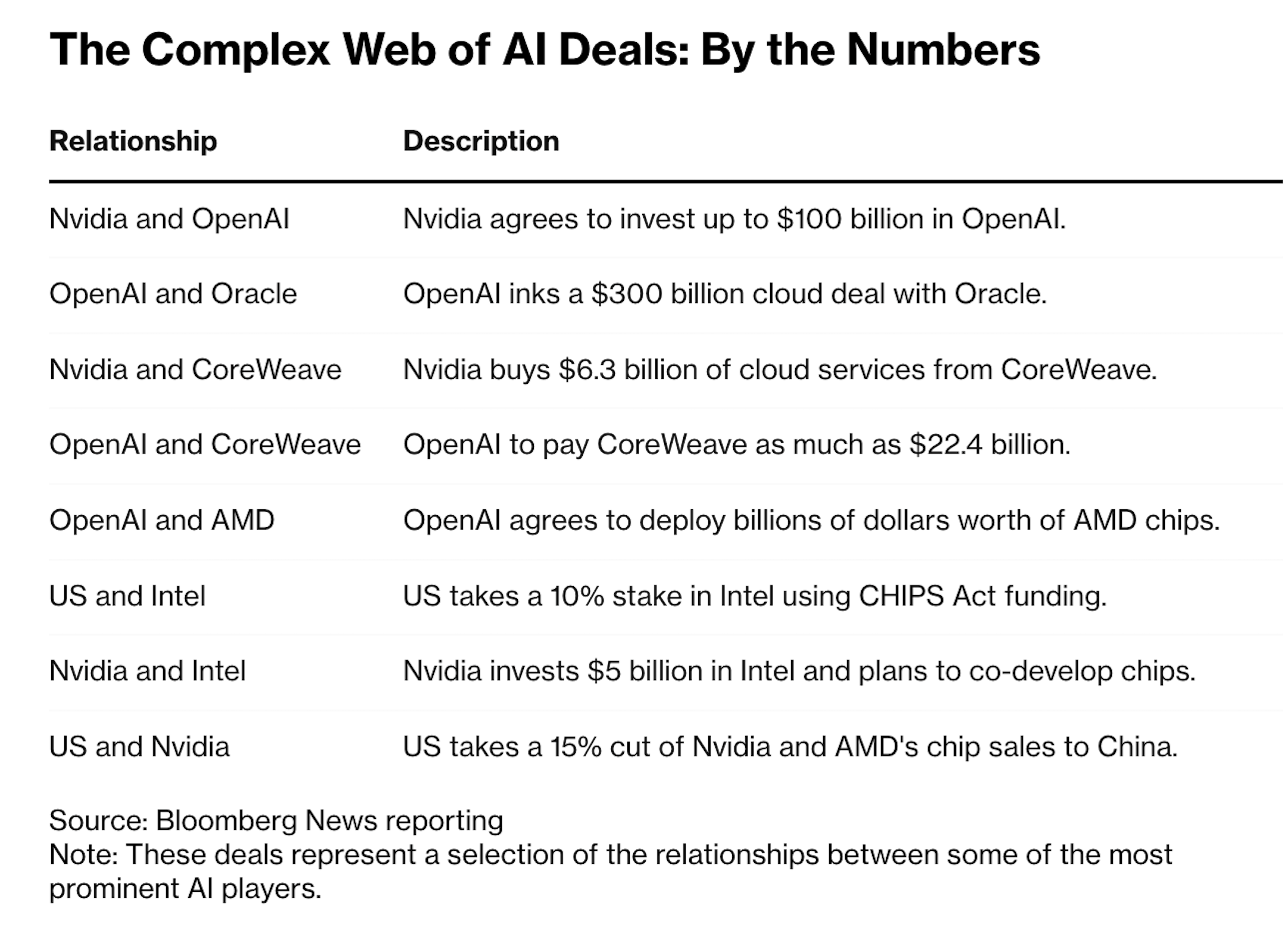
The complexity doesn't end with OpenAI and Nvidia. Elon Musk's startup xAI is in the midst of a $20 billion funding round featuring roughly $7.5 billion in equity and as much as $12.5 billion in debt. Nvidia is reportedly preparing to invest $2 billion in the venture, facilitated through a special purpose vehicle that will be used to purchase Nvidia chips. The chips will then be rented out over five years.
Similar dynamics are evident with CoreWeave, a newer entrant in cloud infrastructure. Nvidia both invested in and contracted services from CoreWeave, taking a 7 percent ownership stake and promising $6.3 billion in service purchases. OpenAI also received $350 million from CoreWeave before extending cloud agreements up to $22.4 billion.
Executives inside the AI sector maintain that these overlapping arrangements are essential to meet extraordinary demand. "It's a virtuous, positive cycle," AMD CEO Lisa Su told Bloomberg TV. OpenAI President Greg Brockman described the environment as requiring "an industry-wide effort" spanning the entire supply chain.
Despite industry assurances, some observers see parallels to previous speculative markets. Paulo Carvao, a senior fellow at Harvard Kennedy School who studies AI policy, noted, "In the late 1990s, circular deals were often centered on advertising and cross-selling between startups, where companies bought each other's services to inflate perceived growth. Today's AI firms have tangible products and customers, but their spending is still outpacing monetization."
Nvidia, responding to criticism, emphasized that it does not require its investment recipients to use Nvidia products. CEO Jensen Huang told CNBC, "We don't make it a requirement that they use that investment to buy Nvidia's technology. They could use it to do anything they like." OpenAI, on the other hand, declined to comment.
Previously, much of the AI sector's funding flowed through established technology giants like Microsoft, Amazon, and Google, enabling strategic alliances that also benefited cloud service providers. Now, newer AI ventures such as OpenAI and xAI are turning to traditional debt markets to finance astronomical infrastructure ambitions. "Altman has the power to crash the global economy for a decade or take us all to the promised land," wrote Bernstein analyst Stacy Rasgon in a recent investor note.
CoreWeave CEO Michael Intrator acknowledged circular financing worries, but suggested these concerns will subside as enterprise adoption increases. "When Microsoft comes to us to buy infrastructure to deliver to its clients who are consuming 365 or Copilot, I don't care what the narrative is about circular financing. They have end users that are consuming it."
Image credit: Bloomberg