
In context: Introduced in 2020, the DDR5 SDRAM standard expanded the limits of memory frequency, data transfer, and overclocking potential compared to DDR4. A newly validated record pushes the technology to unprecedented speeds – but further gains may soon hit a ceiling.
Hwbot officially validated a new DDR5 overclocking record after German overclocker "Sergmann" pushed a single module to 6,504.9 MHz. The feat hit 13,010 megatransfers per second (13 GT/s), earning him the top spot on Germany's overclocking leaderboard.
The new record came just weeks after overclocker Salty Croissant claimed the slightly faster 6,510 MHz and 13,020 MT/s on a DDR5 module. However, that result never received Hwbot validation. The discrepancy suggests the earlier attempt either failed to meet submission rules or proved too unstable to verify.
Sergmann used a single 24 GB Corsair Vengeance DDR5 module rated at 8000 MT/s, paired with a Gigabyte Z890 Aorus Tachyon Ice motherboard marketed for "infinite overclocking performance." The setup also included a Core Ultra 9 285K CPU, known for its endurance under heavy overclocking.
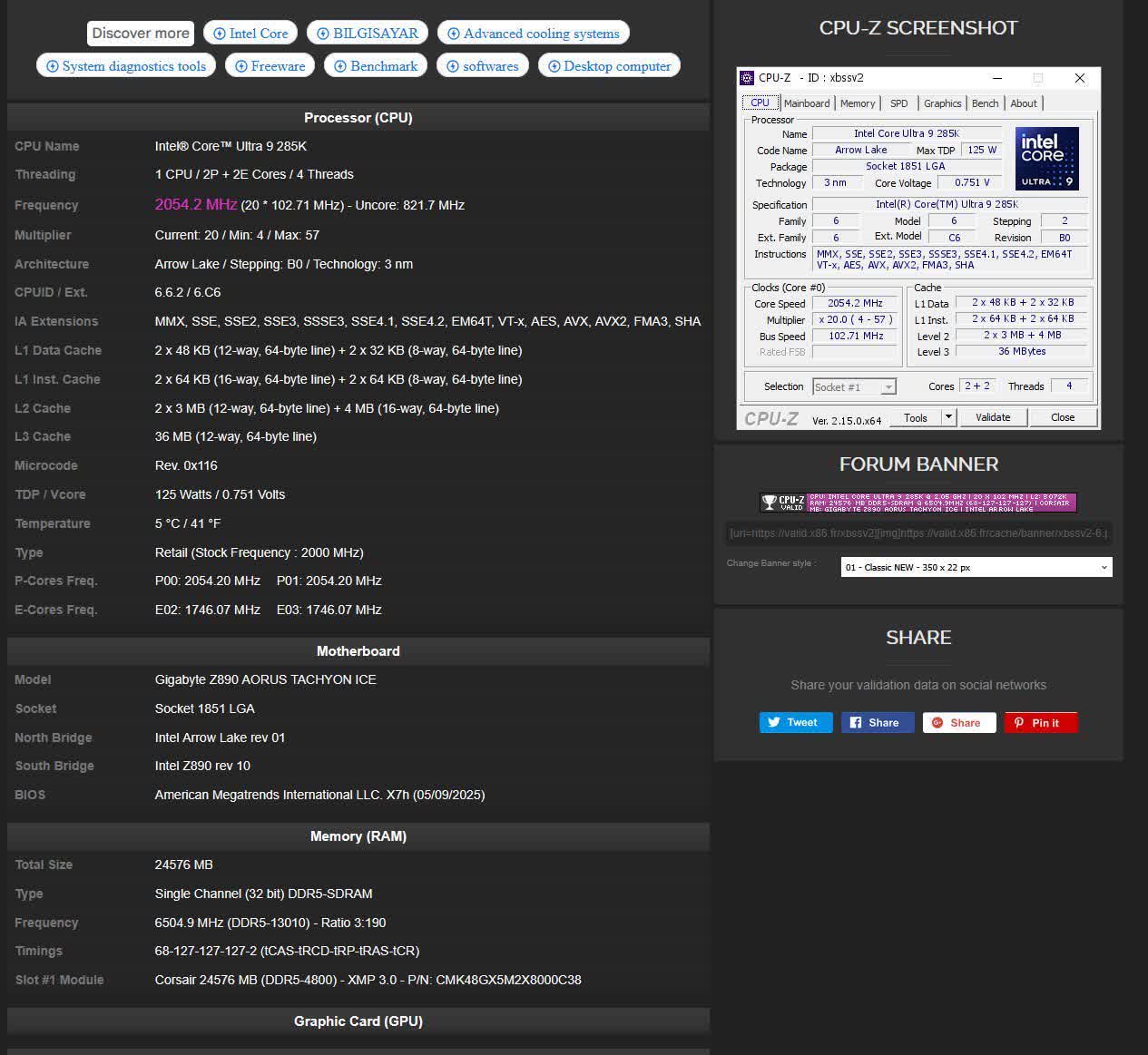
Sergmann configured the memory at CL68-127-127-127-2 and limited the CPU to a 2+2 core setup to improve voltage stability for the memory controller. To manage extreme heat and maintain system stability, the overclocker relied on liquid nitrogen cooling.
The memory timings and CPU configuration Sergmann used are ideal for extreme overclocking but impractical for a typical workstation or gaming PC. The German overclocker also relied on a 1,600W Seasonic power supply and gave a nod to Salty Croissant in the comments on the record-setting run.
Standard DDR5 memory frequencies can reach up to 9,600 MT/s, while higher speeds require specialized techniques or extreme cooling, such as liquid nitrogen. Sergmann improved the previous overclocking record by only 90 MT/s, suggesting we may be approaching the theoretical limits of DDR5 frequency under extreme conditions.
Memory overclockers will likely celebrate in a few years, when JEDEC finalizes the next-generation DDR6 standard. The new SDRAM should deliver transfer rates between 8,800 and 17,600 MT/s, with a peak data bandwidth of 134.4 GB/s.