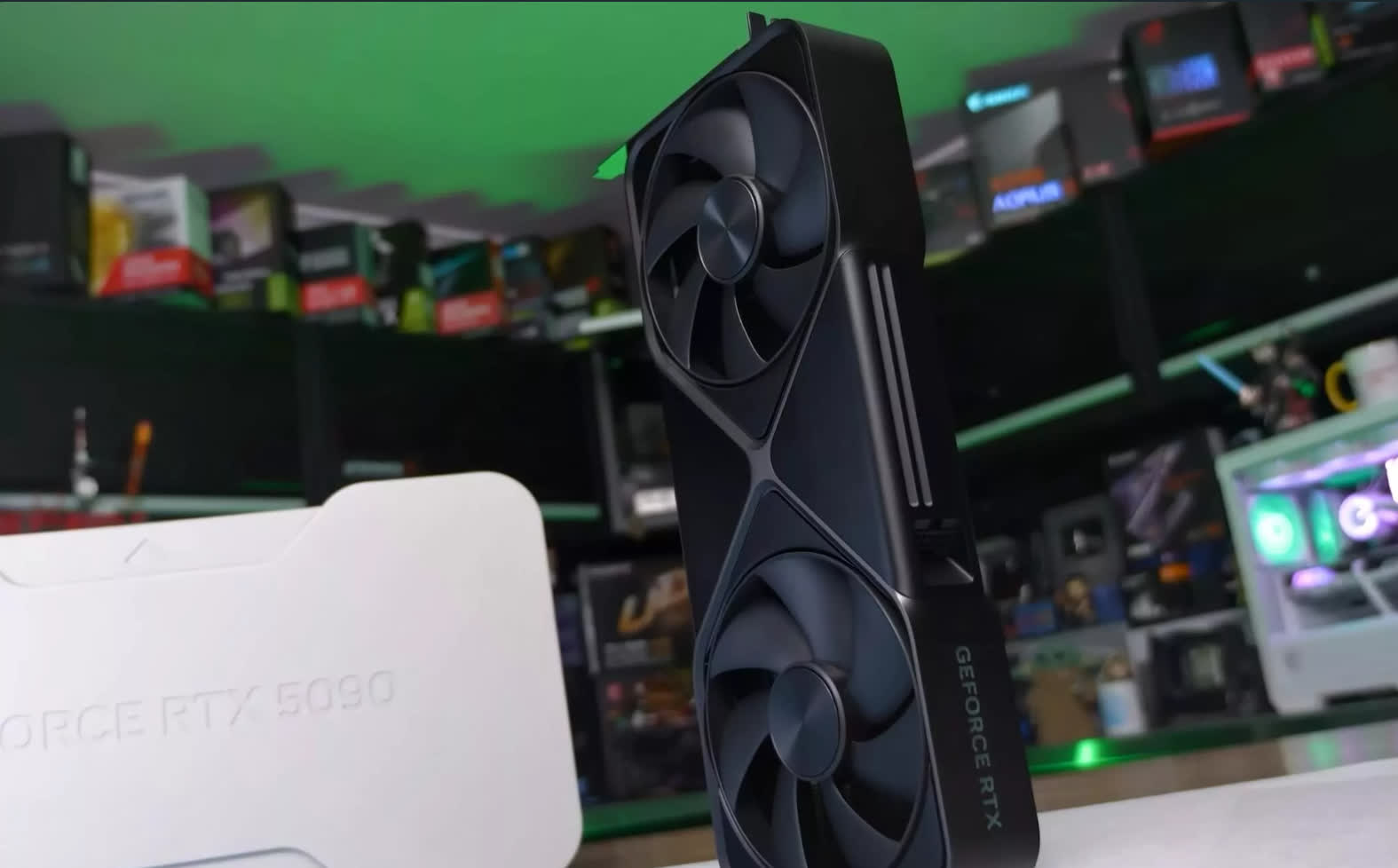
Facepalm: Owning an RTX 5090 might be some gamers' dream, but it could turn into a nightmare: a famed repair specialist has branded the design of the Founders Edition consumer Blackwell card one of the worst in the history of GPUs.
Computer repair shop and popular YouTube channel Northridge Fix has made plenty of headlines over the years, many of them related to the well-documented RTX 4090 melting power cable issues.
In a recent video, the channel examined an RTX 5090 that was sent in after it stopped working following modification with a custom water block.
According to the technician, a customer had brought in two RTX 5090 graphics cards for repair after both stopped working following water block installations. One of them – an Asus model – was successfully revived by reverting to the stock cooler. The Founders Edition, however, turned into a painful case study in over-engineering.
The technician's chief complaint centered on Nvidia's decision to make the 5090 Founders Edition modular, splitting the GPU into multiple interconnected parts that rely on delicate connectors instead of a unified PCB layout.
He explained that the card's PCIe connector is attached to the main board via a small, "very fragile FPC (flexible printed circuit) connector." During disassembly, it became clear that this connector is not designed to tolerate repeated removals or physical stress; one damaged or misaligned pin can prevent the entire card from outputting an image.
"The 5090 is a very heavy card," he noted, "and when you start adding fragile joints between major components, you're just asking for trouble."
Inspecting the card under a high-powered microscope, the repair expert discovered that one of the FPC connector's pins had been bent and another had snapped completely, likely during the water block installation process. This single broken pin was enough to stop the card from functioning, despite all voltage rails measuring correctly.
The biggest problem came when trying to find a replacement for the connector. After sourcing multiple electronics suppliers, no direct or compatible replacement part could be found.
"What's the point of designing it in two pieces if you can't buy the connector that joins them?" the technician asked. "If one pin goes bad, the whole GPU is dead, and there's nothing you can do about it."
Also highlighted was the card's unnecessarily complex internal structure; the teardown process required dealing with numerous screws, brackets, and small components, each introducing another possible failure point. The presenter likened the situation to plumbing: "The more joints you have, the more likely you'll get a leak." By comparison, older GPU designs with a single, solid PCB were far more robust and easier to service.
The technician's conclusion was to avoid the RTX 5090 Founders Edition at all costs, especially if you plan to modify or water-cool it. "If it's not broken, don't fix it," he warned. "The old-style GPUs worked just fine – why change something that didn't need changing?"
In the end, the technician returned the GPU casing to the customer and left the card unrepaired, declaring it unfixable without a replacement connector.