Forward-looking: The massive surge in new data center projects fueling the AI craze is making a handful of IT companies extremely wealthy. Seagate is one of the few manufacturers still designing and producing HDDs, and now it's working on major increases in data density to provide the storage capacity AI companies will likely require in the coming years.
According to new research presented at Japan's Research Center for Magnetic and Spintronic Materials (CMSM), Seagate is making significant progress on the next generation of its hard disk drive technology. In recent lab experiments, the US-based storage company achieved a data density of 6.9 TB per platter in HDDs using heat-assisted magnetic recording (HAMR).
The first HAMR drives, which debuted earlier this year, featured an areal density of 3 TB per platter. This means Seagate has already more than doubled that figure in laboratory testing. At CMSM's seminar on the future of hard-disk and storage technologies, the company also described several concepts that could push density even further.
Seagate has already reached 8 TB per platter in computer simulations and is working to maximize HAMR's capabilities to 10 TB per platter. The company says it is developing new magnetic-storage architectures and read-head designs and is even exploring ferroelectric recording as a potential alternative to traditional magnetic methods.
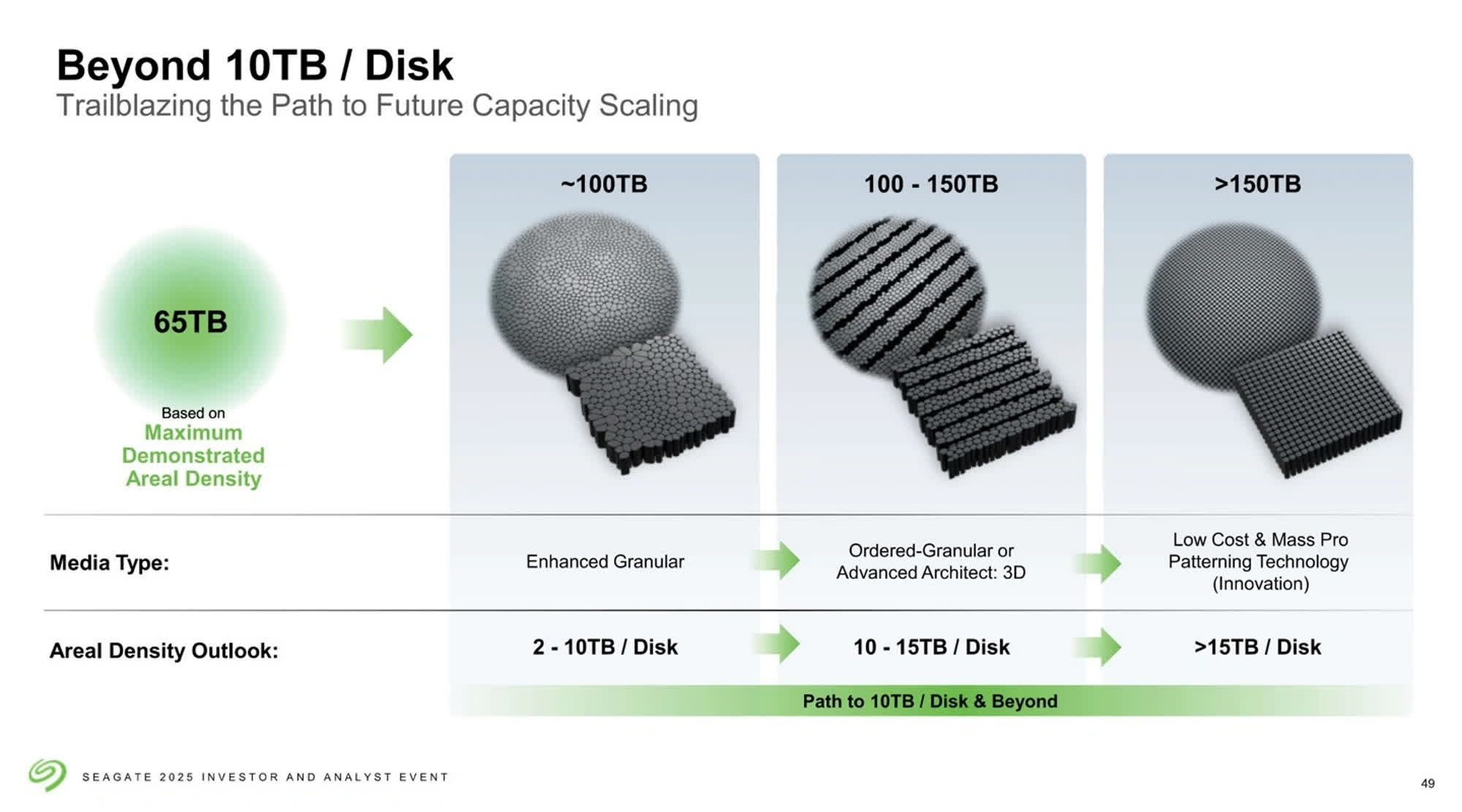
Seagate's roadmap includes developing a 7 TB platter for ultra-high capacity HDDs planned for release sometime next decade. Thanks to recent advances in novel magnetic-recording techniques, the company expects to eventually reach an unprecedented 15 TB per platter – or even higher levels in the foreseeable future.
From a customer standpoint, this dramatic increase in density could mean access to individual HDDs offering hundreds of terabytes of storage. If Seagate achieves its lofty R&D goals, multi-petabyte hard drives (one petabyte = 1,000 TBs) could soon make their way to market.
Either way, Seagate continues to invest heavily in HAMR after becoming the first HDD manufacturer to deliver the technology to customers. The company expects to produce 100 TB drives by 2030 to meet the growing storage demands of AI data center projects and other enterprise clients.
Running a multi-petabyte HDD within current storage infrastructures will almost certainly going to meet with a few pain points. Traditional interfaces such as SATA would make data-intensive tasks excruciatingly slow. Seagate, however, is working on potential solutions to address these limitations.