Data centers on track to consume 20% of US power by 2035

Shawn Knight

Posts: 15,837   +202
Staff member
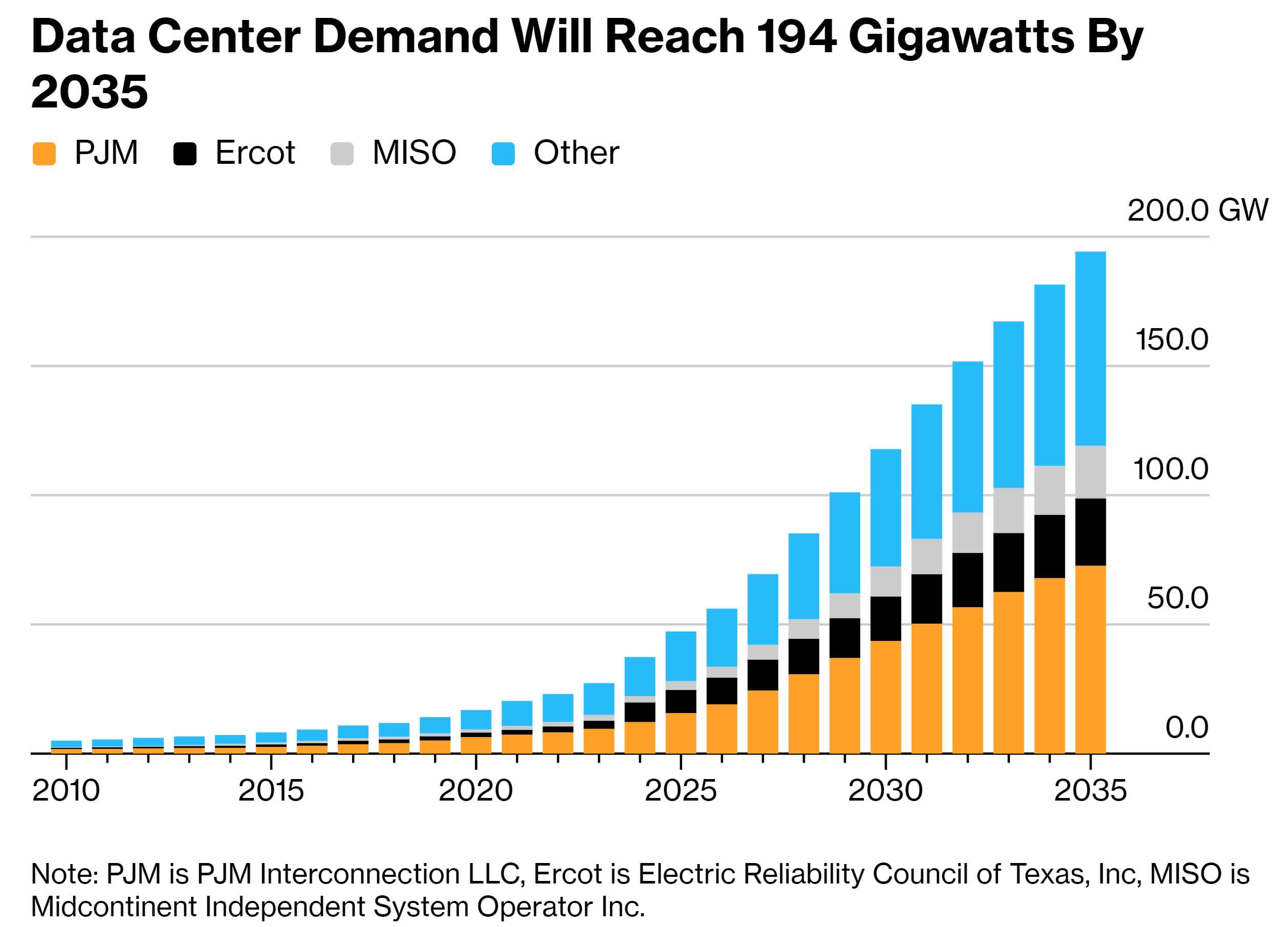
Looking ahead: Data centers are on track to consume 12% of the nation's total electricity supply by 2030 and one-fifth of US supply by 2035, according to the latest projections from BloombergNEF. For comparison, data centers today account for approximately 5.9% of power consumption.
The research firm estimates that US data centers will require a staggering 194 gigawatts by 2035 – up 83% over its previous forecast from last December. Put into context, one gigawatt is roughly the output of a single traditional nuclear reactor.

BloombergNEF blamed a surge in AI facilities scheduled to be built over the coming decade as the primary driver for the soaring energy demand. And in states where AI data centers are more densely packed, power needs will be even greater. PJM Interconnection LLC, a grid operator that's active in more than a dozen states including Virginia, expects more than a third of its capacity to go to data centers.
Lloyd Arnold, an analyst with BloombergNEF and one of the authors of the latest report, said the grid is already struggling to keep up with current demand, which is impacting how assets connect to it. In addition to all of the new AI data centers coming online, grids are still responsible for powering cities, electric vehicles, and everything else.

Even more worrying is that these estimates may be conservative, and only cover the US.

Worldwide data center energy demand will be significantly higher. As TechCrunch highlights, data centers collectively could require as much as 1,935 terawatt-hours of juice – roughly equivalent to what India currently consumes annually.

The one good thing about estimates is that they aren't set in stone. As such, there's a slim chance that something unexpected could happen in the AI industry – a true bubble burst – and many of the planned data center facilities might not even get built. Again, that seems unlikely given the current trajectory and hype around AI, but crazier things have happened. Remember the Dot Com bubble in 2000?

Permalink to story:

 
Great news!
That's 3.5x increase in consumption. Having in mind the blazing fast improvement in both efficiency and capability, 3.5x more energy can power a 3000x improvement.

If datacenters power themselves from their own behind the meter generation, everything related to the power grid is entirely irrelevant. We should simply dismantle any bureaucratic obstacles to datacenter own generation if some basic requirements are met.
 
Just cut to the chase already and attach the powerplants directly to the datacenters as they are built and let whatever is left over trickle down to the common man. Deregulate everything and let the people fight for batteries to entertain the rich in arenas. I'm bored with how slowly this is all happening.
 
I'm fine with whatever amount of energy and water datacenters consume, so long as they pay what other consumers pay for the privilege. At even the $0.14/Kwh a consumer pays where I live, a datacenter will quickly fund a huge amount of generation capacity if they're required to pay similarly.
 
Great news!
That's 3.5x increase in consumption. Having in mind the blazing fast improvement in both efficiency and capability, 3.5x more energy can power a 3000x improvement.

If datacenters power themselves from their own behind the meter generation, everything related to the power grid is entirely irrelevant. We should simply dismantle any bureaucratic obstacles to datacenter own generation if some basic requirements are met.
Unless, IMO, Data centers choose to power their equipment by using a power generation scheme that pollutes.
I'm fine with whatever amount of energy and water datacenters consume, so long as they pay what other consumers pay for the privilege. At even the $0.14/Kwh a consumer pays where I live, a datacenter will quickly fund a huge amount of generation capacity if they're required to pay similarly.
Either that or they go broke because they are not able to keep their business profitable.
 
I'm fine with whatever amount of energy and water datacenters consume, so long as they pay what other consumers pay for the privilege. At even the $0.14/Kwh a consumer pays where I live, a datacenter will quickly fund a huge amount of generation capacity if they're required to pay similarly.
Not only that, but over the medium and long term, datacenters make electricity less expensive, not more. They have far lower transmission and billing costs per unit energy consumed, and they consume power at a much steadier, more predictable rate. The most expensive problem most utilities face isn't generating the power itself, but matching supply to demand in real time.

One point missing from these discussions is how much power and other resources are saved by software running on datacenters. AI-driven logistics is already saving tens of millions of gallons of diesel fuel from shipping costs, and one study I saw estimated that by 2030, the use of AI in agricultural irrigation would save more water than that used by all datacenters combined.

Unless, IMO, Data centers choose to power their equipment by using a power generation scheme that pollutes.
You mean, like the source that powers the computer you used to post that?
 
COULD put a series strain on the power grid? Heck! A super cold winter, hot summer, earthquake, tornado or Taylor Swift TV special can do that now!
And what have we done for the last 10-20 years? Retired coal fired power plants, not built new nuclear plants but built solar & wind farms. Hey, solar/wind are nice, but in the event of a "weather event"
you just can't make the sun shine brighter or the wind blow harder.
At least with a GENERATOR station, you can increase the output, when needed.
One of the BIGGEST problems we face is the POWER GRID. It hasn't been expanded or updated to
meet the increasing demand.
 
Not only that, but over the medium and long term, datacenters make electricity less expensive, not more.
I am suspicious of this claim. There appears to be a lot of conflicting research on this topic. Besides, what is considered short term? I can see why people might have a problem with DC's increasing their power bills for even a few years without any immediately apparent benefits.
and they consume power at a much steadier, more predictable rate.
This I have more insight on. Depends on what type of load you are talking about. AI deployments are actually less predictable. I have witnessed it myself. Loads will randomly spike (up and down) in the extremes. This can cause problems for the DC and the substation. Its caused some odd behaviors with some of our equipment.
More on the topic:
https://pv-magazine-usa.com/2026/06...enge-isnt-generation-its-grid-responsiveness/
 
Back