
Keep 'Em Bursting: The overwhelming majority of the AI industry is currently running on multi-billion loans, rental contracts for non-existing data center capacity, and blind faith on the technology's ability to transform everything. According to new estimates, the end result of these converging factors is a company that's doomed to not reach profitability for a very long time.
HSBC Holdings predicts that OpenAI will keep asking for hundreds of billions of dollars in loans until 2030, despite an explosive growth in revenue and popularity. The British investment bank recently provided an updated forecast on OpenAI's tortuous path to profitability, taking into account the currently known contracts and loans with a few assumptions about the general trends of the AI service market.
The results of this speculative exercise are striking, especially as they come from a financial institution that shares the same blind faith in AI's transformative capabilities as OpenAI and many Big Tech players. Within five years, the AI startup is expected to rent a cumulative $792 billion of data center capacity, going up to $1.4 trillion by 2033.
How will the company pay for this unprecedented rental bill? HSBC expects that the number of OpenAI users will reach 3 billion by 2030, which is around 44 percent of the world's adult population, excluding China. Chatbots are predicted to become as ubiquitous and useful as productivity suites such as Microsoft 365, and 10 percent of their users will pay for the service.
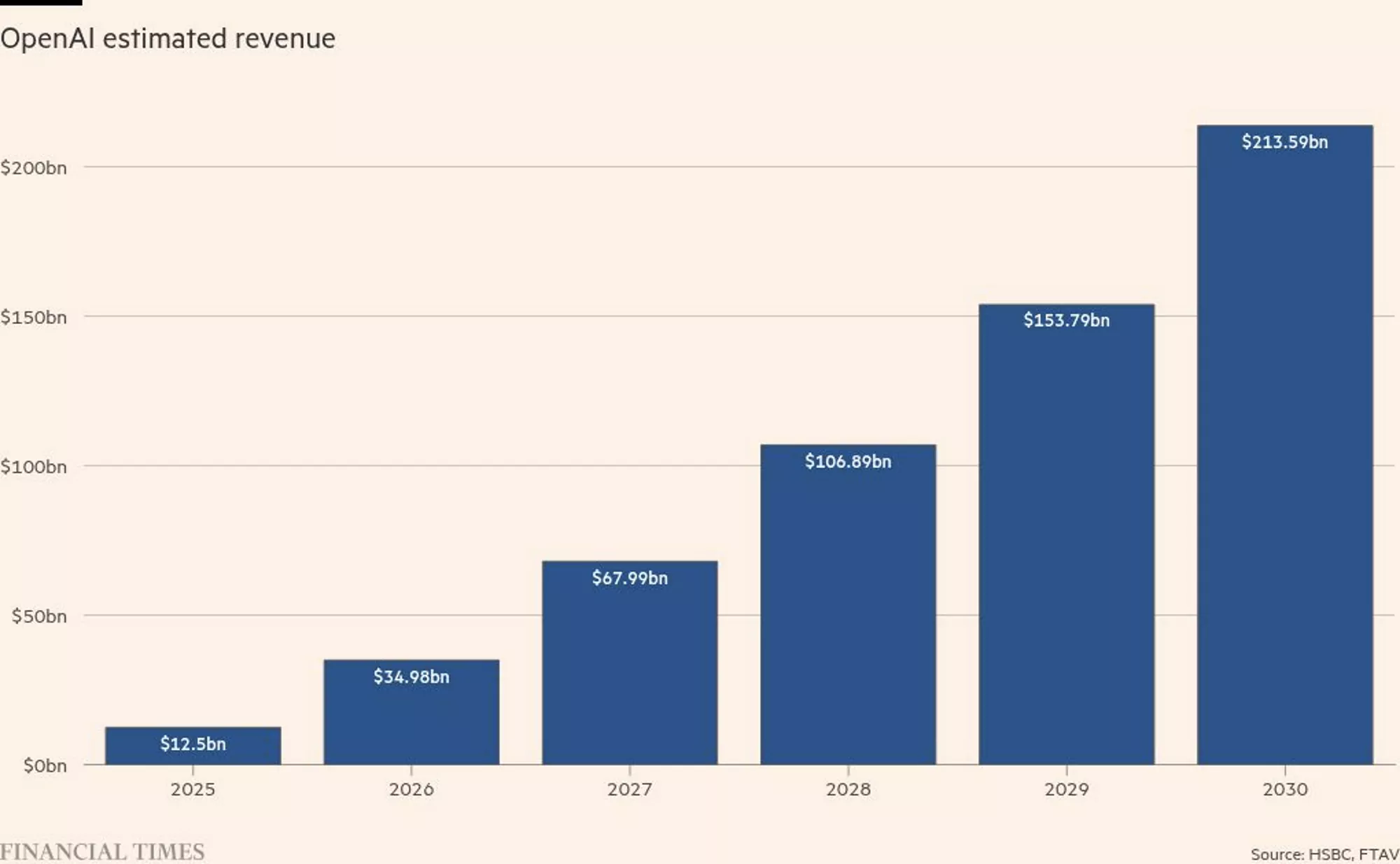
Thanks to paid subscriptions, advertising, agentic AI services, and other commercial initiatives, OpenAI is going to capture 56 percent of all revenue from consumer AI in 2030, which HSBC estimates will be $129 billion in total. Surprisingly, Europe's largest bank thinks that Google will not be part of the market, while Anthropic, xAI, and "other" players will still be around in five years.
Enterprise AI revenue is expected to reach $386 billion, and OpenAI will get a 37 percent share of that market. All in all, the corporation will have a cumulative cash flow of $282 billion in 2030 – plus a few billion coming from Nvidia, AMD, and other partners. OpenAI will ultimately have to deal with a $207 billion gap in funding.
HSBC predicts that the San Francisco-based company could be forced to adapt to a certain degree of "flexibility" in terms of AI infrastructure. Dealing with a shortage in computing capacity is always better than facing a liquidity crisis, the bank said.
Despite the growing signs of an incoming, devastating burst of the AI financial bubble, HSBC hasn't lost faith in technology miracles that generative AI and other ML technologies are eventually going to achieve. AI tech will become an integral part of every production and vertical process, the bank said, bringing significant productivity gains on a global scale.