Bottom line: OpenAI's financial model reflects the intense pressure to retain the people driving its breakthroughs. The company's willingness to spend aggressively on equity has redefined what competitive pay looks like in artificial intelligence – and raised the stakes for every firm vying to shape the field's future.
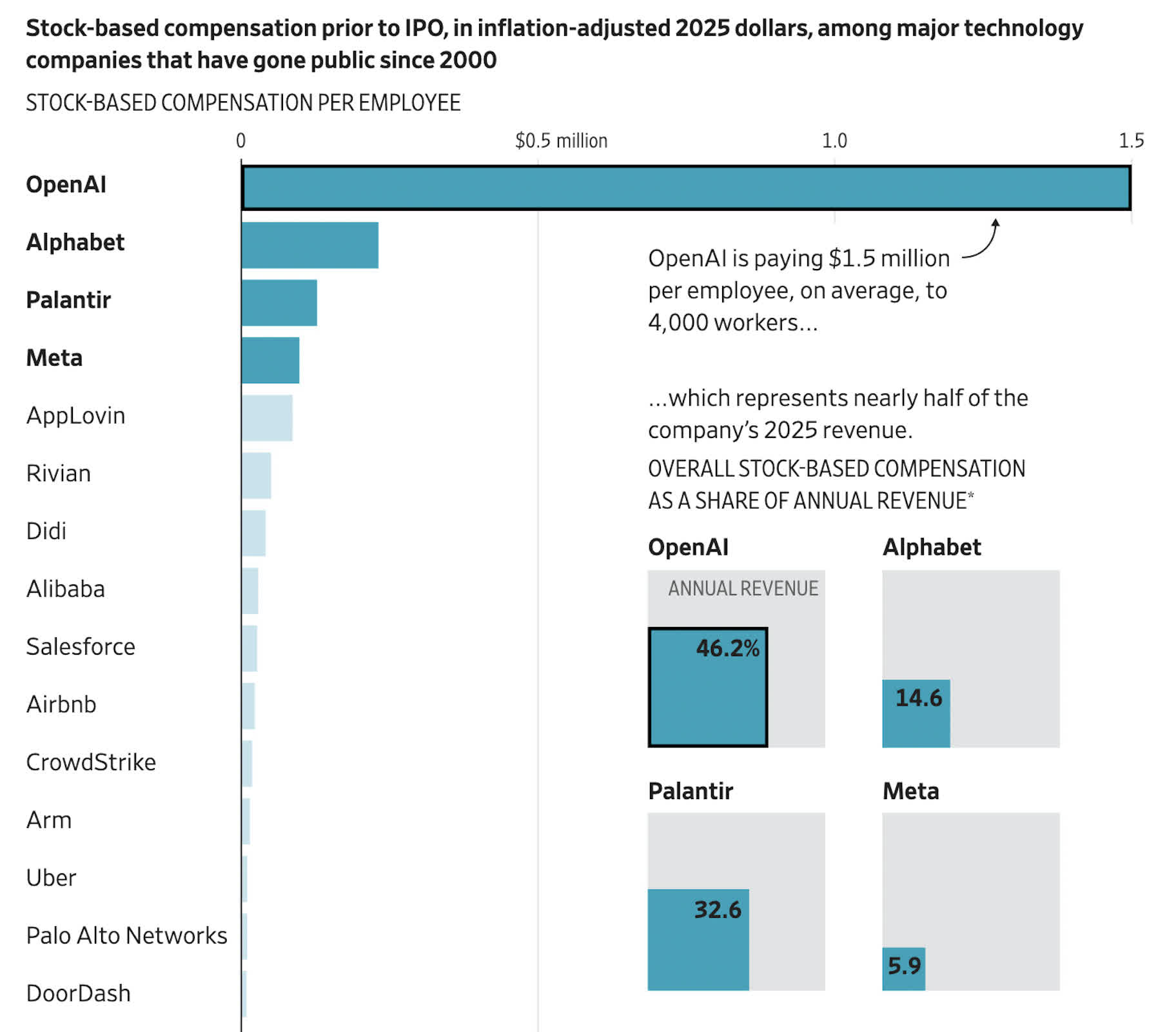
Internal financial disclosures show that OpenAI is distributing more equity per employee than any major technology startup on record. Its stock-based compensation – averaging roughly $1.5 million per worker across a staff of about 4,000 – far exceeds the benchmarks set by historical peers, according to data the company shared with investors.
Adjusted for inflation to 2025 dollars, that figure is seven times higher than the stock-based pay Google reported in 2003, the year before its initial public offering. A Wall Street Journal analysis of 18 other major tech companies found that OpenAI's average equity payout is 34 times larger than typical pre-IPO compensation levels over the past 25 years, based on data compiled by compensation research firm Equilar. OpenAI declined to comment on the figures.
The data marks an extraordinary shift in how top AI firms compete for talent. Founded less than a decade ago, OpenAI is now compensating researchers and engineers at levels once reserved for IPO-bound companies flush with capital.
Those stock-based packages are intended to secure the company's lead in the AI arms race, while also driving up operating losses and diluting shareholder value, according to people familiar with OpenAI's financials.
Costs have risen sharply as competition for elite AI specialists has intensified. The pay surge accelerated after Meta's CEO Mark Zuckerberg began offering compensation packages worth hundreds of millions of dollars – and in rare cases as much as $1 billion – to senior AI researchers and executives as part of an aggressive recruitment campaign.
That effort lured more than 20 OpenAI employees, including ChatGPT co-creator Shengjia Zhao, prompting the company to issue one-time retention bonuses in August, some valued in the millions.
Financial projections shared with investors indicate that OpenAI expects its stock-based compensation to grow by approximately $3 billion annually through 2030, underscoring how central pay incentives have become to its growth strategy.

In another change likely to push costs higher, the company recently ended a policy requiring employees to work at least six months before their equity vests, eliminating a standard cliff used by most Silicon Valley firms to manage turnover risk.
By 2025, OpenAI's compensation costs are projected to account for 46% of total revenue, a higher ratio than any large tech firm prior to going public, except for EV maker Rivian, which reported no revenue in the year before its IPO.
For comparison, Palantir's stock-based pay equaled 33% of revenue in 2020, Google's stood at 15% before its IPO, and Facebook's was just 6%, according to the Equilar analysis. On average, pre-IPO tech companies devoted about 6% of revenue to stock-based pay.
Image credit: The Wall Street Journal