
Looking ahead: With the move to 2nm, Intel's Core Ultra Series 3 marks both a technological achievement and a signal of the company's shifting priorities. The emphasis on AI acceleration, efficiency-per-watt improvements, and a unified CPU-GPU-NPU design sets the stage for how Intel plans to compete in a mobile computing era defined by local AI processing.
Intel's long-anticipated 2-nanometer 18A manufacturing process is finally in production, powering the company's new Core Ultra Series 3 chips, code-named Panther Lake. The processors, unveiled at CES 2026, are targeted primarily at laptops and compact PCs and mark Intel's first mass-produced chips built on this advanced node.
Systems featuring Core Ultra Series 3 processors are scheduled to arrive by January 27, with pre-orders opening earlier in the month. Intel's announcement provides the first concrete details on how these chips differ from the outgoing Series 2 generation, particularly in AI and graphics performance.

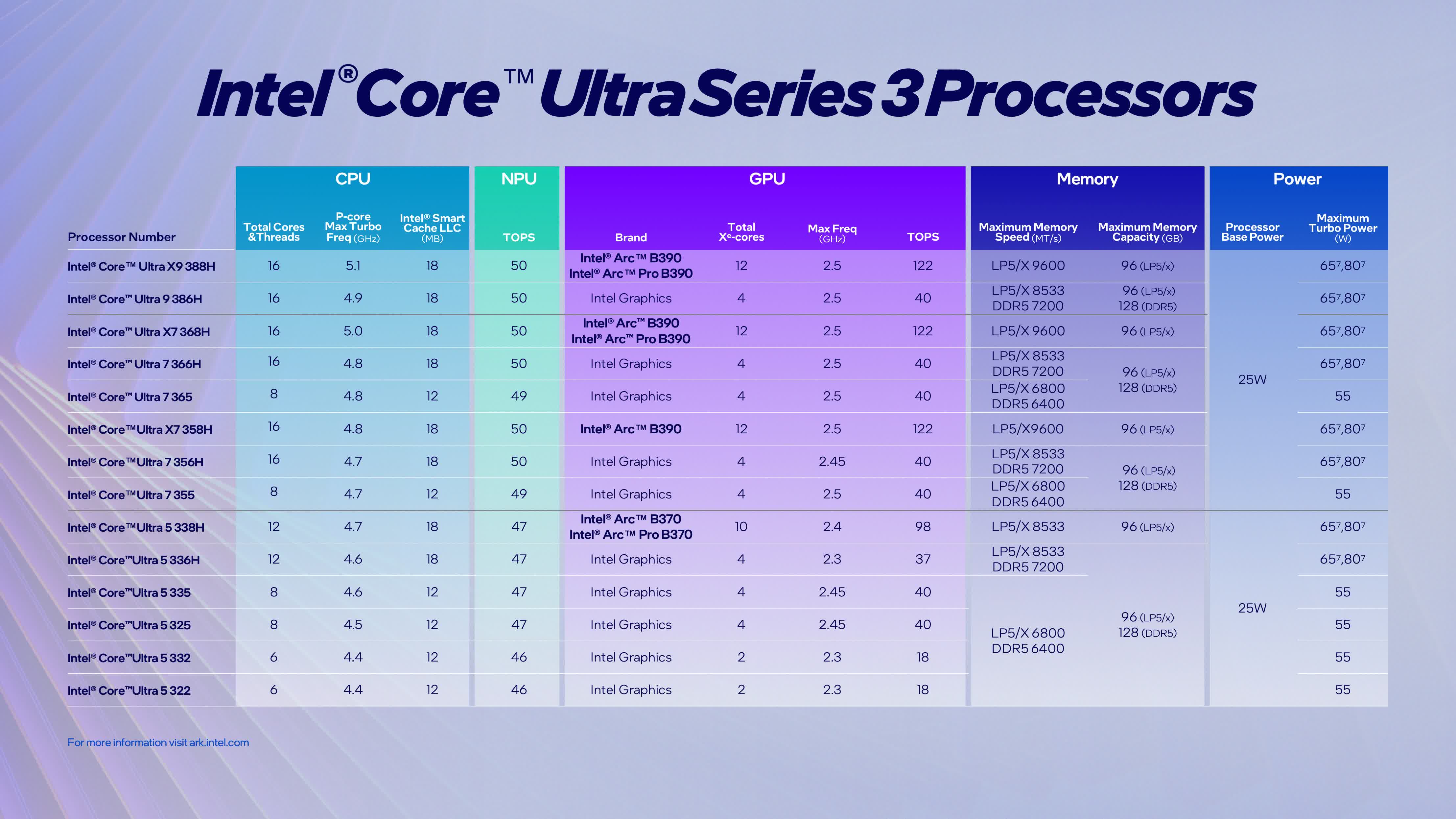
Each chip in the Core Ultra Series 3 lineup integrates an updated CPU, next-generation graphics cores, and a redesigned neural processing unit. On the CPU side, Intel offers up to four high-performance P-cores, eight high-efficiency E-cores, and four low-power LPE-cores, for a total of 16 cores in the top-tier model.
Intel said that both efficiency and per-clock-cycle workload capacity have improved compared with the previous generation.
Today Intel launches #IntelCoreUltra Series 3 processors for PCs and edge AI applications. It's one of the most important launches of the new Intel CEO @LipBuTan1 is building. Here's why: pic.twitter.com/oNsBYnXuq2
– Intel News (@intelnews) January 5, 2026
The headline model, the Core Ultra X9 388H, runs at a peak clock speed of 5.1 GHz and features 18 MB of L3 cache. By comparison, the earlier Core Ultra 9 285H had six P-cores, eight E-cores, two LPE-cores, and 24 MB of L3 cache, with a peak frequency of up to 5.4 GHz.
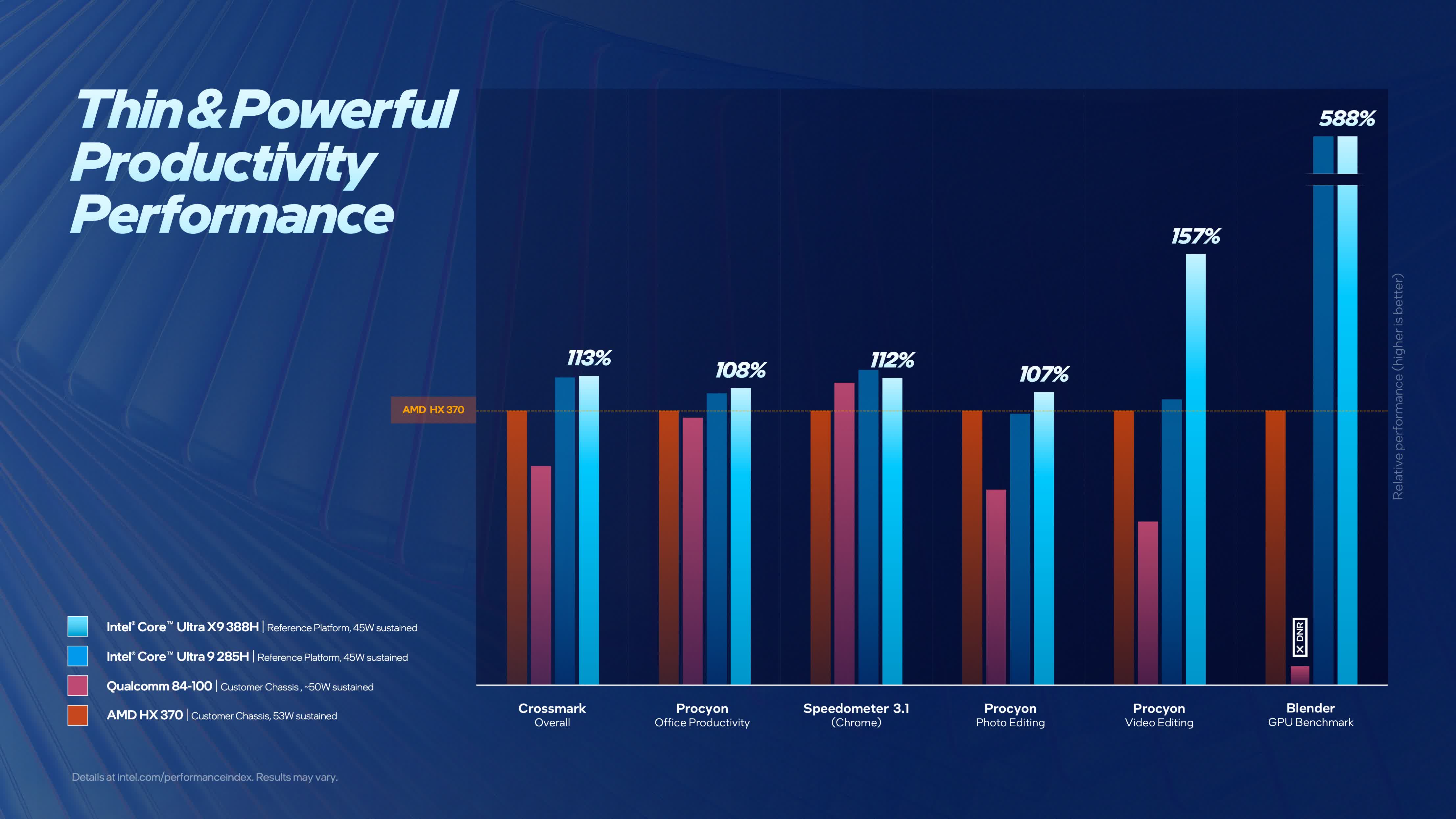
Despite these differences on paper, Intel claims the new Ultra X9 388H can outperform the older 285H by up to 70 percent in gaming and deliver as much as 60 percent better multi-threaded performance compared with the Core Ultra 9 288V from the Series 2 lineup.
The new generation also integrates top-tier connectivity, including Wi-Fi 7 (R2), Bluetooth 6.0, and Thunderbolt 5 support across select Ultra 7 and Ultra 9 variants.
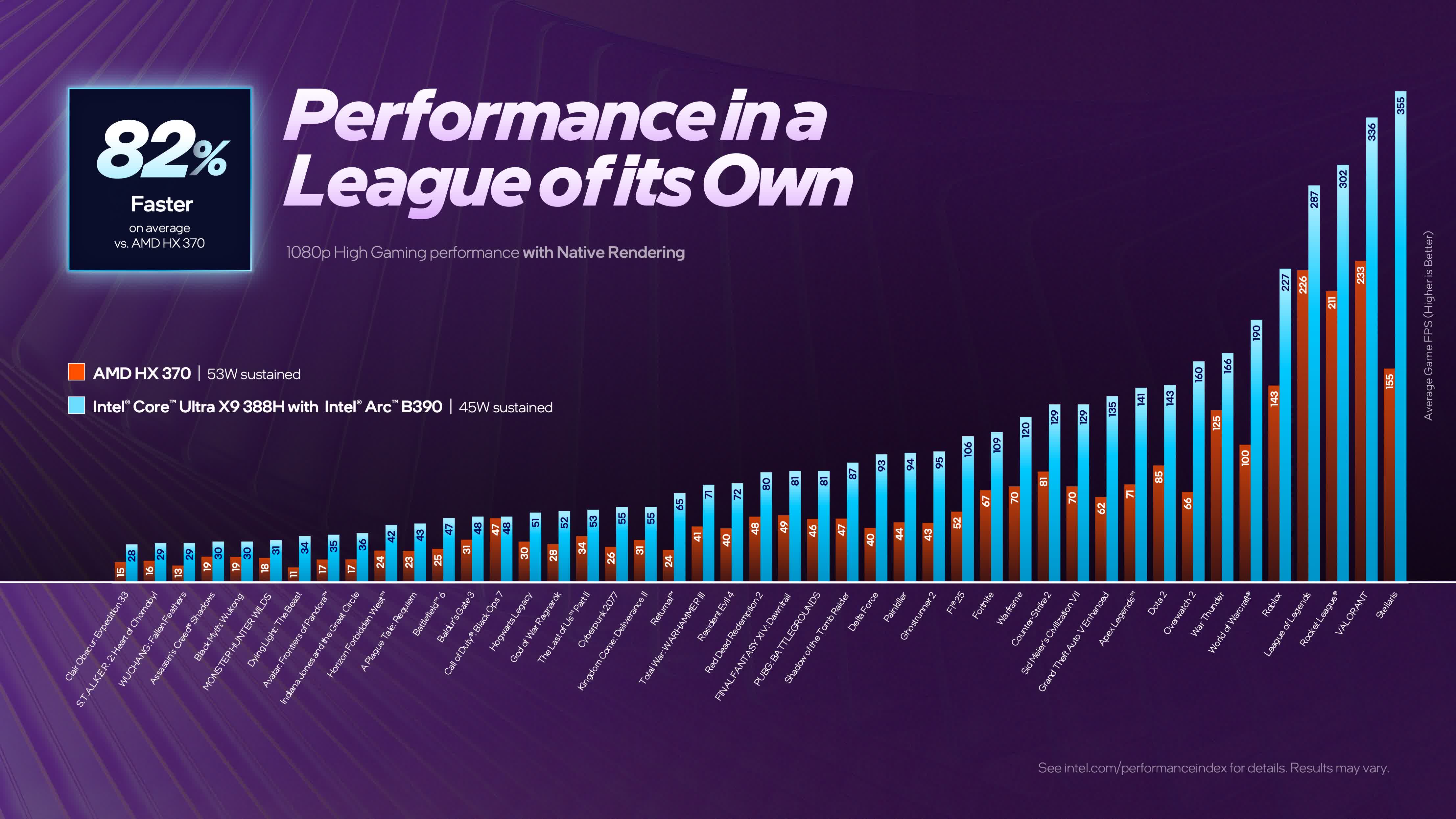
Intel's mobile graphics see a significant upgrade with the introduction of the Xe3 architecture, replacing the XeLPG system used in Series 2. Xe3 is derived from the company's Arc Battlemage platform – the same architecture powering discrete GPUs such as the Intel Arc B580 – and offers up to a 50 percent increase in GPU core count.
The most powerful variant integrates 12 Xe cores, setting a new standard for integrated graphics performance within Intel's mobile processors.
Models equipped with these Xe3 Arc Battlemage GPUs feature an "X" in their product name, signaling enhanced graphical capability. Intel has also introduced XeSS 3, the latest version of its AI-powered upscaling technology. Like AMD's FSR 4 and Nvidia's DLSS 3 and 4, XeSS 3 uses multi-frame reconstruction to boost frame rates through AI-generated frames.
Artificial intelligence is a central focus of the Series 3 launch. Each processor now includes Intel's NPU 5, a redesigned neural engine capable of up to 50 trillion operations per second for AI workloads. Combined with the Arc Xe GPU cores, which deliver up to 120 TOPS, the system can achieve as much as 170 TOPS – and even more when factoring in CPU contributions.
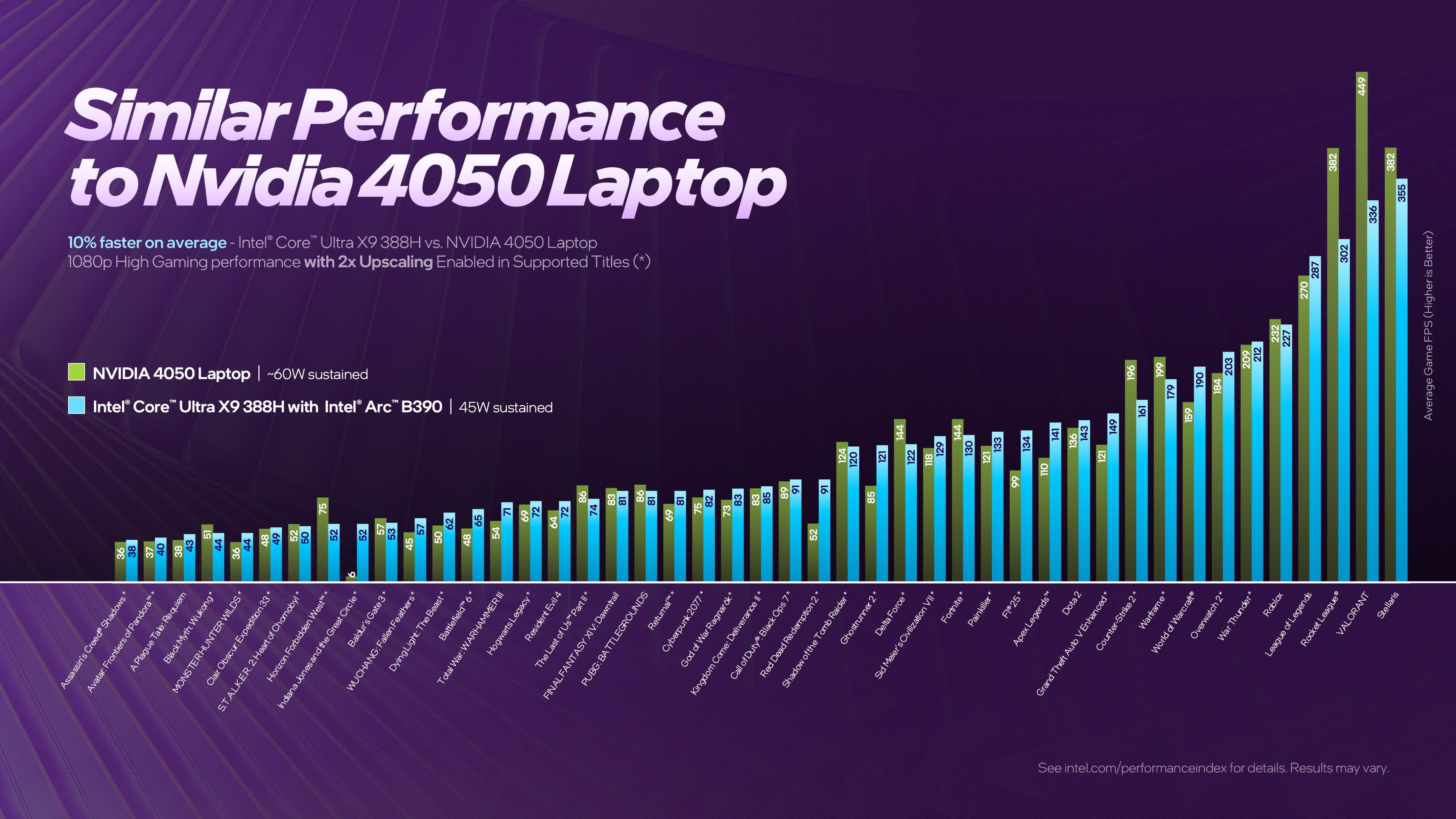
Early performance comparisons suggest that Intel's AI hardware now competes directly with Nvidia in similar price segments. The company's Arc GPUs, including the desktop B580, already contend with Nvidia's $299 GeForce RTX 5060 for AI tasks.
Intel introduced two flagship variants at launch: the Core Ultra 9 386H and Core Ultra X9 388H. Both share a 16-core configuration but differ in graphics and PCIe connectivity.
The X9 388H includes the Arc B390 integrated GPU with 12 Xe cores but has only 12 PCIe lanes (four PCIe 5.0 and eight PCIe 4.0). The standard 386H, meanwhile, trades the stronger GPU for expanded PCIe bandwidth – 12 PCIe 5.0 lanes and eight PCIe 4.0 – making it a better fit for laptops with discrete GPUs.
The same hierarchy applies to the Ultra 7 lineup. The Ultra X7 368H closely mirrors the X9 388H, aside from slightly lower clock speeds, while the Ultra 7 366H aligns with the Ultra 9 386H. Ultra 7 models without the "H" suffix, such as the 365 and 355, cut the core count to eight and target midrange systems.
Intel's Ultra 5 series spans the lower tier, comprising six models in total. The 12-core Ultra 5 338H features the Arc B370 GPU with 10 Xe cores, while non-H variants like the 332 and 322 scale down to eight cores and two Xe GPU cores, suitable for entry-level devices.
Pre-orders for Panther Lake-equipped laptops are expected to begin January 6, with a full retail launch scheduled for January 27. Final pricing will vary depending on system design, though Intel confirmed that all models shipping this month will utilize its new 18A process and integrated NPU 5 architecture.