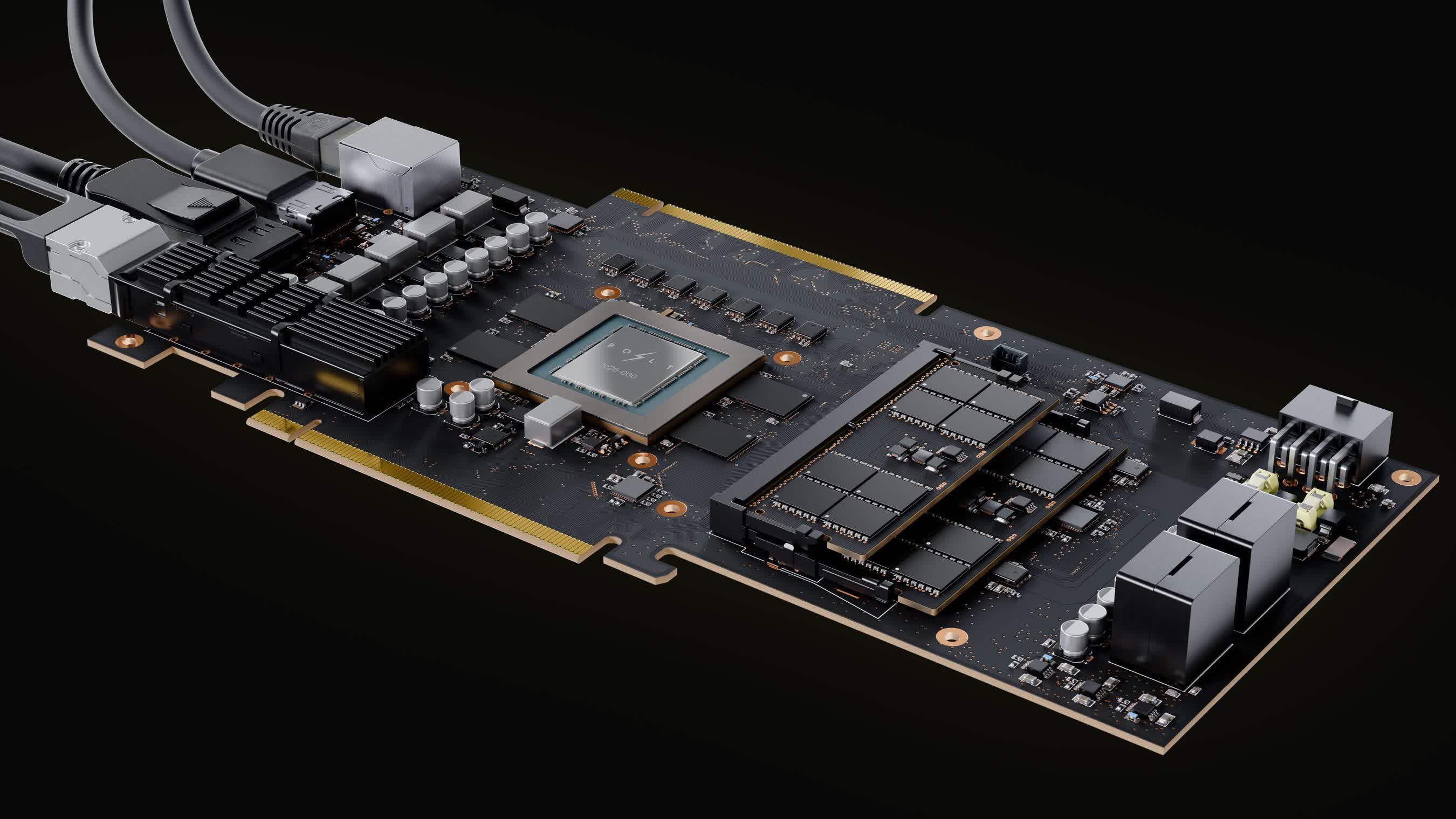
Big quote: At CES 2026, California-based GPU startup Bolt Graphics showcased its Zeus GPU platform, targeting gaming, CAD workloads, and HPC simulations. Originally announced a year ago, Zeus is built around an open-source RISC-V ISA command processor and promises up to 10x the path tracing performance of Nvidia's RTX 5090.
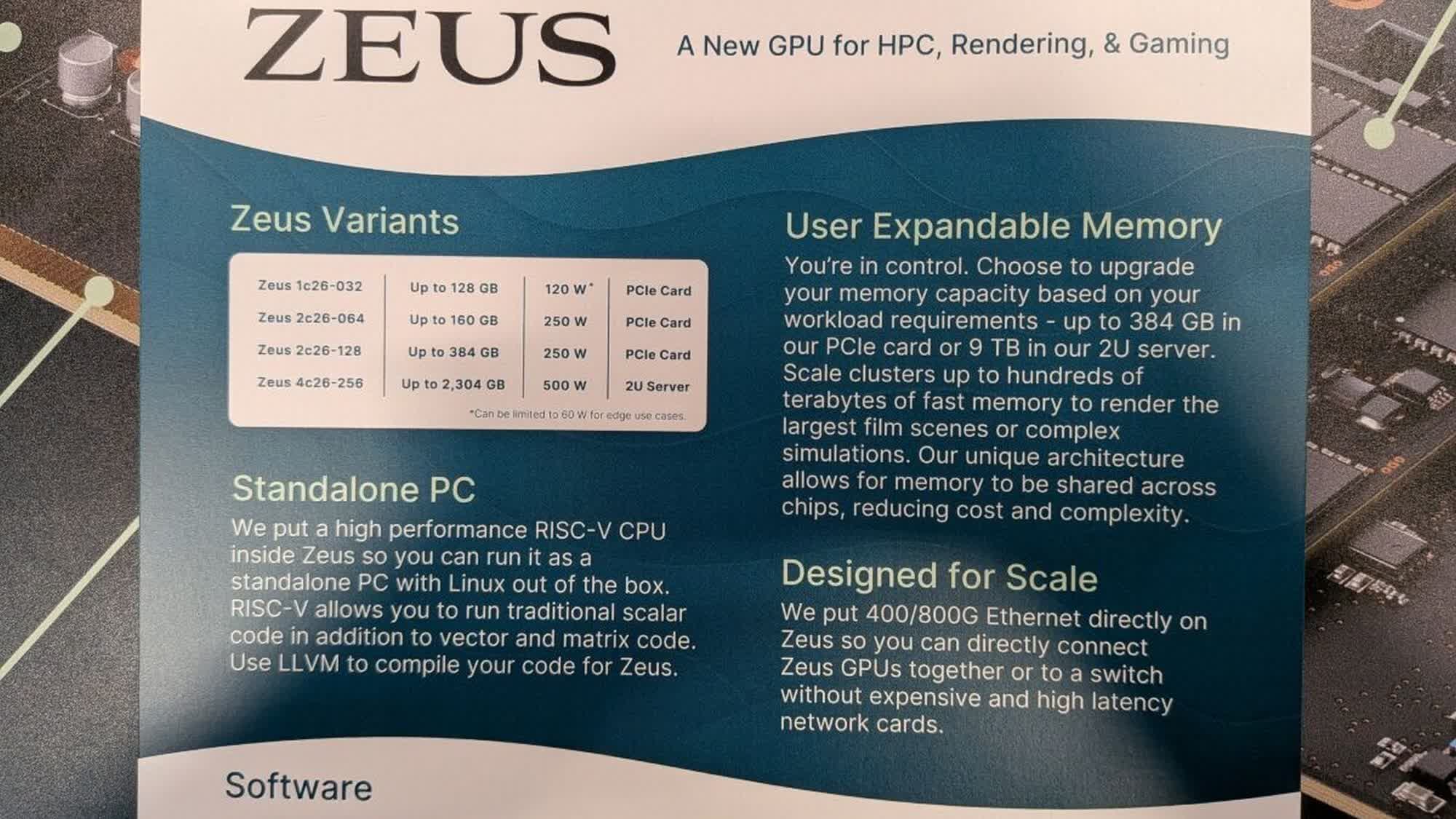
The prototype card on display at CES supports up to 384GB of combined LPDDR5X and DDR5 memory, including as much as 128GB of soldered VRAM. It also features up to four DDR5 SO-DIMM slots and an 800Gbps memory interface. Power consumption tops out at 225W, delivered through an 8-pin PCIe connector.
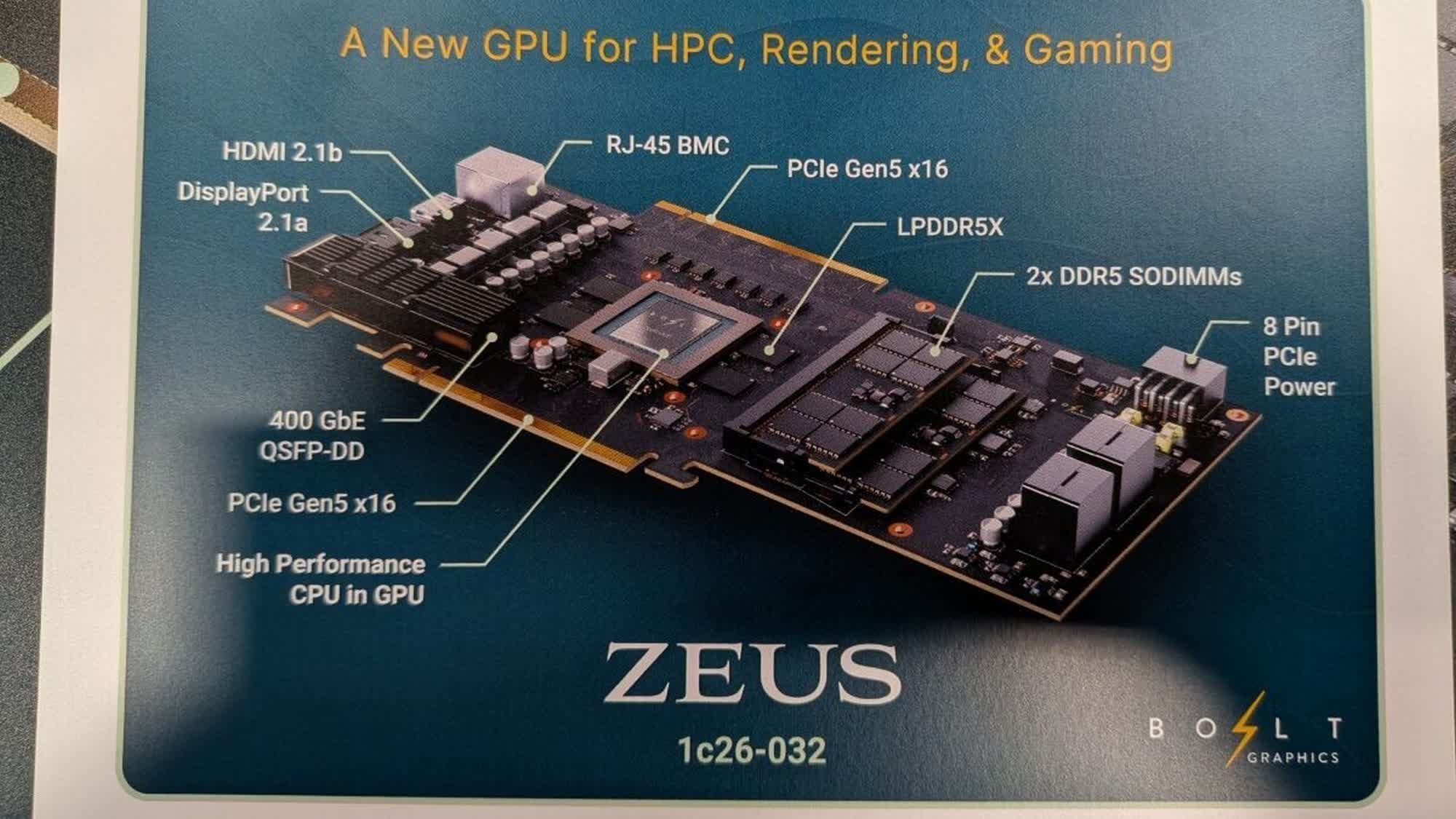
The Bolt Zeus features 2x PCI-Express 5.0 x16 slots with CXL 3.0. Other connectivity options include one DisplayPort 2.1a and one HDMI 2.1b output. It also has built-in 400GbE and 800GbE QSFP-DD ports, offering advanced networking for large-scale rendering and simulation workloads.
An onboard BMC/IPMI controller enables data centers to deploy multiple units in rack-mounted render servers or workstations. Bolt also confirmed that Zeus includes Texture Mapping Units (TMUs) and Raster Operation Units (ROPs), though the company has not disclosed exact specifications.
According to FP64 math benchmarks published by Bolt Graphics, the entry-level Zeus 1C featuring a single processing unit can deliver up to 2.5 times the path tracing performance of an RTX 5090.
The card is equipped with 32GB of LPDDR5X memory offering 273GB/s of bandwidth and can be expanded with up to 128GB of DDR5 memory via two SO-DIMM modules at 80GB/s.
The dual-silicon Zeus 2C, with up to 128GB of LPDDR5X memory, is claimed to provide 5 times the path tracing performance of Nvidia's flagship GPU. Meanwhile, the quad-silicon Zeus 4C – designed as a server platform rather than a standalone card – could deliver up to ten times the performance. The 4C configuration includes four I/O chiplets, up to 256GB of LPDDR5X, and as much as 2TB of DDR5 memory.
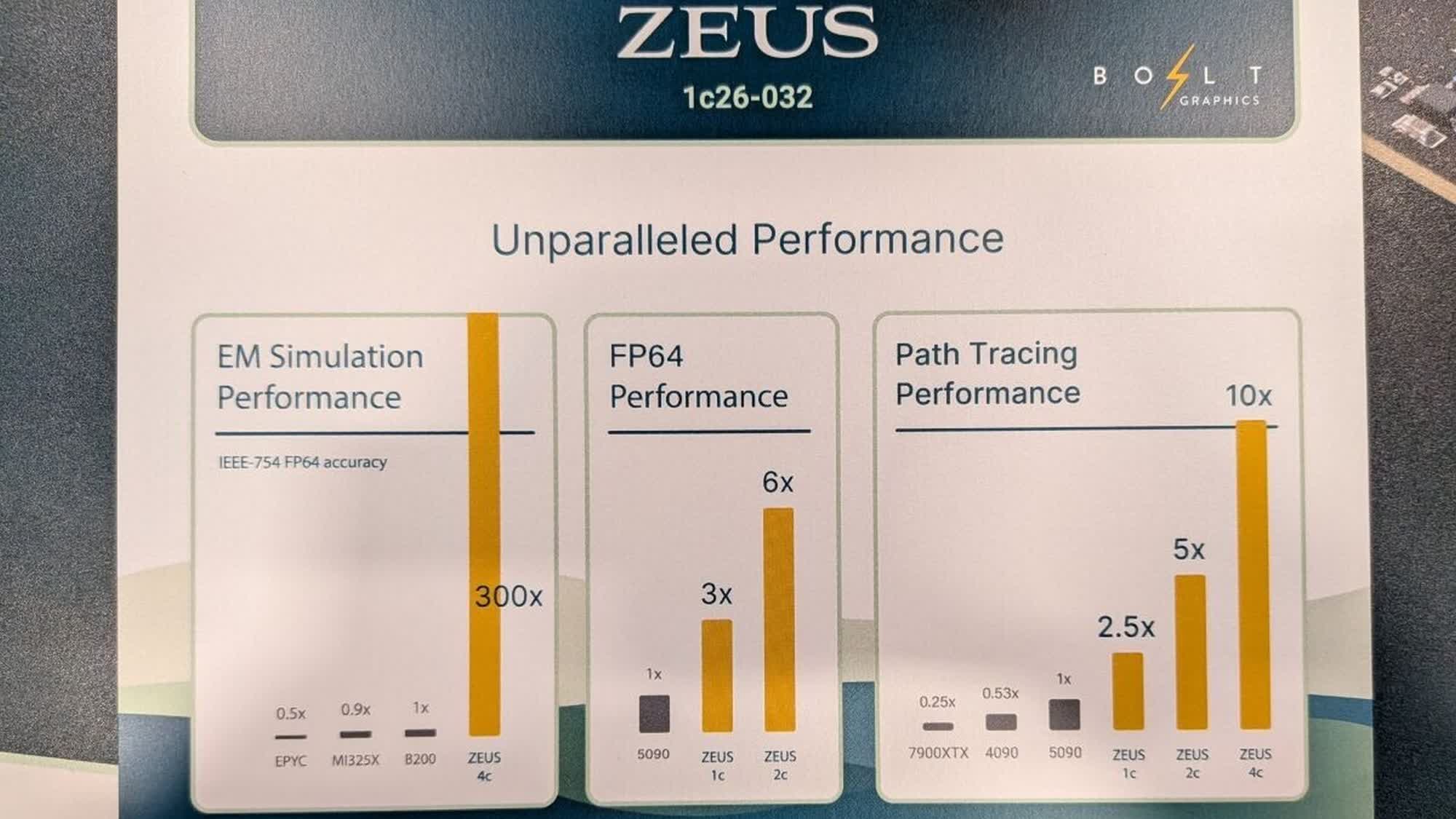
Bolt's FP64 EM simulation benchmarks suggest the Zeus 4C is up to 300 times faster than an Nvidia B200 Blackwell GPU under controlled conditions.
Bolt has not released any rasterization or traditional rendering benchmarks, nor has it announced a precise launch date, though the company has previously stated that Zeus is expected to be available sometime in 2026.
Image credit: TechPowerUp