
Forward-looking: The same instruments built to record earthquakes could soon help track spacecraft tearing back through Earth's atmosphere at hypersonic speeds. In a study published in Science, researchers demonstrated that seismic networks normally used to detect tremors and ground motion can also capture vibrations from sonic booms generated by re-entering space debris. The approach represents an inventive crossover between planetary seismology and aerospace monitoring at a time when orbital congestion is increasing rapidly.
The method exploits the acoustic shockwaves produced when a returning object travels faster than the speed of sound. As these sonic booms strike the ground, they generate low-frequency vibrations detectable by seismometers. By comparing the timing of signals across different sensors, scientists can estimate the debris' trajectory through the sky, its velocity, and even whether it fragmented before impact.
"This is rapid re-entry forensics," said Constantinos Charalambous, a planetary seismologist at Imperial College London who co-authored the study with Benjamin Fernando of Johns Hopkins University. The pair analyzed data from more than 100 ground-based sensors across the American Southwest to reconstruct the April 2024 re-entry of debris from China's Shenzhou-15 spacecraft.
The shockwave swept across tens of millions of residents from Southern California to Las Vegas, leaving a detectable seismic imprint throughout the region.
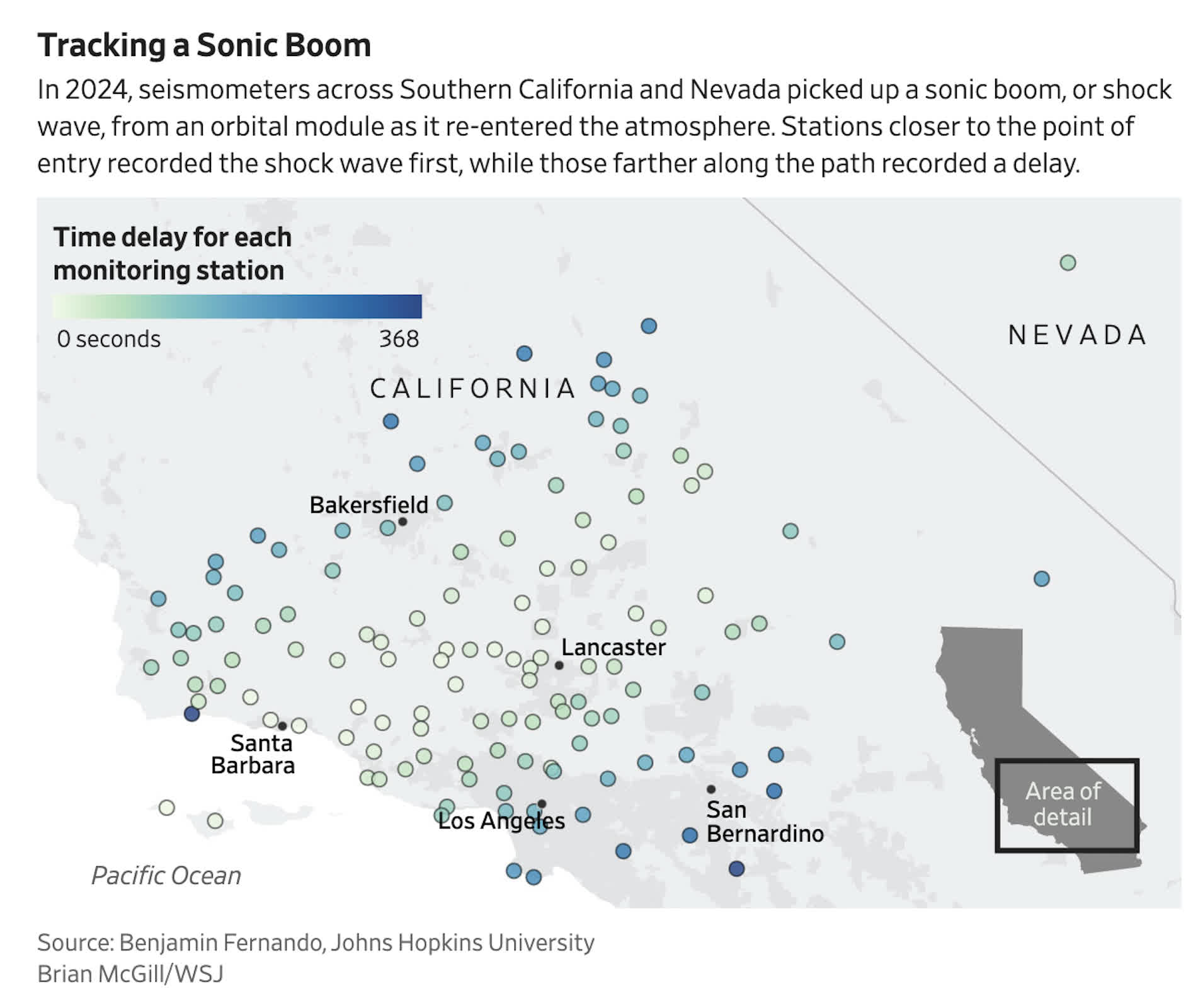
Image credit: The Wall Street Journal
Traditional tracking systems rely on radar and optical telescopes to monitor objects in orbit. However, these systems lose sight of debris once it begins to burn up in the upper atmosphere, complicating re-entry predictions.
Even with sophisticated modeling, uncertainty can span thousands of miles. In contrast, seismic signatures provide an after-the-fact footprint that can confirm a debris object's final trajectory and help identify potential fallout zones.
Fernando explained that the new method cannot serve as a warning system; a falling spacecraft always moves faster than the sound it generates. "This object is always going to outrun its own sonic boom, meaning you'll see it and it will hit you before you hear it," he told The Wall Street Journal.
Once the event occurs, however, the technique can guide response teams to potential landing areas and help determine whether surviving fragments pose chemical or radiological risks.
Debris from defunct satellites or discarded rocket stages usually disintegrates during re-entry, but some fragments occasionally survive. These remnants can contain hazardous materials, including flammable propellants and toxic metals. Tracking their fall has become increasingly urgent as orbital traffic grows.
Over the last decade, the number of satellites and spacecraft returning from orbit has risen dramatically, intensifying the challenge of predicting and locating debris impacts. "We are at a point now where this problem is getting worse and worse, but the tracking and response aspect that we're working on here has not actually caught up with reality," Fernando said.