
WTF?! When users type a health-related question into Google, the top result now often comes from an AI-generated summary rather than a traditional blue link. However, new research reveals that the source behind these AI explanations is not a medical authority – it's YouTube.
A large-scale analysis by SE Ranking, a search engine optimization platform, examined 50,807 health-related searches conducted in Berlin on Google. The study found that Google's AI Overviews, which automatically summarize search results using generative AI, cited YouTube more than any other source. The video platform appeared in 4.43 percent of all citations, surpassing any hospital network, health ministry, or academic medical site.
YouTube, the world's second-most-visited website, thus emerges as the single most influential source shaping how AI Overviews explain health conditions, a striking finding for a company that insists the tool "surfaces high-quality content from reputable sources."
To state the obvious: YouTube is not a medical publisher. On a platform where anyone – from licensed physicians to lifestyle vloggers – can upload content, authority can vary widely.
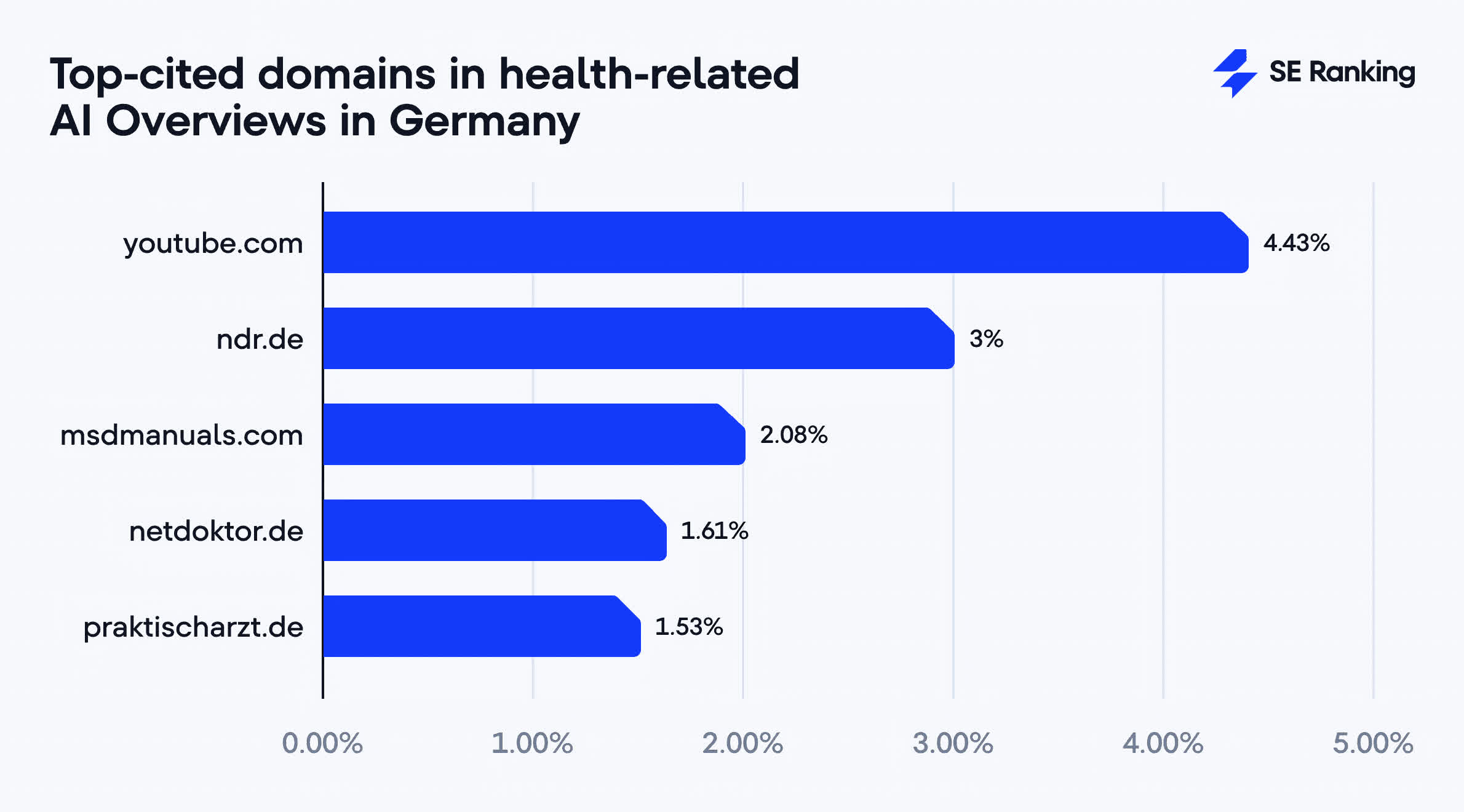
While YouTube topped the list with over 20,000 citations across roughly 466,000 total source mentions, the next most-cited domains lagged far behind. Germany's public broadcaster, NDR.de, ranked second with just over three percent, followed by medical reference site Msdmanuals.com (2.08 percent), health portal Netdoktor.de (1.61 percent), and doctors' career site Praktischarzt.de (1.53 percent).
Overall, AI Overviews appeared in more than 82 percent of the health searches analyzed. The study used only German-language prompts, reflecting search patterns in a country with tightly regulated medical information governed by both German and EU standards. SE Ranking's authors noted that if generative AI systems skew toward non-medical sources even in such a regulated environment, similar patterns may be inevitable elsewhere.
In response to the findings, Google told The Guardian that AI Overviews draw on credible information "regardless of format," noting that many medical professionals and hospital channels publish content on YouTube. The company emphasized that the results of a single German-language study cannot be generalized globally.
Google also cited the same dataset to argue that its system largely relies on expert content: of the 25 most-cited YouTube videos, 96 percent came from verified medical channels. However, those 25 videos accounted for less than one percent of the total YouTube citations examined, researchers noted – a fraction too small to represent the broader sample.

Concerns about AI Overviews go beyond citation patterns. Earlier this month, a Guardian investigation documented examples of misleading and even dangerous medical summaries generated by the system, including false information about liver function tests. In response, Google temporarily suspended AI Overviews for some – but not all – medical searches.
Academic observers say the SE Ranking data underscores the structural nature of these risks. "This study provides empirical evidence that the risks posed by AI Overviews for health are structural, not anecdotal," said Hannah van Kolfschooten, a researcher at the University of Basel studying the intersection of AI, law, and health. "The heavy reliance on YouTube rather than public health authorities suggests that visibility and popularity, rather than medical reliability, drive the system."
The study's snapshot approach – taken in December 2025 – means the results could shift over time or vary across regions. For now, the data show that Google's AI tool, designed to simplify complex questions, still relies primarily on sources shaped by engagement and popularity.