HPC Beyond: Major space agencies rely on supercomputers to tackle the extreme computational demands of modern science, from simulating rocket launches to processing vast streams of space data. These machines are becoming as essential to exploration as the spacecraft themselves. NASA's newly announced super-system raises the bar once again, delivering a major leap in performance while consuming less power.
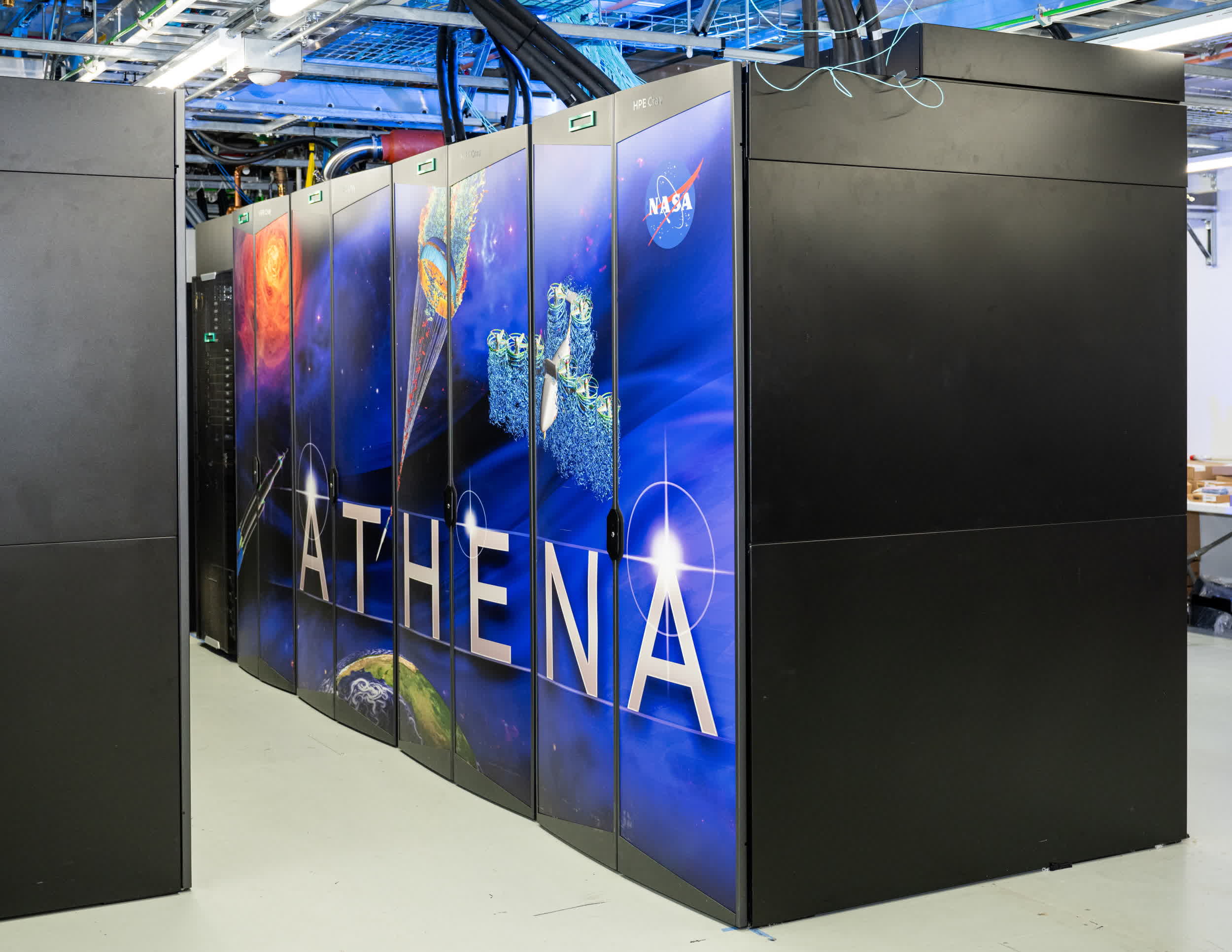
Athena, NASA's latest supercomputer, went online in January following a beta testing period. The US space agency says the new high-performance computing system can deliver more than 20 petaflops of peak performance while significantly reducing the energy required to run the extreme workloads needed to support its mission.
Athena is made up of 1,024 computing nodes, each equipped with two 128-core AMD Epyc CPUs. Built by Hewlett Packard, the system replaces NASA's earlier supercomputers, Aitken and Pleiades. NASA says Athena provides more computing power than any previous machine at the agency, along with improved performance and energy efficiency.
Part of NASA's High-End Computing Capability (HECC) program, Athena is hosted at the agency's Modular Supercomputing Facility at the Ames Research Center in Silicon Valley, California. The system is managed by the Office of the Chief Science Data Officer, which provides NASA with advanced computational resources.

NASA also said the HECC program adopts a flexible, hybrid computing approach. In layman terms, this allows the agency to use powerful in-house HPC systems such as Athena alongside additional resources, including commercial cloud platforms. This strategy helps NASA select the best tool for each specific research task.
Athena will run complex simulations to make rocket launches safer and more efficient. The system will also be used to design new generations of aircraft and spacecraft, train large-scale AI foundation models, and analyze massive datasets and image collections gathered by orbiting space telescopes.
In addition, NASA plans to grant external researchers limited access to Athena, provided their work supports the agency's programs and mission.
According to HECC chief science data officer Kevin Murphy, Athena will enable NASA to "expand its efforts to provide tailored computing resources that meet the evolving needs of its missions."
The name Athena was chosen through a contest held in March 2025 among HECC personnel. In Greek mythology, Athena is the goddess of wisdom, warfare, and handicraft, and the sister of Artemis, the goddess of hunting and nature. The connection is fitting: NASA is preparing to fly its Artemis II mission, which will carry a new generation of astronauts around the Moon and back.