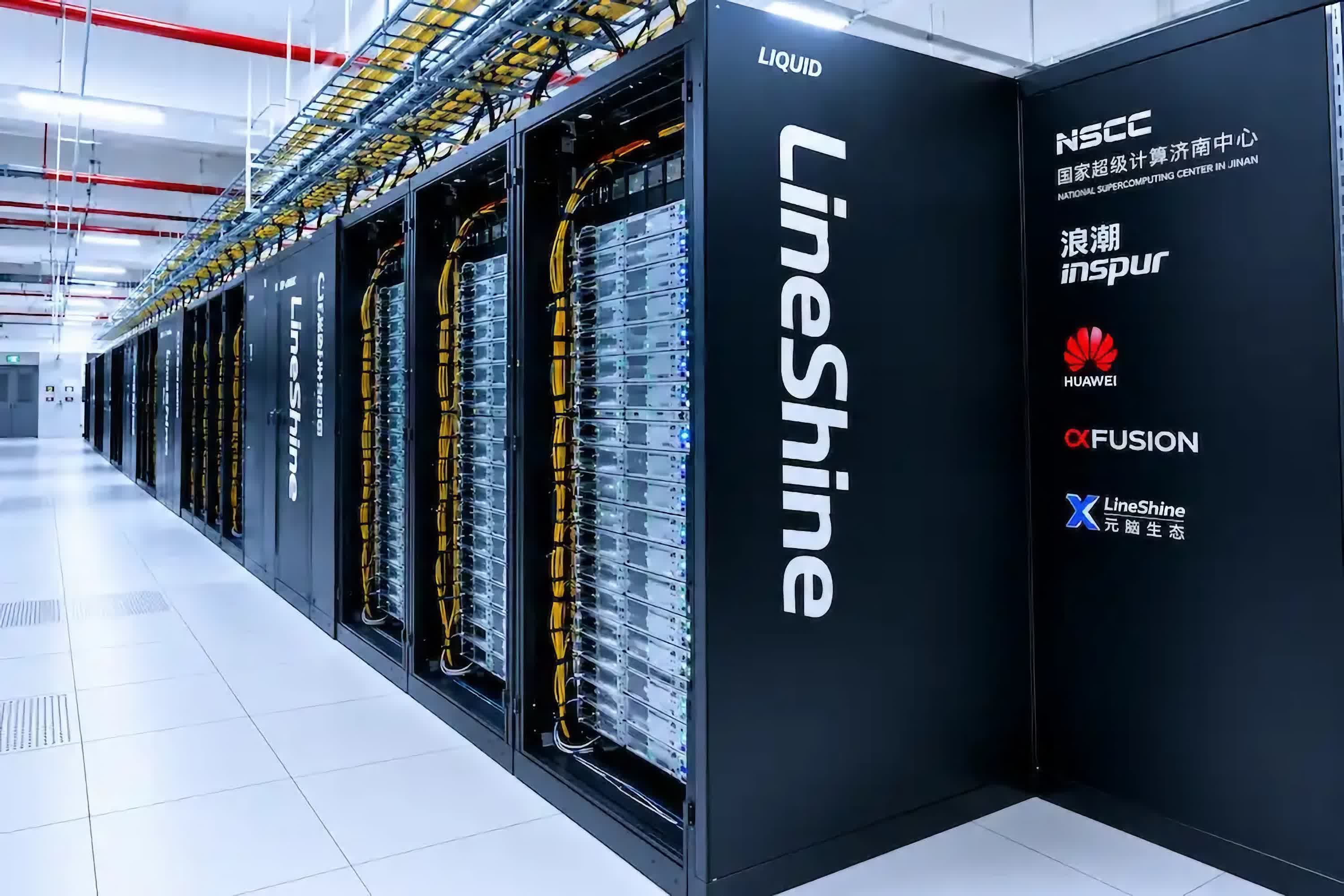
Chinese Syndrome: Chinese institutions have been largely absent from the TOP500 HPC rankings since 2023, when worsening US-China relations led Beijing to stop submitting its most capable systems to the list. Now, the Asian country is hitting back with a vengeance thanks to a brand-new supercomputer system ranked as the most powerful in the world.
The TOP500 project has unveiled the 67th edition of its biannual ranking of the world's most powerful high-performance computing (HPC) systems. Announced at the ISC 2026 conference in Hamburg, Germany, the new list marks the surprise debut of LineShine, a previously unannounced Chinese machine that enters straight at No. 1, becoming the officially acknowledged most powerful supercomputer on the planet.
LineShine posted a 2.198 Exaflop/s result on the High Performance Linpack (HPL) benchmark, which the TOP500 organization says represents roughly 80% of the system's theoretical peak performance of 2.736 Exaflop/s. It is the first HPC system in history to exceed two exaflops of sustained double-precision performance – and it achieved this milestone using an all-CPU design, with no GPU accelerators anywhere in the stack.
TOP500 June 2026 – Top 5 Supercomputers
| Rank | System | Site | Country | HPL (Exaflop/s) |
|---|---|---|---|---|
| 1 | LineShine | National Supercomputer Center, Shenzhen | China | 2.198 |
| 2 | El Capitan | Lawrence Livermore National Laboratory | United States | 1.809 |
| 3 | Frontier | Oak Ridge National Laboratory | United States | 1.353 |
| 4 | Aurora | Argonne National Laboratory | United States | 1.012 |
| 5 | JUPITER Booster | Jülich Supercomputing Centre | Germany | 1.000 |
The system was installed at the National Supercomputing Centre in Shenzhen (NSCS) and built around the custom "LingKun" platform, using "LX2" processors thought to be designed by Huawei. The LX2 is based on the Armv9 architecture, with each chip integrating two compute dies (304 cores in total) plus eight on-package HBM stacks delivering 32 GB of high-bandwidth memory. The platform's 13.79 million computing cores are linked by the proprietary LingQi interconnect and run China's Kylin OS, a Linux-based operating system.
To put it in context, LineShine is a "made-in-China" HPC project: its processors, networking, and storage are all domestically developed, with the notable exception of relying on the Armv9 instruction set architecture, which was designed in the UK by Arm.
The most outstanding result is certainly reaching first place in the TOP500 rankings, scoring an unprecedented win against the US and other major HPC superpowers. US-made El Capitan was demoted to second place (1.809 Exaflop/s), though three of the five most powerful TOP500 systems – El Capitan, Frontier, and Aurora – are still based in the US.
The fifth most powerful HPC machine is Germany's JUPITER Booster, which achieved exactly 1.000 Exaflop/s on the HPL benchmark.
The TOP500 team notes several remarkable takeaways from this edition. LineShine employs an all-CPU design, while other super-systems use different kinds of CPU architectures, GPUs, APUs, or even custom-made accelerators. The ultimate take is that there is no single "best" technology for performing extreme computing workloads, at least when measured by the double-precision demands of the HPL benchmark.
According to the NSCS team, LineShine is the culmination of years of investment in developing domestic computing solutions independent of foreign supply chains. The system is currently being used for complex engineering simulations, scientific research, AI model development, and large-scale language model training.