
What just happened? TV companies love a good acronym, but Samsung Display's latest branding is more straightforward than the usual fare. If you see QD-OLED Penta-Tandem, you're looking at the company's newest, high-end panel stack: its five-layer fourth-gen QD-OLED panel technology.
The "Penta" part in the new branding is literal. Samsung Display says the blue OLED light source inside its QD-OLED panels has moved from a four-layer structure to a five-layer, tandem-style stack.
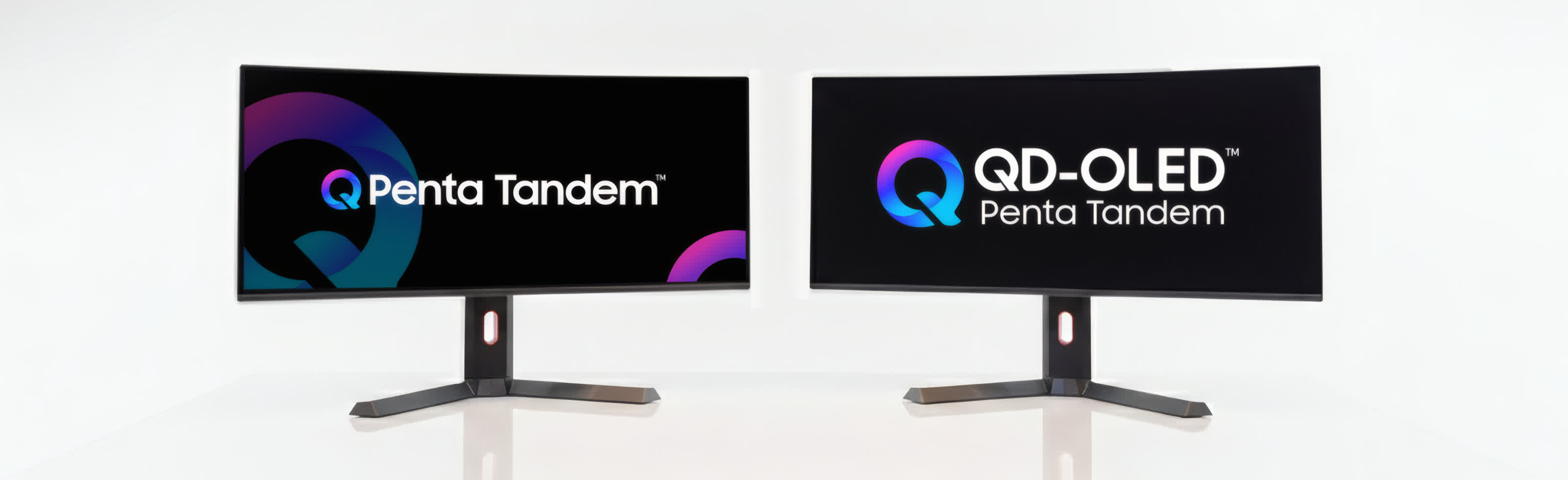
The company is claiming a 1.3x jump in luminous efficiency and roughly double the lifespan versus last year's four-layer designs – two elements that matter when you're chasing higher HDR peaks without turning your TV into a space heater or your monitor into a burn-in roulette wheel.
Samsung Display is attaching some big brightness numbers to the new tech: up to 4,500 nits for TVs and around 1,300 nits for monitors, measured at a 3% on-pixel ratio (a common way to describe short, highlight-level bursts rather than full-screen brightness).
LG Display has been pushing its own multi-stack OLED tech for years. It seems Samsung Display needs a simple "this is the newest one" tag that can compete on store shelves and spec tables – Penta-Tandem is as much a marketing umbrella as it is a materials upgrade.
On the product side, Samsung Display says Penta-Tandem will expand across its full range of panel sizes this year. For monitors, that includes last year's 27-inch UHD panel, newer 31.5-inch UHD and 34-inch ultrawide offerings, and a 49-inch Dual QHD model. In TVs, the company says the technology has already appeared in top-tier self-emissive lineups since 2025.
There's also a readability angle. Samsung Display has been moving QD-OLED monitors toward a more conventional subpixel arrangement (often described as a V-stripe layout) to improve text clarity and reduce color fringing – one of the most persistent complaints about earlier QD-OLED monitor panels on Windows.
Ultimately, QD-OLED Penta-Tandem is Samsung Display doing what every panel maker does when the tech matures: turning engineering advancements into a label that's easy for TV and monitor brands to plaster on boxes. If the promised efficiency and longevity gains hold up in shipping products, this could be one of the rare marketing terms that actually tells you something useful.