
Editor's take: The more money companies spend on AI, the larger fears grow that this is a bubble ready to burst. But for most CEOs, it's more important to be seen spending big on the technology than taking a more cautious approach.
According to a KPMG survey of 100 CEOs (via Business Insider) conducted from late January to mid-February, one in four company bosses believe an AI bubble does exist. However, they also think spending on AI is a key priority – almost 80% of CEOs say they will allocate at least 5% of their capital budgets to AI this year.
Another finding is that six in 10 CEOs said they are prioritizing AI spending to build workers' skills. Moreover, around half said they're using funds to speed innovation and incorporate the technology into day-to-day operations.
Training workers to use AI rather than replacing them with the technology is a positive sign. However, one in five CEOs said they expect to make job cuts this year, though only 9% of those said they expect the layoffs to be the result of AI adoption. That figure seems optimistically low, given the role the technology has played in job cuts at Block, Meta, Amazon, Pinterest, Autodesk, and many others.

One of the concerns surrounding AI is the security implications of introducing it into a business rapidly and without proper security in place. Around two-thirds of CEOs said this is why they are boosting their cybersecurity spending.
It was also found that about six in 10 CEOs are worried about quantum computing attacks against encryption. Two-thirds are apprehensive about whether they have the cybersecurity talent they need, and about six in 10 are responding by training current employees.
Despite all this investment and commitment to the technology, about three-quarters of large-company CEOs said generative AI might have been overhyped over the past year, but its true impact over the next 5-10 years is likely underappreciated.
Some of the negative elements of AI that CEOs worry about include reduced opportunities for early-career employees to build judgement via experience. It's hard to learn from your mistakes when AI is making all the decisions – this is something one in three bosses worry about. Others talked about a general over-reliance on AI and diminished exposure to trial-and-error learning as concerns.
When asked about the economy, 86% of CEOs said they were confident in their own industry's growth. That contrasts with their views on the broader economy: only 55% feel good about US growth and 53% feel good about global growth – and this survey was taken before the US bombings in Iran.
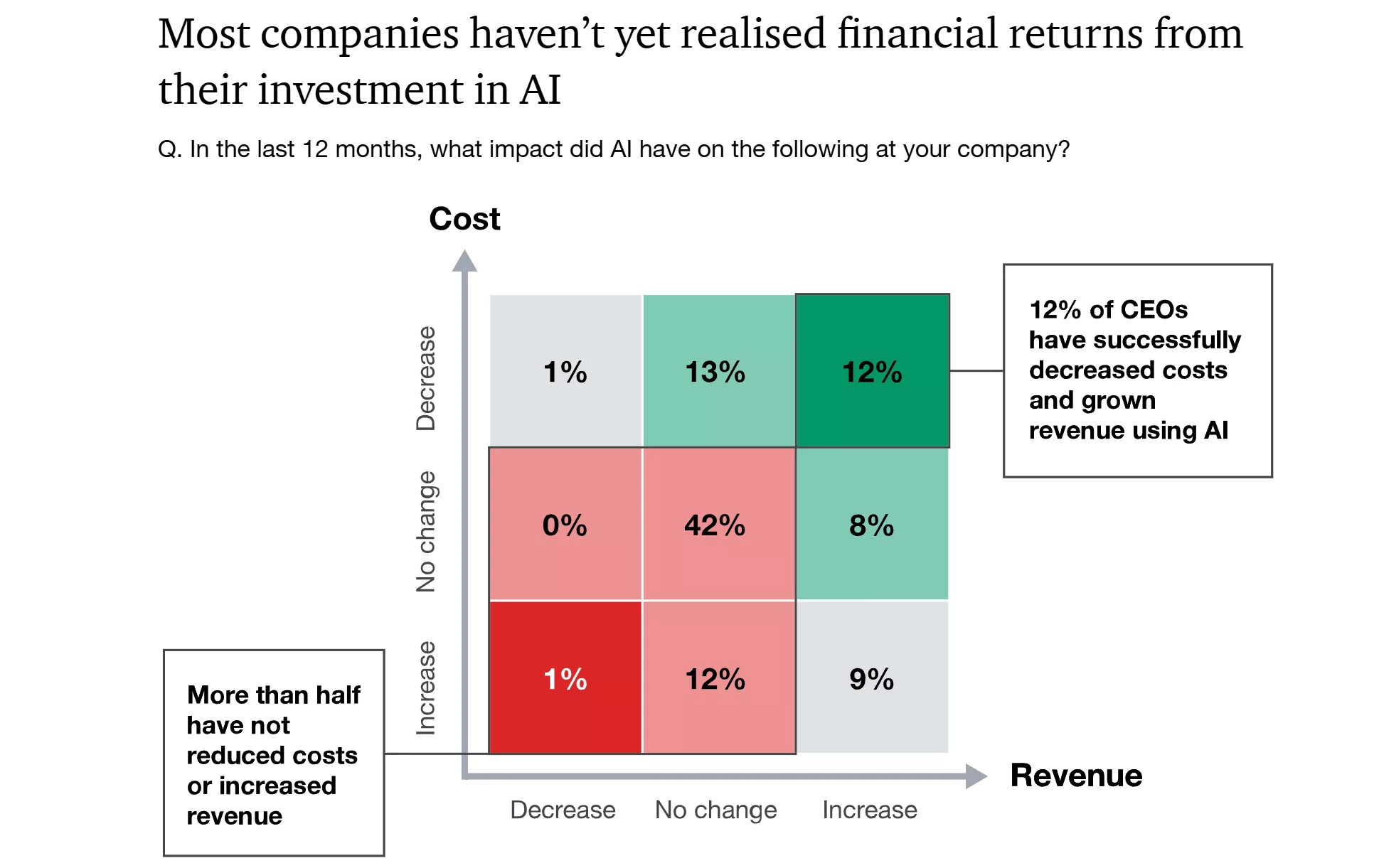
Back in January, a survey that questioned thousands of CEOs found that more than half admitted to seeing no significant financial benefit from AI to date.