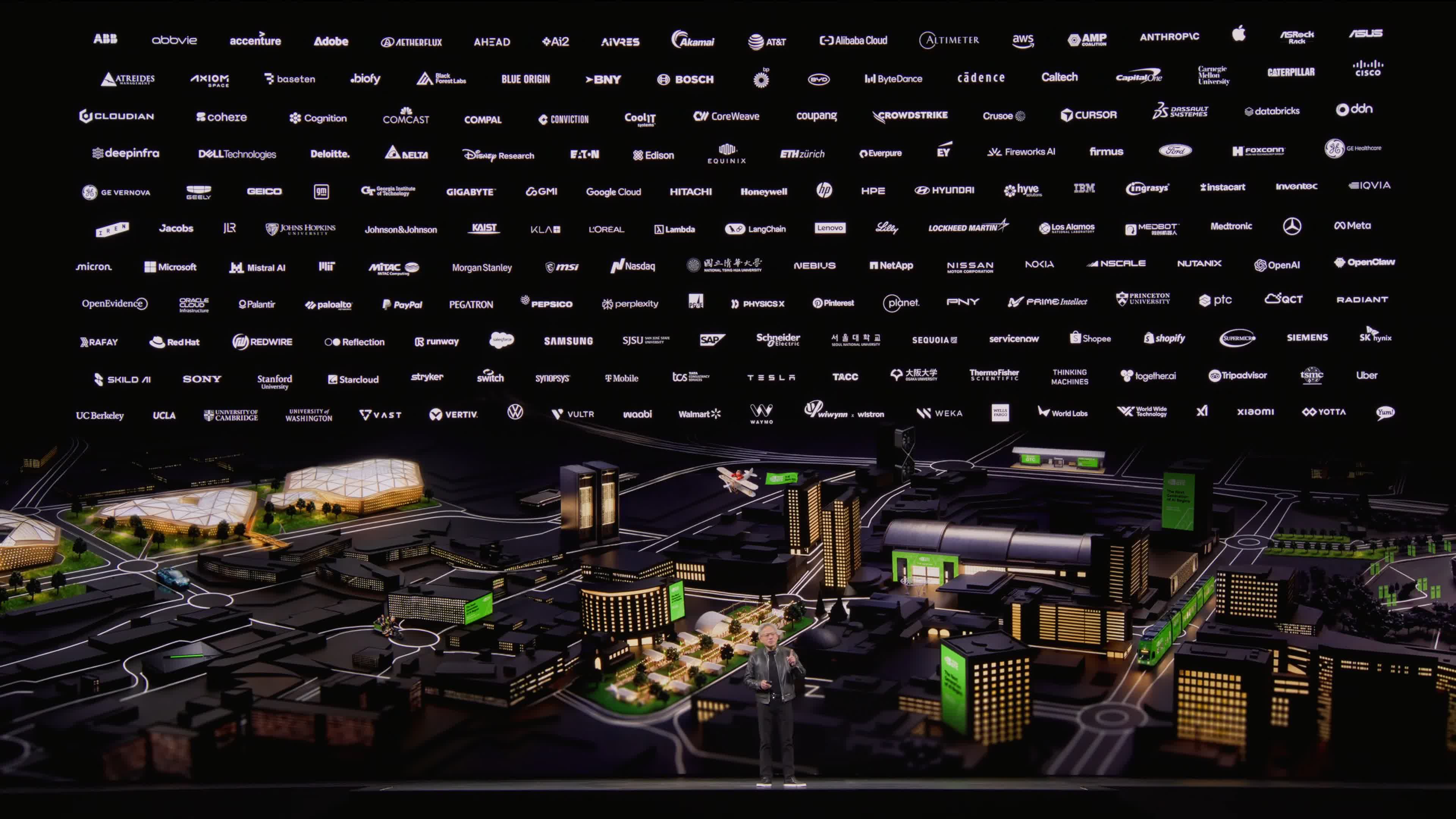
The big picture: The world's most valuable company is widening its ambitions once again. During Nvidia's annual GPU Technology Conference in Silicon Valley, chief executive Jensen Huang unveiled a sweeping roadmap that deepens the company's bets on artificial intelligence hardware and pushes its manufacturing footprint into new territory.
"The inference inflection has arrived," Huang said during the keynote, framing the next stage of the AI boom around systems designed not just to train models but to run them at massive scale.
Huang said Nvidia expects revenue from AI-focused chips to total at least $1 trillion through 2027, roughly double his earlier projection of $500 billion through the end of 2026, as enterprise demand for computational capacity continues to surge.

The figure far exceeds Wall Street estimates, which peg Nvidia's total revenue for fiscal 2027 and 2028 at roughly $835 billion, according to Capital IQ data. Huang said his prediction stems from what he described as "high confidence demand and purchase orders" for the company's next-generation processors. The forecast also extends Nvidia's earlier cumulative outlook rather than representing a new annual revenue target, effectively stretching the company's previous $500 billion platform estimate by another year.
Huang's message was based on a familiar theme: that the exponential growth in computing power needed for AI inference continues to reshape the semiconductor industry's economics. The CEO cited rising enterprise adoption of AI developer tools, such as Anthropic's Claude Code, as one of the main drivers of the need for more efficient compute systems.
"Inference will only become more important as more companies adopt personal AI agent tools such as OpenClaw," he said.
Nvidia increasingly frames this next phase as the rise of "AI factories" running agentic workloads at scale, where inference demand could eventually eclipse model training as the dominant computing task.
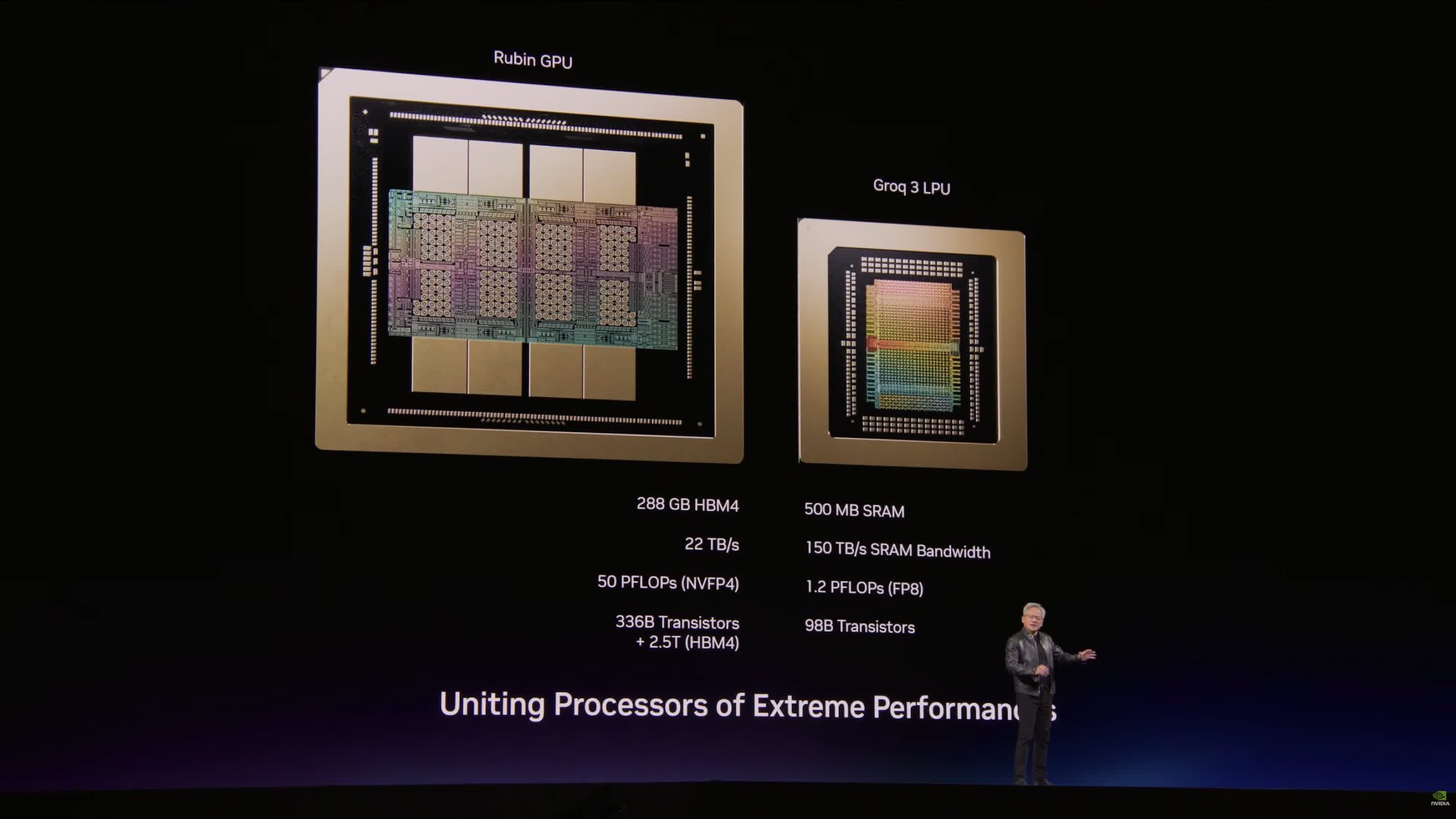
To feed that demand, Nvidia is expanding beyond its longstanding GPU architecture. Huang announced a new chip, the Groq 3, described as a "language processing unit" designed to accelerate the responsiveness of AI systems during user interactions. The chip will be produced by Samsung Electronics.
Groq 3 is also the first product to emerge from Nvidia's licensing agreement with chip startup Groq, signed late last year. The deal brought Groq founder Jonathan Ross – best known for his work on Google's early AI chips – into Nvidia's fold. Huang said the Groq 3 chips are already in volume production and scheduled to begin shipping in the second half of 2026, likely during the third quarter.

Huang also used the stage to highlight Nvidia's growing presence across unconventional computing environments. He detailed partnerships involving robotaxi systems and introduced a chip concept intended for "orbital data centers" – an approach aimed at managing AI workloads in space. The idea aligns loosely with similar concepts Elon Musk has floated, including integrating his companies SpaceX and xAI through such orbital infrastructure.
Analysts suggested that investors remain cautious, balancing near-term excitement over Nvidia's technological expansion with questions about the sustainability of long-term growth. Gene Munster, managing partner at Deepwater Asset Management, said the company's stock faces what he called a "wall of worry" despite sharply rising demand. "Bottom line from Jensen's keynote," he told the Financial Times, "demand is measurably stronger than even the highest expectations, and investors are still having a hard time getting comfortable with that."