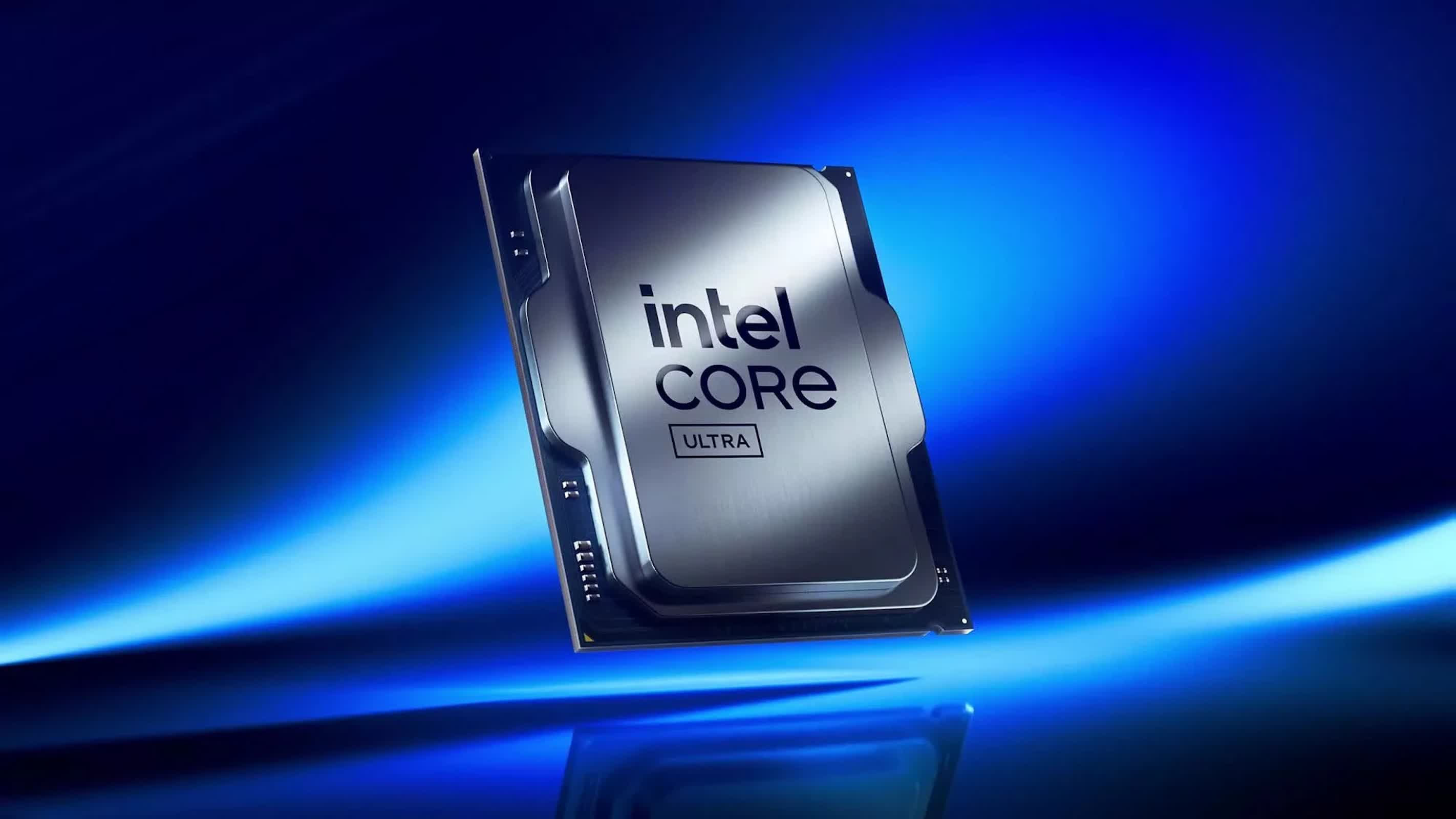
Rumor mill: Intel's next round of high-end laptop silicon is coming into sharper focus, and the emphasis this time is on scaling core counts without abandoning the desktop-class I/O that has defined the HX tier. According to newly leaked info, Team Blue is preparing two Nova Lake-HX configurations for high-end notebooks that pair the CPUs with discrete GPUs.
The chips sit above the mainstream Nova Lake-H line and retain a wider I/O complex with PCIe 5.0 connectivity for discrete GPUs. Leaker Jaykihn describes Nova Lake-HX as a higher-end branch of Nova Lake-H that uses a broader I/O subsystem designed to work with discrete GPUs.
At the top of the stack, Intel is said to be working on a 28-core Nova Lake-HX part built around eight Coyote Cove performance cores, sixteen Arctic Wolf efficiency cores, and four additional low-power Arctic Wolf E-cores.
This 8P+16E+4LPE layout represents about a 17% increase in core count over the current 24-core HX dies while staying within a single compute tile that groups the 8P+16E cores behind a shared L3 cache.
The four low-power E-cores sit on the SoC tile, succeeding today's Darkmont-based low-power islands. Jaykihn notes that both Coyote Cove and Arctic Wolf succeed Intel's current Cougar Cove and Darkmont microarchitectures.
– Jaykihn (@jaykihn0) April 1, 2026
Below that flagship part, Intel is rumored to have a second Nova Lake-HX configuration with fewer cores. One version of the leak describes a 6P+8E+4LPE layout that reuses the 6P+8E compute tile from Nova Lake-H and combines it with the HX-oriented SoC and I/O tiles.
A separate description outlines an alternative 4P+8E+4LPE, 16-core configuration. In either case, these dies are meant to sit above the current HX offerings on core count while keeping power envelopes realistic for mobile chassis.
Graphics is where Nova Lake-HX looks deliberately conservative. The iGPU tile is described as the smallest in the Nova Lake family, carrying just two Xe cores based on the Xe4 "Druid" architecture. That is fewer GPU blocks than Intel is expected to ship on other Nova Lake variants and far below what rivals are integrating into their so-called "halo" APUs.
The design assumption is that HX buyers will pair the CPU with a discrete GPU over a full-bandwidth PCIe 5.0 PEG interface, making a large integrated GPU an unnecessary use of die area.
– Rayan Malik (@raywccf) April 1, 2026
On the desktop side, Intel's related Nova Lake-S family is rumored to climb as high as 52 cores across dual compute tiles and to carry a bLLC cache pool of up to 288 MB, with mobile parts capping out at much lower core counts and cache to keep thermals in check.
AMD, meanwhile, is preparing up to 24 cores in comparable desktop-class mobile packages based on its future Zen 6 architecture, and is positioning its Strix Halo, Gorgon Halo and later Medusa Halo SoCs as the answer for high-end integrated graphics and AI workloads rather than discrete-first designs.
Farther out on Intel's roadmap, Jaykihn also claims that Razer Lake-AX, rather than Nova Lake-AX, is intended to compete with AMD's halo-class APUs. That family is expected to arrive late in the decade and could intersect with Intel's custom SoC efforts that marry its x86 cores with Nvidia RTX GPU tiles for high-performance notebooks.
For now, Nova Lake-HX is not anticipated to land in shipping systems until roughly the CES 2027 timeframe.