
The takeaway: Engineers from North Carolina State University and the University of Houston have developed a fiber reinforced composite material that can reportedly self-repair more than 1,000 times. It is also said to be significantly stronger than the composites currently used to manufacture aircraft wings, turbine blades, and similar hardware. Researchers believe it could significantly extend the lifespan of automobiles, aircraft, spacecraft, wind turbines, and other critical machines.
The breakthrough addresses a critical structural failure known as delamination, where layers in fiber reinforced polymer (FRP) materials begin to separate over time. The new composite looks similar to traditional FRPs but is designed to be tougher, making it less prone to cracking or breaking.
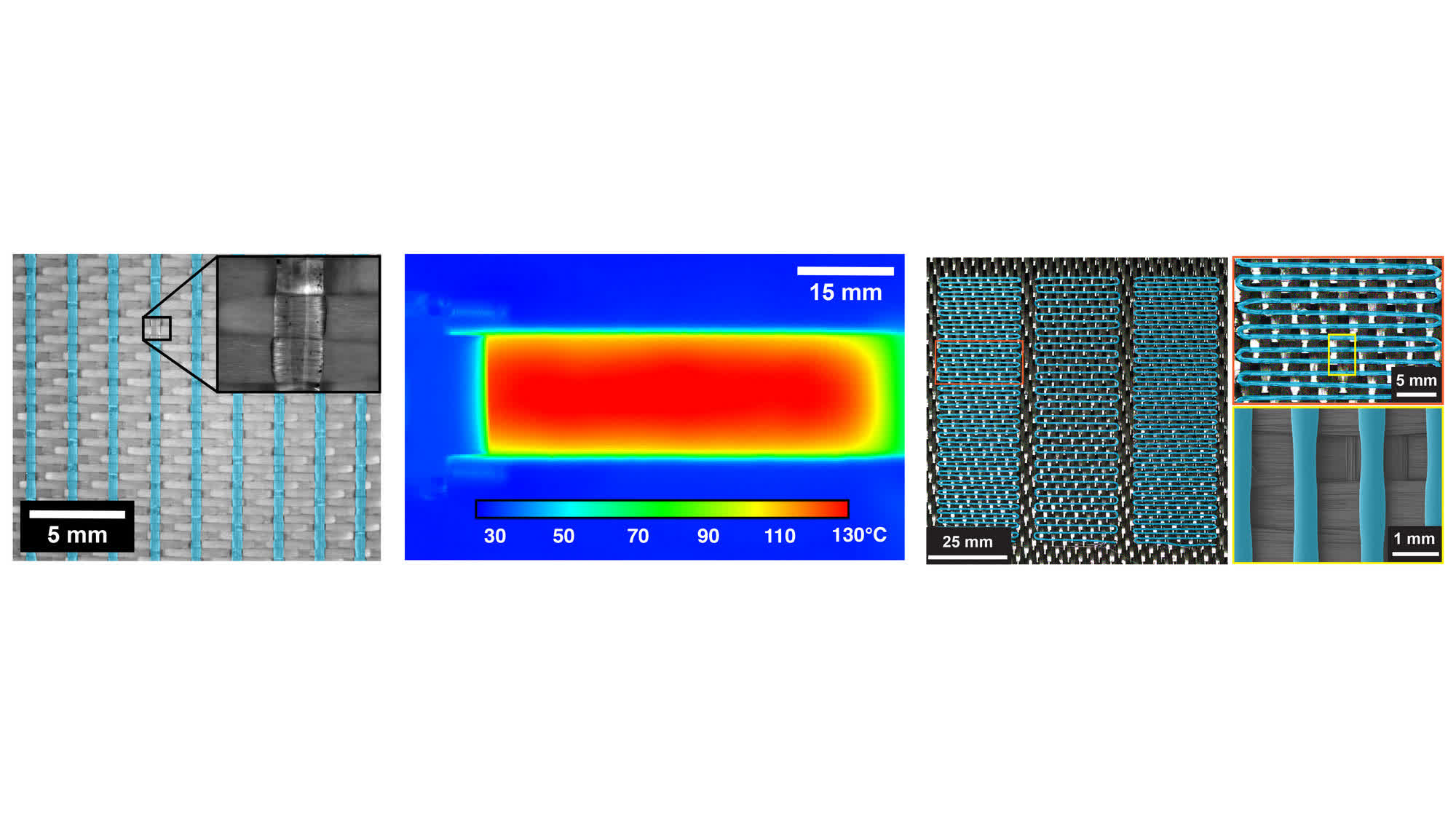
It achieves this by using a 3D printed thermoplastic healing agent to form a patterned interlayer between the composite's laminates. Made from poly(ethylene-co-methacrylic acid) (EMAA), the interlayer makes the material two to four times more resistant to delamination than conventional FRPs, reducing cracking and structural damage.
Another key innovation is the addition of carbon-based embedded heater layers. When an electric current is applied, these layers warm and melt the EMAA interlayer, allowing the material to flow into microscopic cracks and re bond the damaged interface. The process, which relies on polymer chain re entanglement, is referred to as "thermal remending."
To test the material's self healing capabilities, the team applied tensile force to simulate real world use. After creating a 2 inch delamination, they activated the healing process and repeated the cycle 1,000 times over 40 days to measure how many cycles the material could endure without losing structural integrity.
They observed that the material was able to self-heal damages and retained its toughness during the tests, suggesting that its large-scale adoption in the aerospace, renewable energy, automotive, and other industries could potentially extend the service life of key components in cars, airplanes, windmills, and spacecraft from a few decades to several centuries.
According to lead author Jack Turicek, the material is stronger than conventional composites from the outset and can better withstand damage for at least 500 cycles.
While toughness does decline with repeated healing, it does so very slowly, potentially allowing components to remain functional for up to 500 years. By comparison, conventional FRP composites have a typical lifespan of about 15 to 40 years.
Researchers say the material could help reduce costs by increasing the lifespan of critical components and lowering energy use, as well as improve industrial waste management by reducing the need for frequent replacements. However, they caution that the material still needs to be tested in real world conditions before it can be hailed as the real deal.