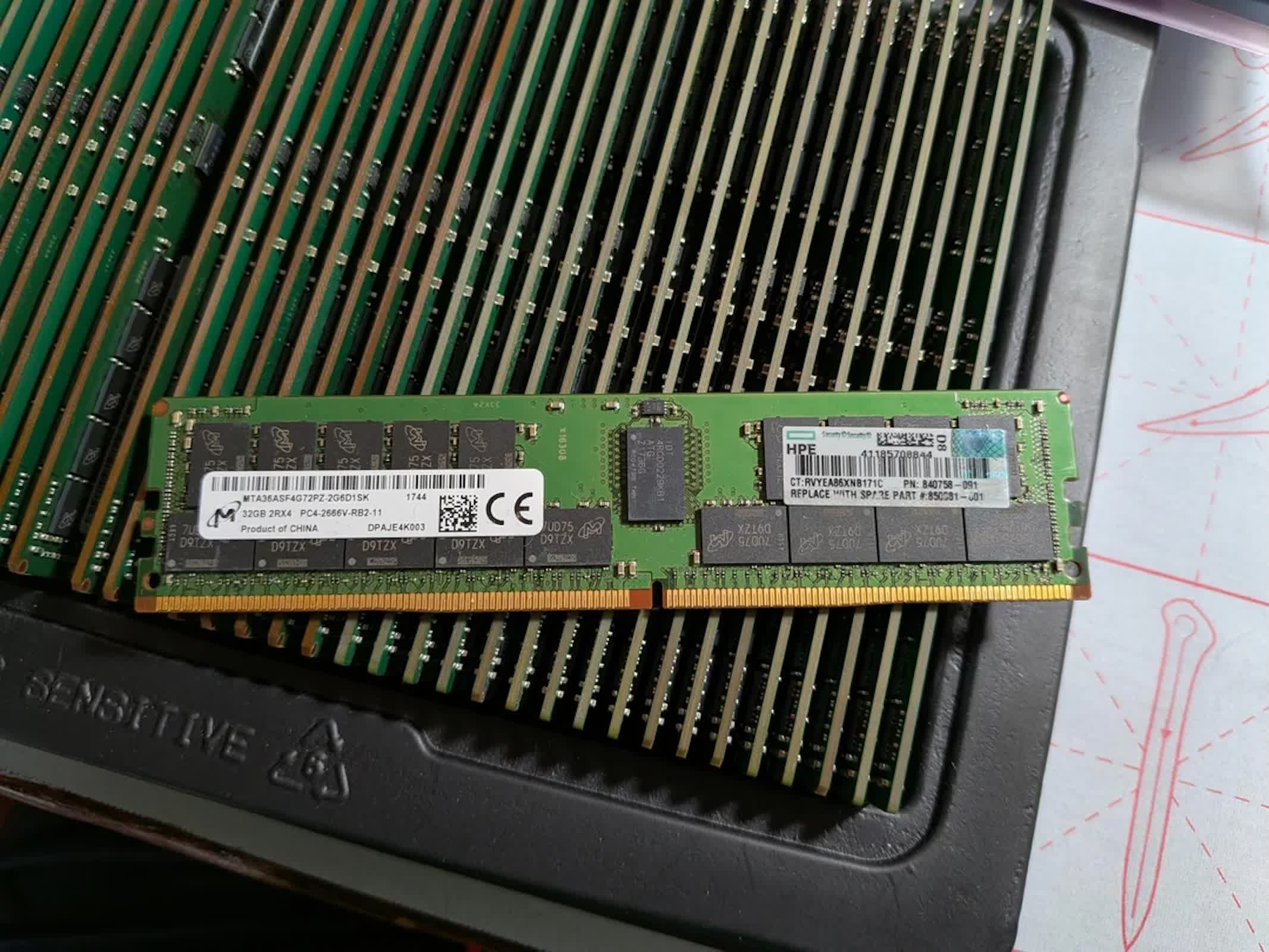
In context: A batch of server memory slated for disposal instead ended up in private hands, highlighting how enterprise hardware is often handled once it's written off. The situation began in 2024 during a server upgrade at an unnamed company. New systems arrived with higher-capacity memory already installed, leaving the existing modules – 72 sticks of registered DDR4 RAM – unused. They were set aside for disposal, but an employee retrieved them before they were scrapped and later gave them to a family member, who shared the story online.
The story began in 2024, when an unnamed company completed a server upgrade. The incoming systems came with higher-capacity memory already installed, rendering the existing modules redundant. 72 sticks of registered DDR4 RAM were set aside for disposal. Before they were scrapped, an employee took them. They eventually passed to a family member, who posted about it online.
At current market prices, the haul looks significant. Comparable SK hynix registered DDR4 modules currently sell for about $287.95 each, putting the total value at more than $20,000. But that number tells only part of the story.
When the modules were pulled from service, they were worth far less. Price-tracking data shows they averaged around $35 in 2024, dropping further to roughly $29.02 by mid-2025. The sharp rise since then reflects a broader tightening of DRAM supply, driven largely by surging demand for AI infrastructure. Components that were once unremarkable line items in a server refresh budget have quietly become considerably more valuable.
That shift, however, rarely registers inside corporate IT departments. Once equipment is fully depreciated, accounting conventions render it essentially worthless on paper. The practical calculus reinforces that view: testing, storing, or finding uses for older hardware takes time and resources that often exceed what the parts are actually worth. Working components get discarded as a matter of routine.
Posts from the pcmasterrace
community on Reddit
A commenter on the original Reddit post offered a blunt description of how that thinking takes hold. "In many places where I worked, the sysadmins in charge of the servers were not hardware enthusiasts, had never built their own machines, and did not care what things cost as long as the infrastructure kept running," wrote ArcticCelt. "They constantly did things like that, throwing away perfectly good equipment instead of keeping it for test labs or anything useful. It was their budget to spend, and they simply did not give -- because no one above them understood how any of it worked."
The rescued memory, though, is of limited use to most people who might come across it. Registered DIMMs are purpose-built for server environments that demand stability across large memory pools. They depend on error correction and buffering features that consumer hardware does not support. Standard desktop motherboards will not recognize them. Making use of them requires a platform built around a server-class processor, an Intel Xeon or AMD Epyc.
That narrows the options considerably. A gaming rig or everyday workstation is out. The most practical path is resale, aimed at buyers running home labs, small data center setups, or operations still dependent on older enterprise equipment.
Even then, the price would land well below current retail. Used server memory carries the usual discounts: age, no certification, unknown service history. Still, the total return could approach what a high-end consumer PC costs new.
None of this is unusual. In enterprise environments, hardware lifecycles are governed by upgrade schedules, budget cycles, and depreciation tables – not by whether something still works. Fully functional components routinely become surplus. Many end up as e-waste.